
Clean sneakers according to the instructions for the exact pair: hand cleaning is the cautious starting point for many ordinary canvas or nylon shoes, but neither a fabric upper nor a gentle washer cycle proves that a whole shoe is washable. Identify the materials, remove loose dirt, use only an approved cleaning method, and allow the shoes to dry fully before wearing them. Do not put an unfamiliar pair in a washer just because another brand permits it.
A useful cleaning plan answers three different questions: what can get wet, what needs cleaning, and when you need the shoes again. Those questions prevent common mistakes such as soaking a mixed-material shoe to remove one small mark or starting a full wash the evening before an early appointment. This guide helps you choose a proportionate method and recognize when to stop rather than escalating to stronger products.
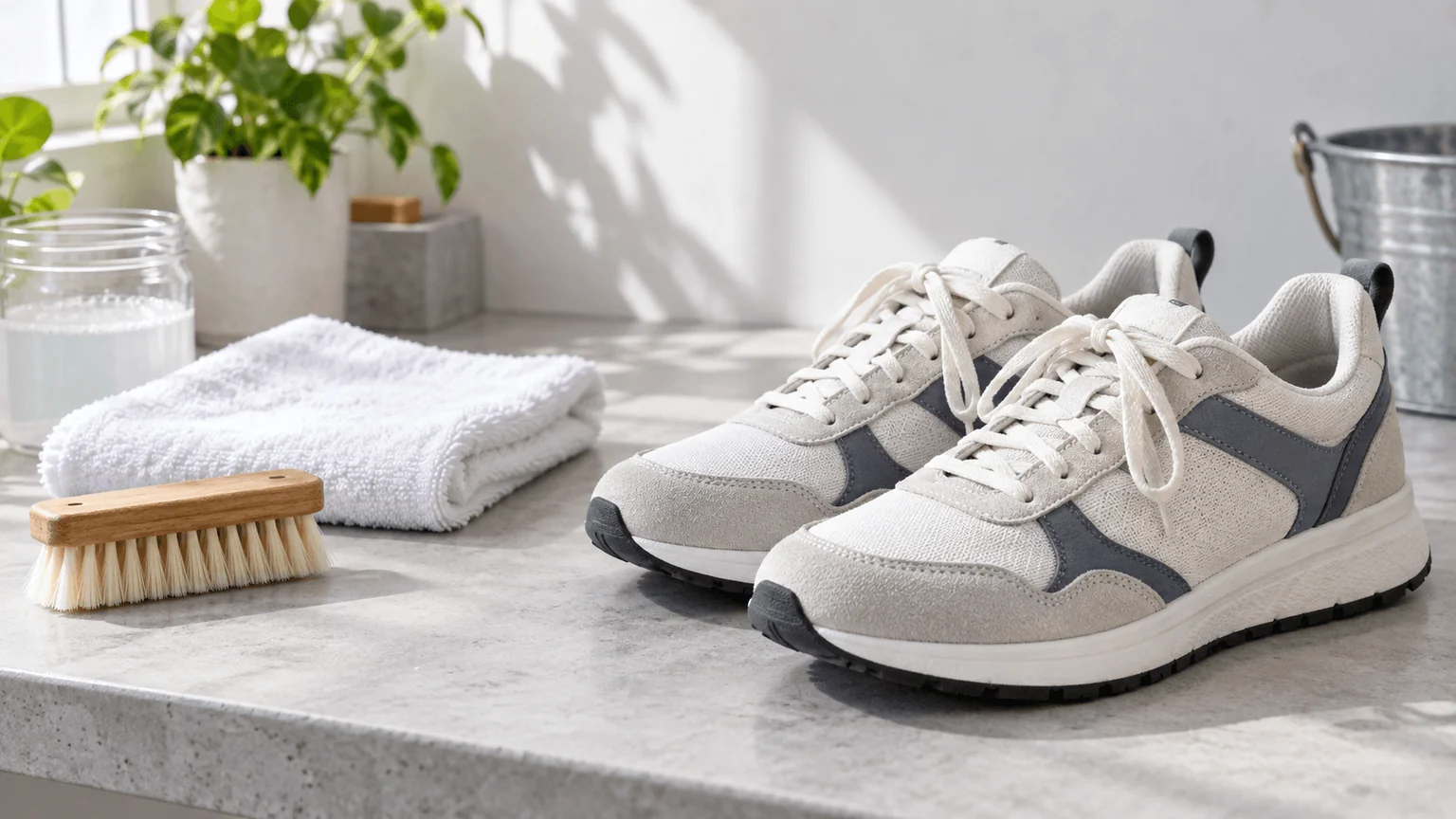
The examples below are planning examples, not Fresh Spin experiments or promises of stain removal. Manufacturer instructions take priority. The illustrations depict generic shoes and are not photographs of Fresh Spin, customer belongings, or a tested cleaning result.
What should you check before cleaning a sneaker?
Find the brand, model, and available care information before assembling products. Look inside the tongue, on the original box, and on the maker’s product or care page. A material description is useful, but it is not necessarily a washing instruction. A label that identifies a textile upper does not tell you everything about the lining, overlays, decorative details, or construction.
Next, inspect the actual pair rather than relying on the product photograph. Note loose stitching, peeling surfaces, a separating sole, worn lining, and any decoration that has been added after purchase. Cleaning will not repair those defects. If an important seam or sole connection is already failing, ask the manufacturer or a shoe-repair professional about repair before introducing water or brushing that area.
Write down the cleaning goal in plain language: remove loose trail dust, clean a dirty rubber edge, wash detachable laces, or address an all-over dirty fabric upper. This is more useful than starting with an ambitious goal of making an old shoe look new. It gives you a specific stopping point and makes it easier to select the least extensive treatment that addresses the problem.
- Exact model and care instructions found?
- Every visible material identified, including trim?
- Existing damage checked?
- Cleaning goal and acceptable result chosen?
- A realistic drying window and alternative footwear available?
Why do manufacturers give different washing advice?
The American Cleaning Institute explains that many manufacturers discourage machine washing because agitation and some detergents can damage certain leathers and adhesives. Its fallback guidance is aimed at most canvas and nylon sneakers, not every shoe sold as a sneaker. That distinction is important when one pair combines a fabric toe, textured overlays, foam, and a padded lining. See ACI’s sneaker-care guidance.
Compare the following primary-source examples without treating them as interchangeable recipes. Converse’s cleaning guide directs users away from machine washing and drying its canvas and leather shoes and gives separate dry-brushing advice for suede. New Balance’s care guidance also discourages washing machines and dryers, explaining that many of its materials should not be submerged or exposed to heat. These are clear reasons not to use a washer as the default.
By contrast, Allbirds’ care page permits machine washing for many of its shoes while explicitly noting exceptions. Its general method uses a delicates bag, cold gentle washing, mild detergent, and air drying. The practical conclusion is not that one brand is correct and another is wrong. It is that permission belongs to the product. An instruction for a washable Allbirds model does not authorize washing a different shoe with a similar-looking upper.
How do you resolve conflicting online instructions?
Give the most specific applicable instruction the most weight. Start with the exact model’s label or current manufacturer directions. Then consult the maker’s general care page. A general industry guide can help when product information is missing, but it should not cancel an explicit restriction on the shoe in your hand. Retailer summaries, social posts, and videos about different models are weaker grounds for taking a risk.
For example, an adidas running-shoe article describes both hand cleaning and a cold gentle machine option. That does not establish a universal rule for every adidas material or construction. If your own model’s instructions differ, use those instructions or ask the maker to resolve the conflict. Do not combine the soaking step from one article, a bleach suggestion from another, and a dryer shortcut from a third.
A useful message to customer support is short and concrete: identify the model, describe the material or trim that concerns you, and ask whether the entire shoe can be wet-cleaned, whether the insole is removable, and which drying restrictions apply. Include a photograph of the care information if possible. Until the uncertainty is resolved, postponing a full wash is a valid decision, especially for a valuable or sentimental pair.
Which cleaning route fits your pair?
Use targeted hand cleaning when the problem is limited
If the manufacturer permits it and only the outsole or a small surface area is dirty, work on that area instead of washing everything. Keep the rest of the shoe out of the cleaning solution. The benefit is control: you can see the material as you work and stop quickly. The tradeoff is that a localized clean may not produce an evenly refreshed appearance on a heavily soiled shoe.
Use a complete approved routine when the whole shoe needs attention
An all-over clean is a different task from wiping a sole. Read the entire manufacturer’s routine first, including rinsing and drying, and check whether it applies to the insoles and laces. Do not start if you can complete the wet stage but have nowhere suitable to leave the shoes afterward. The cleaning method is only workable when its finishing steps are workable too.
Pause when the shoe falls outside ordinary fabric care
Suede, special finishes, delicate decoration, electronic components, unknown coatings, and damaged construction call for model-specific guidance. This guide does not give a universal wet-cleaning recipe for those items. A cautious pause is especially sensible when the only identified material is the large fabric panel and the smaller trim remains unknown. The most noticeable material is not necessarily the one that determines the cleaning restriction.
What supplies should you prepare?
For a maker-approved hand-cleaning method, prepare the specific cleaner the instructions allow, clean water, a soft brush or cloth, an absorbent towel, and a place for removed parts. Use an ordinary container to hold the working solution if the instructions call for one. Keep the product label available so you can check dilution rather than guessing from how much foam you see.
It helps to organize the workspace into three areas: the uncleaned shoe, the active cleaning area, and the clean drying area. This is a workflow suggestion, not a specialized equipment requirement. Its purpose is to keep a dirty brush or sole from returning to a cloth you are about to use on the upper. Lay out only what the chosen method needs; an assortment of unrelated stain removers makes accidental improvisation more likely.
Have a separate place for each pair’s laces and inserts. If you are cleaning several family members’ shoes, a simple handwritten label beside each pair can prevent mismatching parts. Take a photograph of unusual lacing before removal. The photograph is a reassembly aid, not evidence of a cleaning result. Check that the drying area will remain available after the kitchen counter or other shared workspace needs to be cleared.
How should you separate laces, insoles, and the shoe?
Remove only parts designed to come out. Do not pull hard on an insole that appears glued down merely because a general tutorial begins with removal. If the manufacturer does not make the attachment clear, leave it in place and ask. The instructions for a replaceable insert may also differ from those for the shoe itself, particularly when an aftermarket insert has been added.
Treat each removable component as its own care decision. A washable lace does not prove the upper can be washed; a washable upper does not prove an insert tolerates the same treatment. Put an uncertain component aside until its instructions are established. This prevents an easy-to-clean item from becoming the reason you expose the entire pair to an unsuitable process.
Converse describes removing laces for cleaning and gently cleaning removable insoles with an appropriate cloth, sponge, or soft brush before setting them aside to dry. Keep those directions within their stated product context. For any other pair, check the maker’s equivalent instructions. If laces or inserts are too worn to be useful after cleaning, consider a compatible replacement rather than repeating a harsher cleaning cycle in pursuit of an unrealistic result.
How do you hand-clean suitable canvas or nylon sneakers?
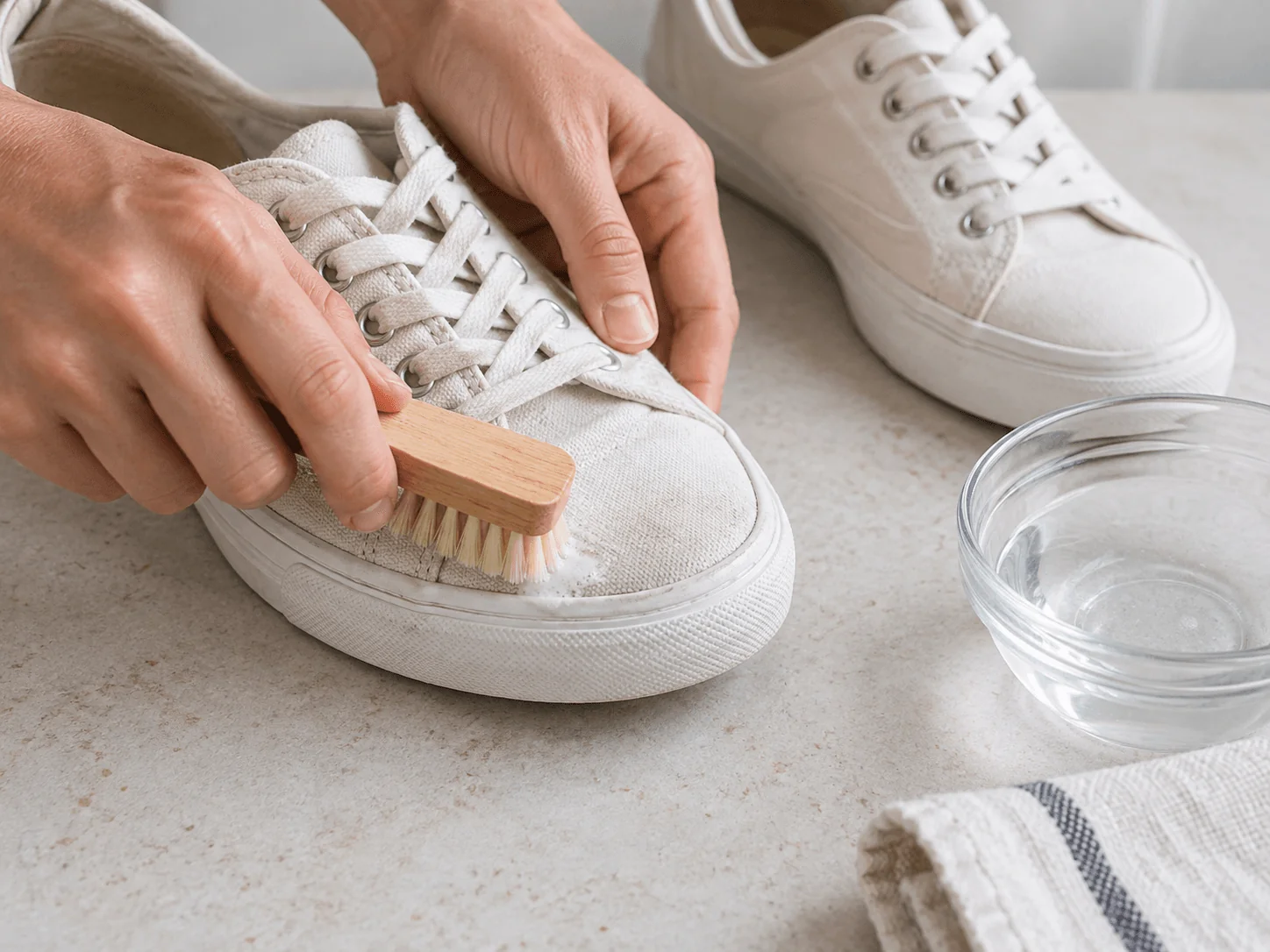
When the pair qualifies for ordinary fabric hand care and no manufacturer instruction conflicts, ACI describes gentle detergent, a soft brush, clean-water rinsing, and natural drying. It warns against bleach, solvents, harsh chemicals, and abrasives in this general routine. Its guidance also recommends white paper towels for shape support and complete drying before liners are returned or the shoes are worn. Keep this basic method separate from specialized treatments for other materials.
For more controlled surface cleaning, Nike’s step-by-step guide starts with dry removal of loose dirt and a mild diluted cleaning solution. It separates the sole from the upper and recommends gentle work followed by blotting rather than aggressive rubbing. This is useful as a product-care example, not a reason to ignore another maker’s restrictions.
- Confirm which of those approaches the shoe’s directions allow before wetting it.
- Prepare the permitted solution and test an inconspicuous area where the maker recommends testing.
- Work on a manageable section so you can observe the surface rather than scrubbing blindly.
- Remove soil and cleaning residue using the rinsing or wiping method specified for that shoe.
- Stop when the intended dirt is removed, the material changes, or the instructions no longer cover what you are seeing.
- Move the shoe to its planned drying area and keep removed components organized.
Do not confuse a repeated pass with a requirement to press harder. If a mark remains after the approved method, decide whether it is worth further treatment before doing anything else. A visible scuff or worn finish may not be ordinary removable soil.
How should you handle mesh, knit, leather, and suede?
Use the material name to ask a better question, not to jump directly to a recipe. A mesh upper may be paired with leather trim. A knit shoe may have overlays or components with separate restrictions. A leather-looking panel may be coated or synthetic. If the description is incomplete, check the product page or ask the maker before treating the entire upper as one uniform material.
New Balance separates suede and leather from its ordinary athletic-shoe routine and directs users to specialty cleaners for those materials. Converse distinguishes canvas and leather cleaning from suede care, for which it specifies brushing dry dirt and avoiding water. These examples are not interchangeable instructions for every finish. They show why the phrase “clean all sneakers the same way” is too broad to be useful.
For a mixed-material pair, map the shoe before starting: fabric toe, smooth side panel, fuzzy heel trim, rubber edge, and interior lining. Then find a routine that accounts for all of them. If the permitted treatment for one part is incompatible with another, ask about targeted cleaning rather than immersing the whole shoe. Do not assume that a tiny decorative patch can be ignored because most of the shoe is washable fabric.
Can you put sneakers in a washing machine?
Only when the applicable instructions permit it. Nike’s washer guidance recommends hand washing rather than machine washing its shoes. A bag, cold water, or a gentle cycle does not change that recommendation. Those measures may be part of an approved routine for another product, but they do not create approval where none exists.
For an Allbirds model covered by its machine-washing instructions, the maker calls for removing laces and insoles, brushing away excess dirt, using a delicates bag, and choosing a gentle cold cycle with a small amount of mild detergent. It excludes bleach and fabric softener and directs users to air drying. Check the stated exceptions and the exact product before applying that sequence. Do not extend it to unrelated brands.
There are two separate permissions at a shared laundry facility: permission from the shoe maker and permission under the facility’s machine-use rules. One does not replace the other. This article is not authorization to wash footwear in Fresh Spin equipment. Before bringing any unusual item, use the contact page to ask whether the intended use is allowed. If it is not, choose the approved hand-care method elsewhere rather than treating an empty machine as permission.
Why is drying part of the cleaning decision?
A cleaning plan that stops at rinsing is incomplete. Before starting, decide where the shoes will dry, whether the area will stay available, and what you will wear meanwhile. Avoid making the last available pair unusable right before work, school, travel, or an appointment. If the timing does not work, a smaller approved clean or postponement may be the better choice.
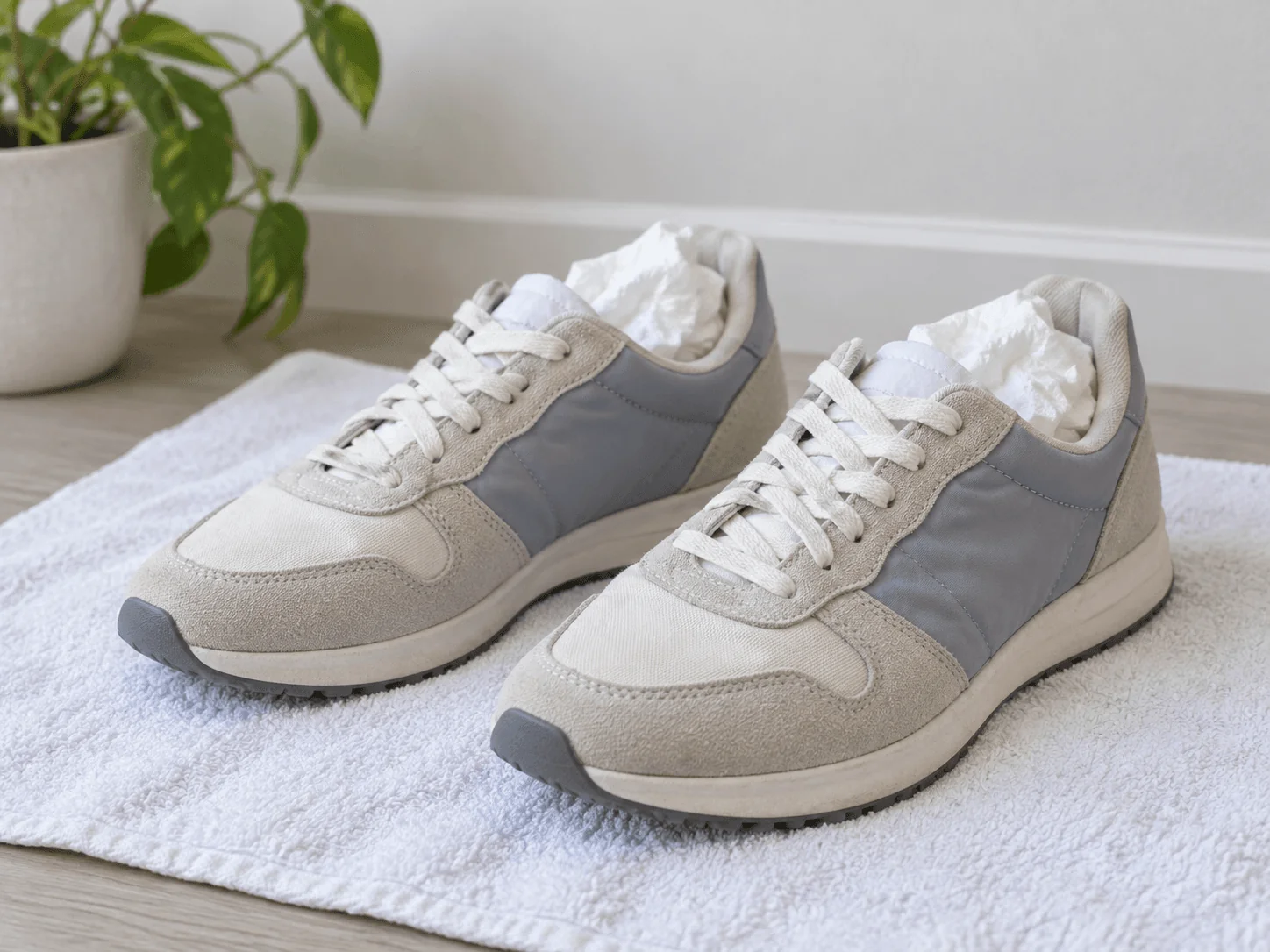
Manufacturer drying instructions can include room-temperature air drying and restrictions on direct heat. New Balance gives a 24-hour air-drying recommendation for its routine; that should not be read as a guarantee that every shoe in every environment is dry after the same interval. Follow the applicable directions and assess the actual condition of the pair before reassembly and wear.
Keep a simple completion checklist beside the shoes: upper checked, interior checked, removable inserts checked, and laces checked. The easiest part to touch is not necessarily representative of the whole item. If a component remains damp, keep the task open rather than marking it finished because the exterior looks clean. Do not use a heater or dryer shortcut to satisfy a deadline that the care instructions cannot accommodate.
What if dirt remains after the first approved clean?
First identify what remains. Is it loose dirt in a recess, a visible stain, a scuffed finish, or a worn area? Those observations lead to different next steps. Loose soil may still fall within the original cleaning instructions. A damaged finish does not become a stain simply because you would like it to disappear. Photograph the dry area in ordinary light if you need to explain it to the manufacturer.
Do not judge the final appearance while the shoe is still wet. Wait until the approved drying process is complete, then compare the result with your original goal. If the ordinary dirt is gone and only an old mark remains, stopping may be a better tradeoff than risking the surrounding surface. A cleaner-looking pair does not need to be cosmetically perfect to be usable.
If another treatment is being considered, return to the same evidence standard: exact material, appropriate product, clear instructions, and a defined limit. Avoid stacking treatments merely because each is recommended somewhere online. If you have already used an unknown product, record its name before asking for help. That information is more useful than describing the shoe only as “still dirty” and may change which next step is appropriate.
How should you think about odor and white-shoe stains?
Keep cosmetic cleaning, odor concerns, and disinfection separate. A pleasant smell or a bright appearance is not evidence that a shoe has been disinfected. This guide does not promise to remove microbes, treat a foot condition, or restore every white material to its original color. Those would require a different kind of claim and appropriate supporting instructions.
For ordinary care, check whether a removable component is the part that actually needs attention and consult its care directions. An insert, lace, and upper are not automatically one cleaning problem. If odor persists after the approved care and full drying, ask the manufacturer about compatible replacement components or further care instead of adding fragrance to conceal it. Concerns about a health condition belong with a qualified healthcare professional, not a stronger home-cleaning mixture.
White shoes are still material-specific shoes. Color does not override construction. Before choosing a whitening product, establish whether the maker permits it on every surface you intend to treat. Do not use a formula intended for an uncoated rubber edge across a textile upper or decorative panel without permission. A reasonable goal may be removing surface dirt while accepting discoloration that cannot be safely addressed with the available instructions.
What does a sensible cleaning plan look like in practice?
A canvas pair with dusty soles and clean uppers
The task is limited, so begin by checking the maker’s instructions for the sole. There is no reason to turn a sole-cleaning job into a full immersion simply because the upper is canvas. Prepare only the approved tools, keep the clean upper away from the dirty working area, and stop when the identified soil is removed. Schedule any necessary drying before the next wear.
A mixed-material pair needed tomorrow morning
The first issue is not which detergent to buy. It is whether the care information and timing are adequate. Identify the trim and review the instructions. If the model is uncertain or the full method cannot finish in time, choose another pair for tomorrow and postpone the cleaning. That is a planning decision, not a failed attempt. Avoid creating a drying emergency that encourages unauthorized heat.
A model explicitly approved for machine washing
Read the full product routine, including exceptions, component removal, cleaning products, and drying. Check the washer’s own instructions and any shared-facility rules. Then follow that specific routine rather than combining it with advice for a different brand. Keep the instructions with your care notes so the next wash starts from the same verified information instead of an unreliable recollection of the cycle settings.
How can a household manage several pairs without mixing instructions?
Sort by care method before sorting by color or owner. Make three temporary groups: pairs with a clear approved routine, pairs needing clarification, and pairs needing repair or specialist advice. Only the first group is ready for cleaning. This prevents one person’s washable pair from becoming the accidental standard for everyone else’s footwear.
Keep each pair’s small parts together and do not prepare one large cleaning mixture until you know that the same product is suitable for every item involved. A simple card can list the model, approved method, cleaner, drying direction, and outstanding questions. You do not need a complex tracking system. The purpose is to avoid having to solve the same uncertainty halfway through the next cleaning session.
When children help, give them a clearly bounded task such as sorting detached laces by pair or locating the matching shoe. An adult should choose the products and interpret restrictions. Avoid presenting a whole collection of cleaners as interchangeable options. Finish one care routine before moving to an uncertain pair so a successful result on the first does not become an unsupported assumption about the second.
When should you stop and seek more specific advice?
Stop if the material is unidentified, a finish begins to lift, a color visibly transfers during the permitted test, or the construction appears to be separating. Record what you observed and what product was used. Do not cover the problem with another chemical or keep brushing to see whether it improves. The useful next step is clarification about that shoe, not a more elaborate generic recipe.
Seek specialist advice for valuable, customized, vintage, or sentimental shoes when the consequence of a mistake would outweigh the benefit of a routine clean. Ask whether the proposed service covers the actual materials and what result is realistic. A cleaner should not need to promise a factory-new appearance for the service to be useful. Discuss existing damage before any work is accepted.
Ordinary dirt and hazardous contamination are also different jobs. This general article does not provide a method for footwear exposed to sewage, unknown chemicals, or other hazardous material. Do not bring such items into a shared laundry setting based on a household sneaker tutorial. Obtain guidance appropriate to the exposure and the item. The absence of a warning in a general cleaning article is not an assurance that every contaminated shoe is suitable for ordinary laundering.
What should you record for the next cleaning?
Is the remaining problem cleaning, repair, or replacement?
Before spending more time on an unsuccessful cosmetic treatment, separate the decisions. Cleaning addresses removable soil. Repair addresses a damaged part or construction issue. Replacement may be the practical choice when a required component is no longer usable or suitable. These are not interchangeable solutions: making a worn sole look brighter does not restore its condition, and replacing a sound pair solely because a lace is dirty may be unnecessary.
If you seek a quote, describe the specific goal and ask what is included. Is the person offering surface cleaning, a material-specific treatment, replacement laces, or an actual repair? Ask which marks are likely to remain and whether existing damage changes the recommendation. Comparing clearly described options is more useful than comparing two prices for vaguely different promises of a “deep clean.” Keep the decision focused on the actual pair and your intended use.
Keep a short care note with the model and the manufacturer’s link, not just a note saying “wash gently.” Include which pieces were removable, the permitted product, and how the shoe was dried. If you asked the maker a specific question, retain the response with the model details so it is not later mistaken for advice about an entire brand.
After drying, note whether the original goal was achieved and whether anything needs repair. This is a personal care record, not a performance test or proof that the same process is safe for another pair. It can still save time: you will know which instructions you used and what you decided not to treat. If the manufacturer changes the care guidance or you replace the shoe with a different model, check again rather than automatically carrying the old routine forward.
Keep the routine proportionate to use. Inspect the pair when it is visibly dirty or when you are deciding whether it needs cleaning; do not invent a rigid wash schedule that ignores the actual material and condition. A useful habit is to distinguish an immediate small task from a later full-care task, then leave yourself a clear note about which one remains unfinished.
How does shoe care fit into a regular laundry visit?
Prepare ordinary clothing separately according to its own labels. Shoe-care permission is not implied by a clothing wash symbol, and clothing-care permission is not implied by a shoe tutorial. Fresh Spin’s laundry care-label guide explains the separate decisions for garments. Use it for the shirts, socks, and other washable clothing in your regular load rather than applying footwear instructions to everything together.
For information about regular do-it-yourself laundry, visit the self-serve laundry page. For clothing you would prefer the team to handle, see drop-off wash-and-fold information and check acceptance for any unusual item. These links do not promise sneaker cleaning, shoe restoration, specialty-material treatment, or permission to put shoes in store equipment.
That boundary makes the visit easier to plan. You can arrange ordinary laundry while keeping uncertain footwear out of the load until its instructions and facility rules are clear. Bring the question, model information, and care directions rather than assuming the size of a machine settles whether an item belongs in it.
Frequently asked sneaker-care questions
Does a laundry bag make any sneaker machine washable?
No. A bag may be required by an approved machine routine, but it does not supply the missing manufacturer permission. Start with the exact shoe’s instructions, then the machine and facility rules. If any of those prohibit the proposed use, choose a permitted alternative instead of treating the bag as a workaround.
Can I use the same method for two shoes from the same brand?
Not automatically. Check the model and materials for each pair, especially when one has different overlays, finishes, or inserts. The brand name is a useful starting point for finding guidance, but it is not a complete care label. Save separate instructions when the products have different requirements.
Should I pull out an insole that does not come loose?
No. Do not force a part out merely to match a generic tutorial. Check whether it is intended to be removable and ask the maker when the attachment is unclear. If it remains in place, the cleaning and drying plan must account for that construction rather than pretending the shoe is disassembled.
Can I use heat because I need the shoes soon?
A deadline does not cancel a drying restriction. If the approved routine cannot finish before you need the pair, choose different footwear or defer cleaning. Do not assume that a short exposure to a dryer, radiator, or other heat source is equivalent to the maker’s prescribed air-drying method.
What if there is no readable care information?
Use the model name or product code to look for manufacturer guidance and ask about uncertain materials. General canvas or nylon advice is not a substitute for identifying special trim or damaged construction. When the missing information affects whether the shoe can get wet, pause the wet cleaning instead of guessing.
Does Fresh Spin provide the sneaker-cleaning method in this article?
This is a household care guide, not an offer of sneaker-cleaning service. Ask Fresh Spin directly about unusual-item acceptance or equipment rules before bringing footwear. For routine laundry, use the linked service information and the labels on the actual clothing you plan to wash.
What is the best next step for your pair?
Identify the exact shoe, decide what actually needs attention, and choose one complete approved method. Keep uncertainty separate from ready-to-clean items, plan the drying stage before starting, and stop when the goal is met or the instructions no longer cover the situation. The useful outcome is a cared-for pair and a repeatable decision process, not a universal shortcut that treats every sneaker as the same material.


Leave A Comment