
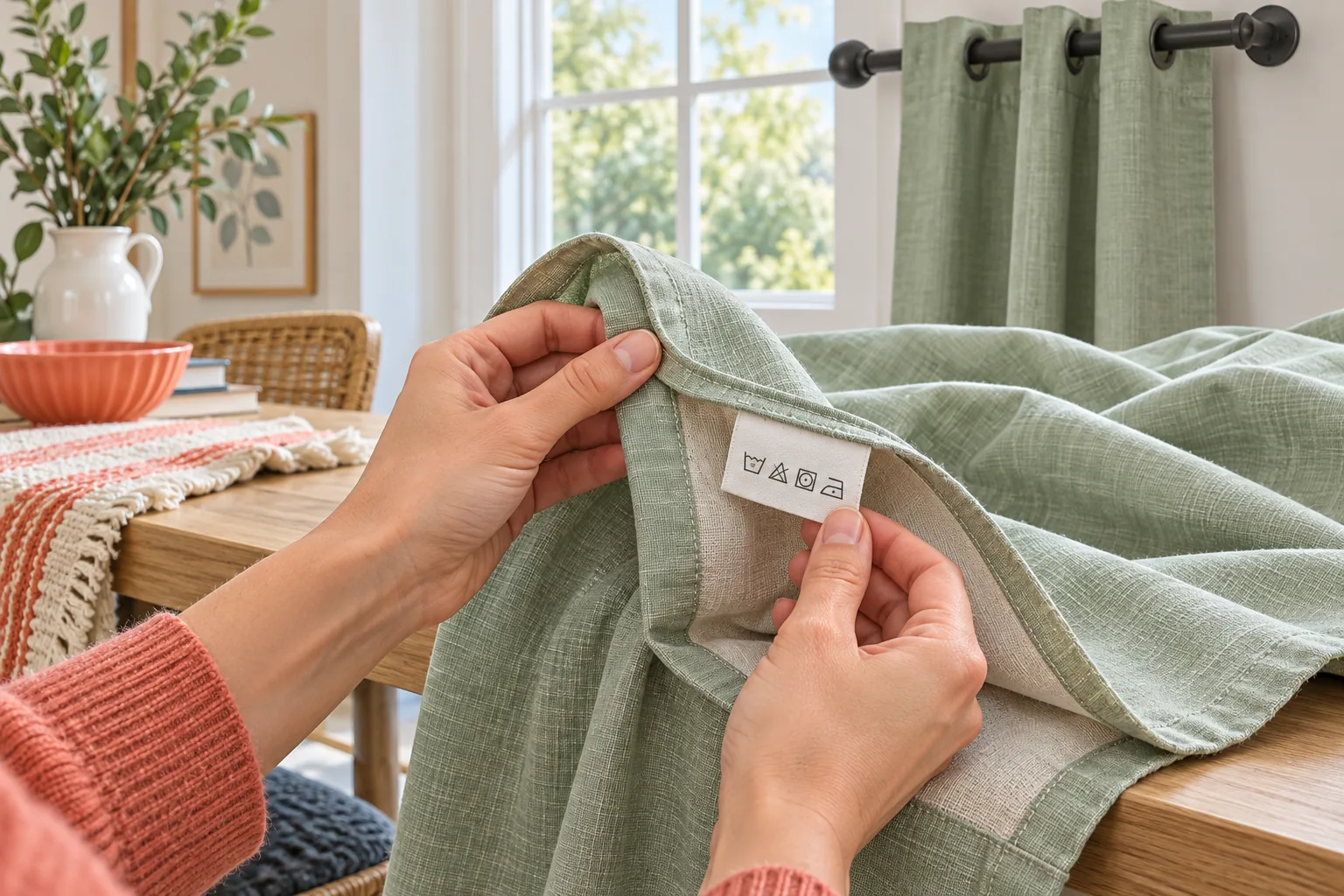
To wash curtains safely, first confirm that the care instructions for the complete panel allow washing, including its lining, backing, trim, and heading. Use the specified washing and drying methods, remove detachable hardware, and plan how you will support and dry the panels before getting them wet. If the instructions are missing or the construction is damaged, identify the product or consult a drapery-care specialist instead of guessing.
A window curtain is not automatically washable because its face fabric resembles a sheet. It may be an unlined piece of cloth, a lined assembly, or a layered blackout product. Those differences matter more than whether the front looks like cotton, linen, or polyester. Likewise, a large washer does not make an unsuitable curtain washable.
This guide covers removable household fabric window curtains and drapes. It does not provide cleaning instructions for shower curtains, roller shades, Roman shades with operating mechanisms, upholstered cornices, or specialty commercial treatments. The aim is to help you choose a defensible care path, organize the job, and recognize when routine laundry is the wrong tool.
The examples below are manufacturer instructions for specific products, not a universal recipe. The planning checklists and hypothetical household situations are practical decision aids, not results of Fresh Spin testing or a promise that every stain can be removed.
Can your curtains go in a washing machine?
Start with a three-part answer: what the label permits, whether the curtain is in suitable condition, and whether you can carry out the entire process. A “yes” to washing is not enough if drying requires equipment or space you do not have. A readable label is useful only when it belongs to the panel in front of you.
- Washing is explicitly allowed: record the temperature, cycle, detergent restrictions, and drying instructions. Then inspect the panel and plan the load.
- Professional cleaning is specified: ask a suitable cleaner about that exact construction. Do not substitute a home gentle cycle for professional care.
- The method is unknown: look for the product record or ask the manufacturer. An uncertain panel is a research task before it becomes a laundry load.
The American Cleaning Institute notes that accumulated dust and sunlight can leave curtain fabrics fragile. Its general window-cleaning advice distinguishes washable curtains from other treatments and suggests vacuuming elaborate treatments where appropriate. That makes condition and construction useful starting checks, rather than treating a cleaning schedule as permission to wash. See ACI’s window and curtain guidance.
For your own decision, separate “I want these clean” from “I know which process is suitable.” Wanting to finish before guests arrive does not resolve an unreadable tag. You can still clean the accessible window area and organize the hardware while you obtain the missing information.
What should you read on the label?
Photograph the whole label, including both sides if it folds over. Keep the photograph with a picture of the curtain and its window. A close-up without context can become confusing when several rooms contain similar white panels. Include any brand name, style number, or order information you can find.
Read the instructions as a set. Note washing permission, water temperature, cycle restrictions, bleaching restrictions, tumble-drying permission, line- or flat-drying directions, and any ironing or professional-cleaning instructions. Do not stop after finding a familiar washing symbol. The next symbol may rule out the dryer you planned to use.
If symbols are unfamiliar, use Fresh Spin’s laundry care-label guide as a reading aid, then confirm unclear instructions with the manufacturer. A guide helps interpret information; it cannot supply instructions that are absent from your particular curtain.
Check whether separate pieces have separate directions. A detachable lining, decorative tieback, or removable trim may not share the main panel’s care method. Keep those items identified rather than treating everything from one window as a single washable set. If two instructions conflict, resolve the conflict before choosing a process.
Finally, distinguish the original manufacturer’s construction from later changes. An added lining or decorative border is a reason to ask whoever made the alteration whether the original directions still apply. A photograph of the altered area is more useful than simply saying that the curtain is “mostly linen.”
Why do blackout curtains need product-specific decisions?
“Blackout” describes a light-blocking function, not one care method. For example, IKEA’s white KORGMOTT panel, article 405.971.49, lists cold machine washing on a normal cycle and low tumble drying, while prohibiting bleach and dry cleaning. Those directions apply to that identified product, not to every blackout curtain. See the manufacturer’s KORGMOTT materials and care information.
By contrast, Threadwell’s drapery-care document advises against laundering its covered drapery products and specifies professional care, including for lined drapery. It also calls for attention to specialty fabrics and solvent sensitivity. That is a different manufacturer’s product guidance, not a reason to override a washable panel’s label. See Threadwell’s drapery-care instructions.
The practical lesson is to identify the actual panel before borrowing advice. A search result titled “wash blackout curtains” may describe a different backing, lining, or product generation. Match the style number and construction when possible. If a current product listing looks similar but you cannot establish that it is the same item, treat it as a lead, not proof.
Look at the reverse side during your inspection. If you see peeling material, loose layers, cracks, or unusual stickiness, document them and pause the cleaning decision. Do not frame a wash as a repair attempt. Ask whether the item remains serviceable and what cleaning, if any, the maker recommends in its present condition.
Are linen, cotton, polyester, and sheer curtains different?
A fiber name is useful identifying information, but it is not a complete instruction. Consider a second specific example: IKEA’s white DYTAG linen curtain, article 004.667.15, permits warm machine washing on a durable-press cycle but prohibits tumble drying and dry cleaning. Its care page also notes possible shrinkage. See the DYTAG materials and care information.
Do not turn that example into “all linen curtains need this cycle.” Instead, use it to see why washability and drying permission are separate questions. A person with that exact product needs a drying plan that does not depend on a tumble dryer. Someone with another linen curtain needs that other product’s directions.
The same reasoning applies to cotton-looking panels, polyester blends, and delicate-looking sheers. Identify the complete item, not just the texture. “Sheer” tells you something about appearance and light transmission; it does not identify a detergent, temperature, or safe amount of handling.
For mixed sets, make a small inventory rather than sorting only by color. List the room, panel type, care method, and any detachable companion pieces. Two white panels can require different treatment. Two visually different panels might have compatible directions but still be better managed as separate, clearly identified jobs.
How do you inspect curtains before taking them down?
Begin while the curtains are still hanging. Photograph the whole window so you can see the original position of the panels, pleats, tiebacks, and hardware. Note which edge faces the center and which faces the wall. This simple record can save time when several similar pieces return from cleaning together.
Look for existing tears, loose seams, missing hooks, separated trim, and uneven hems. Record stained or discolored areas without assuming they have the same cause. A pale patch may not be removable soil. Your before photographs make it easier to judge what cleaning changed and what was already present.
Check whether removal itself is a reasonable household task. If access is too high, the rod is awkward, or the assembly cannot be supported safely, arrange suitable help. Do not balance on furniture or pull a heavy panel down by its fabric. Cleaning should not start with a risky removal attempt.
Once the panel is accessible, inspect the reverse side and heading as well as the visible face. A front that looks sound does not answer every question about the assembled curtain. Set aside anything whose condition or construction you cannot explain, and include those observations when contacting the maker or cleaner.
How should you organize hooks, rings, and matching panels?
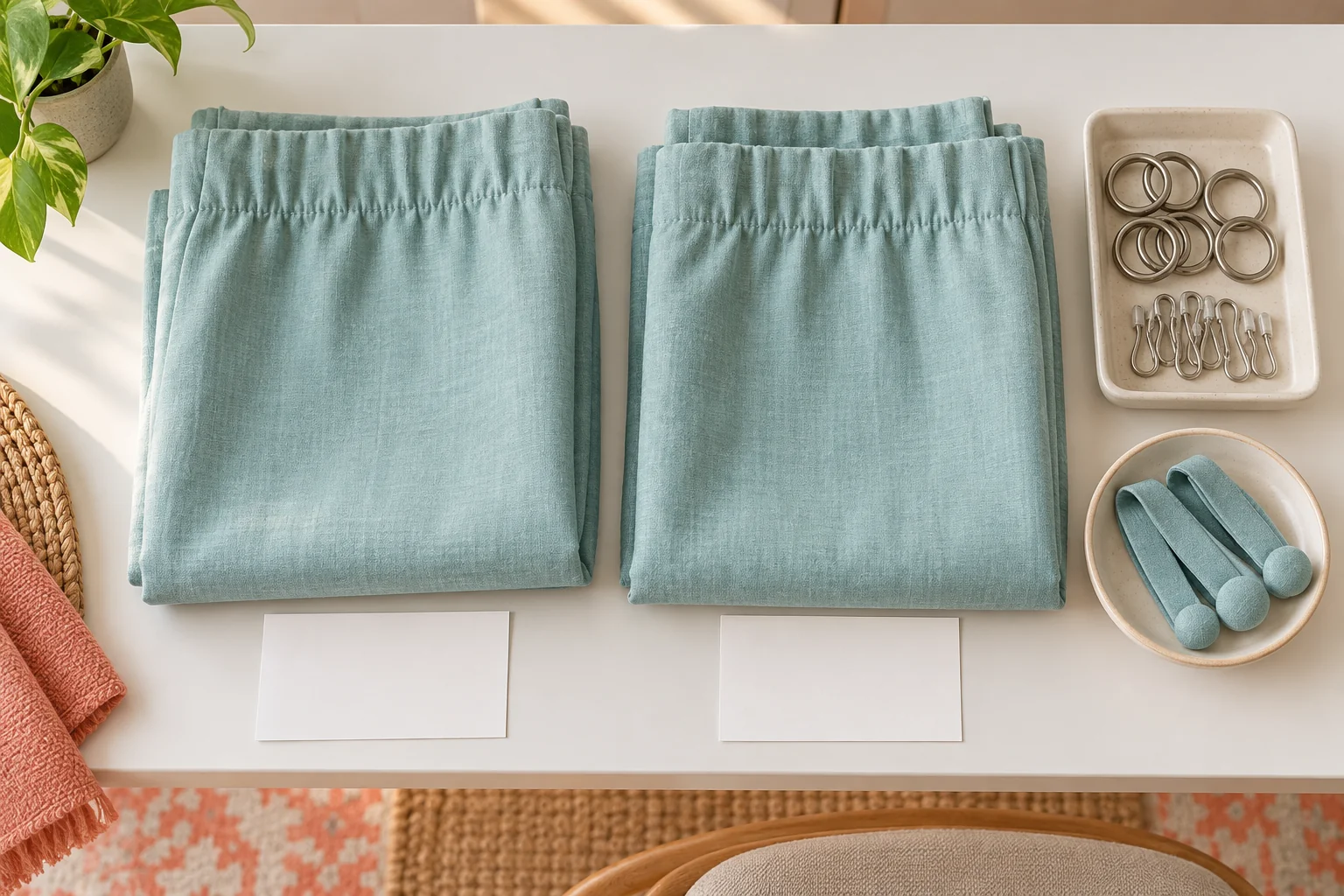
Prepare a clean surface and a container for each window’s removable hardware. Label the container outside the wash area with the room and window position. Photograph an example of the hook arrangement before separating it. Store small hardware securely away from children and pets.
Remove only pieces designed to detach. Loose hooks, clips, and removable rings are different from sewn-in headings or fixed grommets. Do not cut, pry, or force permanent components out because another curtain-cleaning checklist says “remove all hardware.” Confirm how the manufacturer expects the complete panel to be cleaned.
Keep left and right panels associated with their window. If panels need separate loads, use a written checklist or separate clean baskets instead of attaching an improvised marker that might travel through the wash. Mark the container, not the fabric, unless you have an appropriate textile-identification method.
Count the pieces before cleaning and before rehanging. The point is not administrative perfection; it is avoiding a nearly finished job held up by one missing hook. Put tiebacks and valances on the list too, with their own cleaning decisions. Being part of the same room does not make them part of the same load.
What should you do when the care label is missing?
Try to recover the identity before choosing a process. Search an order confirmation, receipt, packaging, or retailer account using the product name and style number. Compare dimensions, heading style, color, and lining. If the curtain was custom made, ask the maker for the fabric and finished-treatment care records.
Send a concise question with useful evidence: photographs of the front, reverse, heading, any remaining label, and the affected area. Explain whether the curtain has been altered and whether you know its previous cleaning history. Ask for instructions for the finished panel, not merely the fabric sold by the yard.
Do not use a small water test as certification that the entire curtain can be washed. Even if a hidden corner appears unchanged, that observation does not settle questions about the rest of the construction or the full drying process. A test can answer only the narrow question it actually tests.
If identification remains uncertain, get an assessment from a specialist who handles drapery. Ask what can be evaluated before treatment and what remains uncertain. For an inexpensive replaceable panel, replacement may enter your decision; for a custom or sentimental treatment, preserving it may matter more than immediate cleaning. Neither choice requires pretending the missing instructions are known.
When is light maintenance a better choice than washing?
Define the problem first. Are you removing loose surface dust, addressing one spill, or cleaning an entire panel? These are different tasks. If a manufacturer allows light dust removal and that is all the item needs, a full wash may be unnecessary. If the problem is a stain, surface dusting is not evidence that the stain has been treated.
Use only maintenance methods suitable for the treatment. Hunter Douglas, for example, provides product-specific cleaning guidance and warns against certain cleaning tools on light-dimming fabrics. Its advice also recommends applying window cleaner to a cloth rather than spraying it toward nearby fabrics. See Hunter Douglas cleaning guidance. These instructions reinforce the need to distinguish window-treatment types.
Keep a brief record of what you did and what remains. “Removed loose dust; stain unchanged” is more useful than “cleaned curtains.” If you later consult a professional, that record separates a maintenance step from a chemical treatment and helps avoid misunderstandings about previous attempts.
Do not promise yourself a fixed washing interval without considering the actual condition and directions. Instead, inspect during your normal room-cleaning routine and decide whether the next action is maintenance, washing, or advice. That approach avoids turning a calendar reminder into an automatic wash command.
How do you plan a washable-curtain load?
Once washing is confirmed, write down the selected method before loading anything. Include the label’s cycle and temperature, the compatible detergent and its measured amount, any permitted pretreatment, and the drying method. This is especially helpful when washing takes place away from home and the printed label is hard to read in the machine.
Choose equipment that can carry out those directions. Review the washer’s operating guidance and load restrictions rather than guessing from the door opening. A panel that can be pushed into a drum is not automatically an appropriate load. If you cannot determine a suitable load arrangement, ask the operator before using the machine.
Keep curtains separate from unrelated household laundry for an easier-to-manage job. That is an organizational choice, not a claim that every mixed load is chemically incompatible. It lets you follow the panel’s instructions, track all pieces, and inspect the result without searching through towels or clothing.
Do not invent a detergent dose based on how long the curtains are. The American Cleaning Institute’s basic cleaning guidance emphasizes using product directions and appropriate laundering choices. Follow both the detergent instructions and the equipment requirements. More product is not a substitute for resolving an unsuitable cycle or uncertain fabric-care instruction.
Prepare the next step before pressing start. Know where wet panels will go, what clean container will carry them, and how you will complete drying. If the only available drying method conflicts with the label, postpone the wash until that conflict is solved.
What is a practical washing sequence?
- Confirm the identity. Match the panel, label photograph, and written plan. Check that no item from another window has been added by mistake.
- Check preparation. Account for detachable hardware and review existing damage. Stop if new uncertainty appears during handling.
- Load according to the equipment instructions. Do not force the planned number of panels into an unsuitable arrangement just to finish in one cycle.
- Set the permitted method. Use the temperature and cycle allowed for this product, with compatible laundry products measured according to their directions.
- Inspect before the next treatment. Look for remaining soil or unexpected changes before drying or ironing. Do not automatically escalate heat or chemicals.
- Move directly to the planned drying method. Support the panel during transfer and keep it off dirty surfaces.
There is deliberately no universal temperature or spin-speed number in this sequence. The process is a way to carry out known directions consistently, not a replacement for them. If the machine cannot provide the specified treatment, choose another suitable option instead of treating a vaguely similar setting as equivalent.
If you separate a matching pair into different loads, record the actual settings used for each. That gives you a useful explanation if the results differ and prevents accidental changes halfway through the job. It also makes the next cleaning easier because you have more than a memory of “the gentle button.”
Is hand washing a safer backup?
Only choose hand washing when the product’s instructions permit it or the manufacturer confirms it. It is not an automatic escape route for dry-clean-only, unidentified, or damaged panels. Calling a method gentle does not establish that water exposure is appropriate for the finished treatment.
Consider the practical handling before committing. A long panel needs a suitable clean container, room to work, a way to support it during transfer, and an approved drying arrangement. If you cannot manage those stages comfortably, hand washing may be a poor choice even when the fabric-care directions permit it.
Follow the permitted hand-washing instructions for temperature, cleaning product, rinsing, and water removal. Avoid inventing a long soaking time or forceful wringing step to compensate for not using a machine. If the directions leave a critical step unclear, resolve it before starting.
A useful comparison is not “machine equals harsh, hand equals safe.” Compare two complete processes against the actual care instructions. Which permitted option can you perform correctly from start to finish? Sometimes the answer is a household method; sometimes it is professional help; sometimes it is waiting for better information.
How should you handle a stain without making the decision harder?
Photograph the stain and note what you know about it. Include when it appeared, what may have caused it, and any products already applied. If you are uncertain, say so. A guessed stain identity can lead a cleaner or manufacturer down the wrong path.
Look for an approved treatment for that curtain before applying a household recipe. Check whether spot treatment is permitted and whether the suggested product is compatible with the entire construction. Do not assume a product suitable for a cotton shirt is suitable for a lined or coated window treatment.
If the manufacturer calls for a hidden-area test, follow that procedure and assess the result before continuing. Keep the conclusion narrow: a test of a permitted spot-treatment product does not authorize immersion washing. If color, texture, or appearance changes, stop and seek advice rather than expanding the treated area.
After a permitted cleaning attempt, inspect the panel before another treatment. A remaining mark is not an instruction to add bleach, increase heat, or combine cleaners. Record the outcome and ask about the next suitable step. For valuable or difficult-to-replace panels, limiting experiments can be more sensible than repeatedly trying stronger methods.
How do you plan drying before washing?
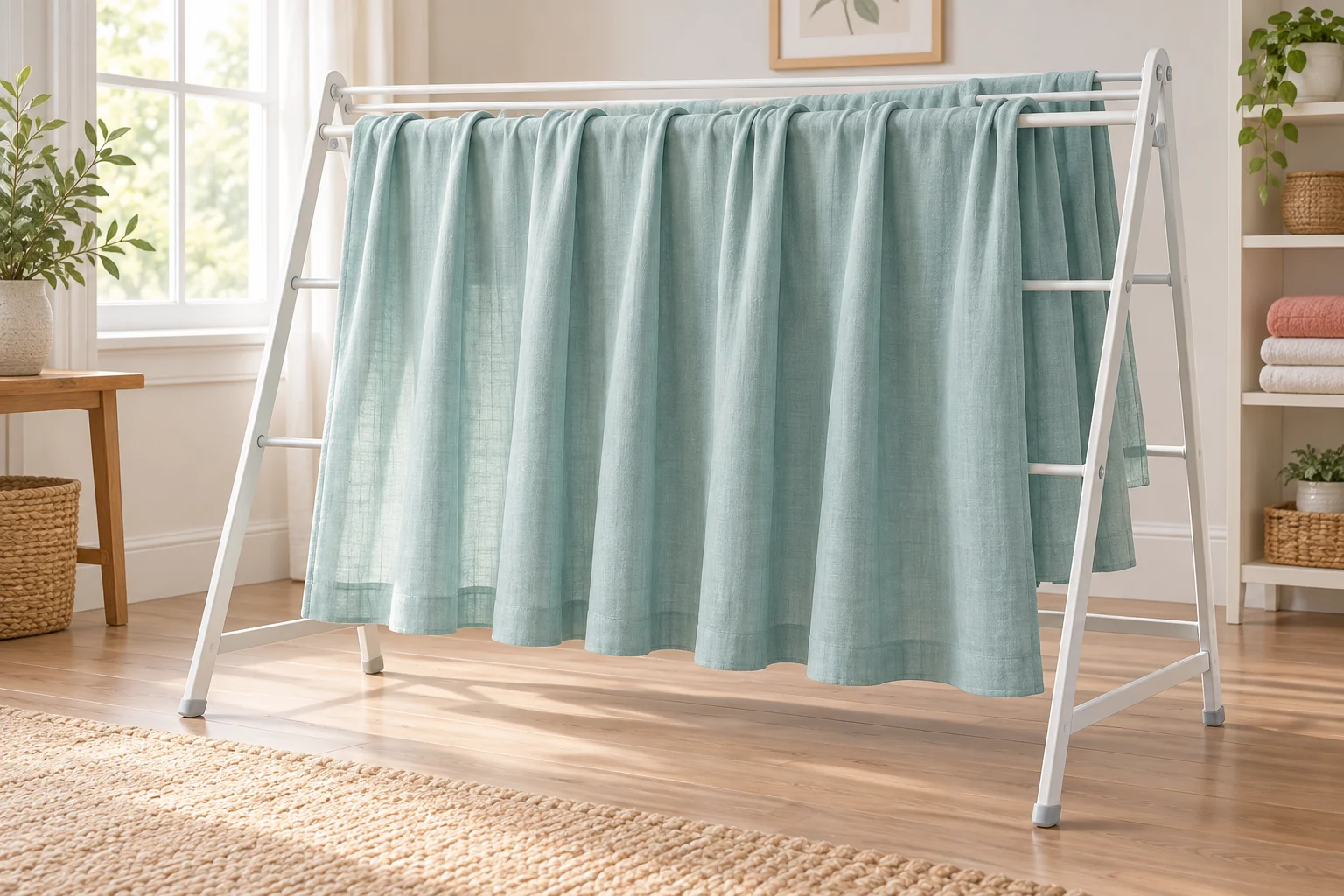
Treat drying as part of the cleaning decision, not an afterthought. Read whether tumble drying is permitted and which setting applies, or whether another method is specified. Do not interpret “machine washable” as “dryer safe.” The manufacturer examples earlier show why those questions must be answered separately.
For a permitted rack-drying method, choose a clean, stable support appropriate to the panel and follow the product’s directions for positioning it. Arrange enough space that fabric does not trail onto the floor or become crowded with other laundry. Keep the setup out of walkways and away from sources of accidental splashes.
Do not use the installed curtain rod as a drying rack by default. The care instructions and the installation both need to support that plan. A direction to rehang at a particular stage, when provided for an exact product, is not permission to hang every wet curtain from whatever rod is available.
For permitted tumble drying, follow the specified setting and the machine’s instructions, then inspect the panel as directed. Do not add an extra hot cycle simply because you are ready to leave. If your schedule cannot accommodate the allowed method, change the schedule rather than the care rule.
Before putting panels away, make sure drying is complete, including thicker hems and headings. If you cannot assess the whole item, unfold it and inspect rather than sealing an uncertain bundle into storage. This final check belongs on the same checklist as washing and hardware removal.
What about wrinkles, ironing, and steaming?
Check finishing instructions independently of washing instructions. A permitted wash does not establish that a hot iron or garment steamer is suitable. Identify any temperature restrictions, which surface may be treated, and whether the manufacturer gives special directions for the lining or backing.
Plan the work surface so the panel can be supported instead of dragging across the floor. Work only within the directions for the exact item and the appliance. If you need to stop, leave the appliance safely according to its instructions rather than resting it on the curtain or nearby trim.
Do not choose a finishing method solely because a wrinkled panel looks disappointing. Some textures are part of the intended appearance; others require professional finishing. Compare the result with the product’s description and your before photographs. Ask the maker about an unexpected change instead of assuming more heat will fix it.
If the care instructions prohibit the finishing tool you own, that is a useful limit, not a challenge to find a workaround. Rehanging an appropriately cleaned panel with a relaxed texture may be acceptable to you. A formal treatment may justify specialist finishing. Decide based on the item and the result you need.
When should you involve a drapery-care specialist?
Seek specialist advice when the label requires it, when the finished construction is uncertain, when damage needs assessment, or when removal and reinstallation exceed what you can reasonably manage. Custom treatments, elaborate assemblies, and altered panels deserve a conversation that includes their construction and history.
Ask concrete questions: Do you handle this type of panel? What information do you need before accepting it? Will you evaluate the lining and trim? Who handles removal and reinstallation? What limitations should I expect for existing marks or damage? Request an explanation of the proposed process rather than assuming the word “professional” identifies one universal method.
Share photographs and the care label before transporting a large set if the cleaner accepts that form of preliminary assessment. Confirm what is included and what remains undecided until inspection. Keep the agreed scope with your panel inventory so nothing is confused with another room’s curtains.
Professional assessment does not guarantee stain removal, exact dimensional preservation, or restoration of worn material. A useful consultation explains uncertainty. You should be able to decide whether the likely benefit is worth the cost and risk without relying on an unsupported promise that the curtains will look new.
Can you use a laundromat for washable curtains?
A laundromat can be a possible equipment option only after you establish that your panels are washable and that the available machines and rules suit them. The venue does not change the care requirements. Confirm acceptance of the item and the required settings before bringing in a large bundle.
Fresh Spin’s self-serve laundry page is a starting point for service information. Use the contact page to ask about your specific washable panels before your trip. This article does not confirm curtain acceptance, particular machine settings, or specialist drapery-cleaning capability.
Describe the item clearly: number of panels, dimensions, whether they are lined or backed, and the exact washing and drying directions. Saying “two curtains” may leave out the feature that matters most. Bring the label photograph so the discussion does not depend on recalling a symbol from memory.
Keep self-service and drop-off decisions separate. Fresh Spin offers drop-off wash-and-fold laundry, but that does not establish that every household textile is accepted. Ask about the particular item and its care requirements. If it needs a specialist process, seek an appropriate provider instead of assuming a general laundry service includes it.
What do three common household situations look like?
A washable pair with a clear label
You have two ordinary panels, readable directions, and no unexplained damage. Your next task is logistical: confirm the equipment, organize hardware, and prepare the specified drying arrangement. Record the settings and inspect the panels before finishing. There is no need to research every curtain fiber once the exact product instructions answer the relevant questions.
A blackout panel with an unreadable tag
You know its function but not its care method. Search the order record and contact the manufacturer with photographs. Do not copy settings from the washable blackout example above. While waiting, organize the window hardware and plan the removal safely. The job advances through identification, not through an experimental wash.
A custom lined set with an old mark
You have a valuable fitted treatment and incomplete cleaning history. Gather the maker’s information, photograph the mark, and request specialist assessment. Ask about the whole set and any matching pieces. Your decision includes the importance of the finished appearance and the limits of stain treatment, not just the price of a wash cycle.
These are hypothetical decision examples, not Fresh Spin customer stories. They illustrate three different starting points. Choosing a different next step for each is more useful than forcing all three through one “easy curtain cleaning” recipe.
Frequently asked curtain-care questions
Should matching panels always be washed together?
Keep them identified as a pair, but follow the equipment’s loading guidance and each panel’s directions. “Together” can mean one organized cleaning session, not necessarily one drum. If separate loads are needed, record consistent permitted settings and track the pieces through drying and rehanging.
Can I use cold water when I cannot read the label?
Cold water does not resolve whether washing is permitted. Recover the product identity or get suitable advice first. Temperature is only one part of the process; the lining, trim, drying requirements, and current condition still need a decision.
Does a dry-cleaning symbol mean every cleaner can accept it?
No acceptance decision has been made merely because a label names a process. Contact a provider that handles drapery, share the instructions and construction details, and ask whether it can assess the item. Confirm the proposed scope before leaving the curtains.
Can I clean just one panel from a visibly matching pair?
You can ask the manufacturer or cleaner how to manage the pair, especially if only one is stained. Consider how important a consistent finished appearance is to you. Do not assume that a successful small-area treatment establishes how the whole pair will look afterward.
What should I do if the panel looks different after washing?
Stop before adding another treatment. Compare it with the before photographs, note the exact products and settings, and contact the manufacturer or an appropriate specialist. Do not attempt to stretch, bleach, or heat it back into shape without suitable guidance.
Are these instructions also for Roman shades?
No. A window shade with an operating system is a different assembly from a removable curtain panel. Use the instructions for the exact shade. Hunter Douglas publishes a separate Roman shade care guide, illustrating why a curtain-washing checklist should not be transferred to mechanisms and shade constructions.
Your final curtain-cleaning checklist
Before starting, you should be able to identify the panel, explain which complete care instructions apply, account for detachable parts, and describe both the washing and drying plan. You should also know what would make you stop: an unclear instruction, unexpected damage, unsuitable equipment, or an unapproved next treatment.
After cleaning, compare the result with your starting record, confirm that the panels are ready for rehanging or storage, and reunite each set with its hardware. Save the label photograph and the method used. That small record turns the next cleaning from a guessing exercise into an informed decision.
The best curtain-care plan is not necessarily the fastest or most intensive one. It is the one that fits the exact finished item and can be completed correctly. Start with identification, make the whole plan before washing, and let unresolved details lead to better information rather than stronger treatment.


One Reply to “How to Wash Curtains: Labels, Linings, and Safe Drying”
[…] a guarantee that a stained item can be restored. For curtains hanging at windows, use the separate window-curtain washing guide, which covers linings and other construction details that differ from bathroom […]