
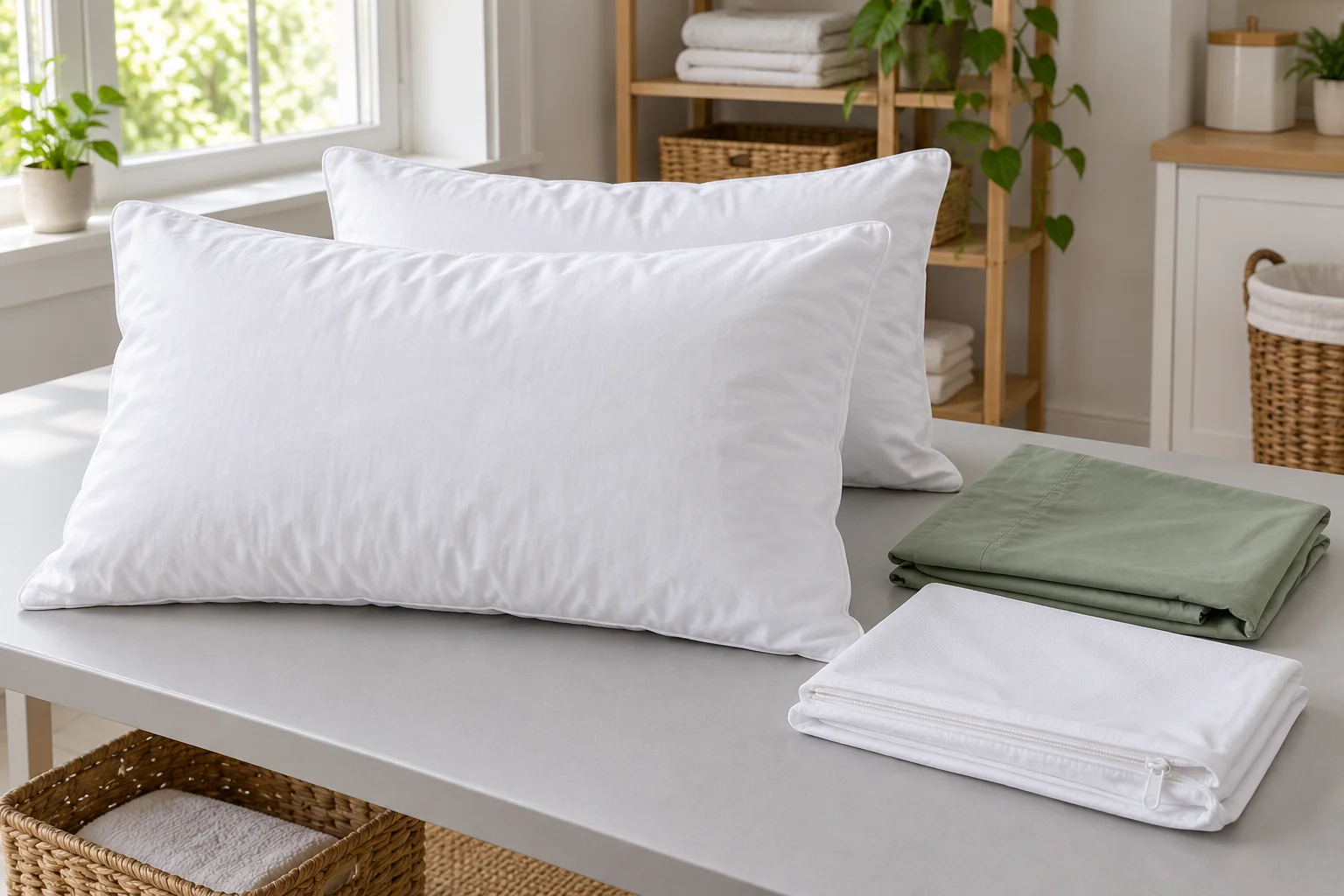
Wash a pillow only when the instructions for that exact pillow permit it; a washable cover does not make the filling washable. Remove the pillowcase and protector, identify the model and its components, and read washing and drying instructions before adding water. For a machine-washable pillow, plan a compatible load, use the specified products and settings, and finish the allowed drying process before returning it to the bed. For a cover-only or spot-clean-only design, keep the insert out of the washer. If the label is missing, the shell is damaged, or the filling remains damp after the permitted process, stop and ask the manufacturer rather than improvising a hotter cycle. This guide concerns ordinary household pillows, not medical decontamination, pest treatment, or infant sleep recommendations.
What exactly are you trying to clean?
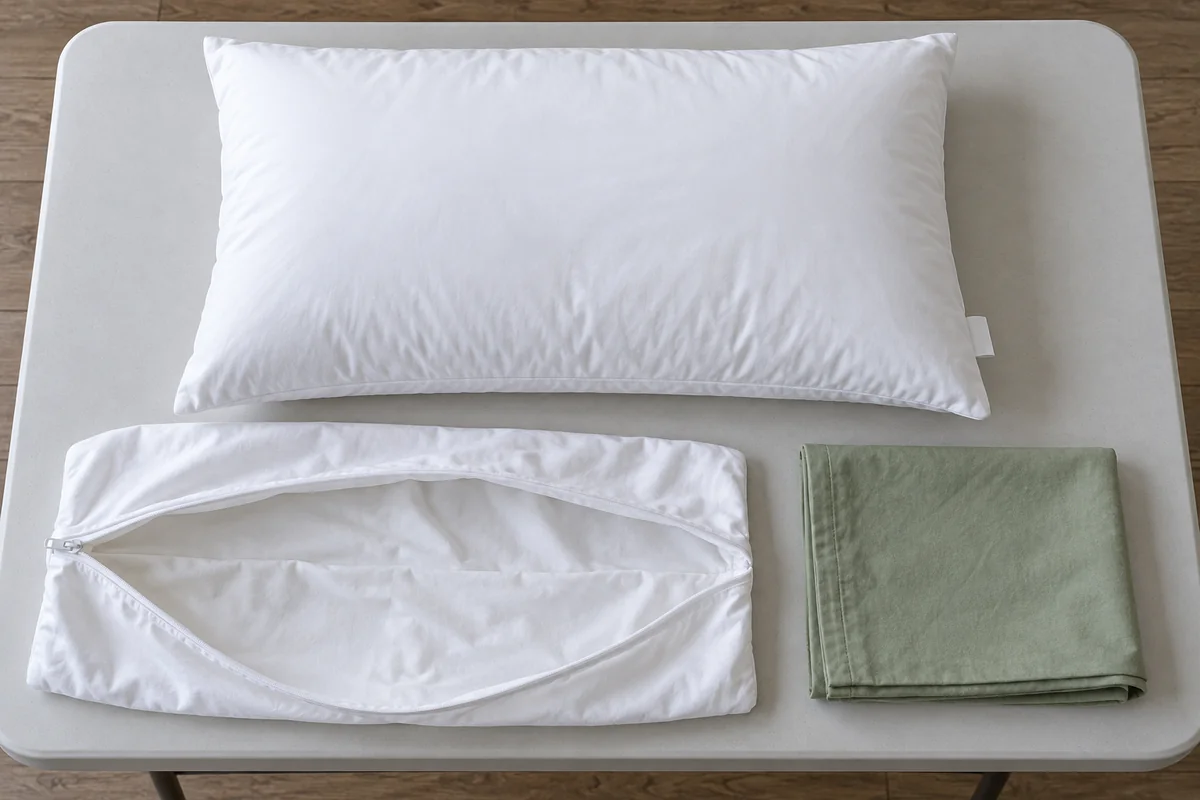
Start by naming the layer. The pillowcase is the removable fabric touching your face. A protector is an additional removable covering. The pillow itself may have a zippered outer cover, a filled inner shell, a shaped foam core, or several separate inserts. Those parts can look like one washable object when stacked together, but they may have different instructions. Take them apart only to the extent the design allows, and keep each instruction with the part it describes.
Set the layers on a clean, dry surface and decide where the actual problem is. Is makeup on the pillowcase, a spill on the protector, or a mark on the pillow shell? Has liquid reached the insert? Cleaning an outer layer is not evidence that the inside has been addressed. Conversely, a mark confined to a removable cover does not automatically call for washing every component. Identifying the affected layer avoids unnecessary handling and gives a manufacturer or laundry provider a clearer question to answer.
Our silk pillowcase guide addresses a different item: the removable case, not the pillow beneath it. Keep those instructions separate. A silk case can be paired with many kinds of pillow, and its washing method does not establish the care method for any of their fills.
How do you read a pillow label without confusing fabric and fill?
Look for both the material information and the care directions. A shell described as cotton may contain polyester fiber, down, feathers, foam pieces, or a combination. A removable cover can have its own label while the insert carries another. Read the entire set of directions, including drying restrictions and component-removal steps, before deciding what the washing symbol means for the assembled product.
Record the brand, model, size, and any version information you can find. A photo of the label is more useful than a note saying white pillow. Also photograph the assembled item if it has layered inserts or an unusual cover orientation. Those photos help with reassembly and with checking whether an online care page actually describes your version. A current product page for a redesigned model should not silently replace instructions supplied with an older item.
Use the laundry care-label guide if a symbol is unfamiliar. Treat washing, bleaching, drying, and ironing as separate permissions. If two instructions appear inconsistent, ask the maker about the exact item. Do not average conflicting temperatures or assume the gentler-looking option makes every construction safe. An instruction that says to wash the cover is narrower than one that permits washing the complete pillow.
Which cleaning route fits your pillow?
Choose a route before choosing equipment. This decision list is an organizing tool, not a substitute for the label. Its purpose is to keep an unresolved insert from entering the machine with a washable cover.
- Whole pillow explicitly machine washable: check the required machine type, load arrangement, products, cycle, and drying method. Confirm that you can complete the entire process.
- Cover washable, insert not washable: remove the cover as directed and set the insert aside in a clean, dry place. Use only its separately permitted care method.
- Spot clean only: identify the approved product and technique. Do not convert that instruction into soaking, hand washing, or a short machine cycle.
- Professional cleaning specified: describe the construction and label to a provider before handing it over. Confirm that the provider accepts that exact item and process.
- Missing or unresolved instructions: identify the model through the manufacturer or purchase record. Keep it outside the ordinary wash load while you investigate.
Two similarly shaped pillows can end up on different routes. That is not a failure of the sorting system; it is the reason for sorting. A removable zippered cover is not proof that the inner material can be removed, and visible loose fill is not permission to empty it into a laundry bag. Distinguish a designed adjustment opening from a seam or zipper that was not intended for routine user access.
Why do manufacturer examples give different answers?
Sleep Number’s pillow-care page separates its models and even shapes within a model family. For example, ComfortFit Curved and Classic are listed as spot-clean only, while the Ultimate’s removable cover is machine washable. Its ResponseFit directions also separate cover washing from limited foam-insert spot cleaning. These examples demonstrate why the model and component matter; they are not instructions for every foam or fiber pillow.
Tempur-Pedic’s care guidance likewise distinguishes removable covers from inserts and says not to wash or submerge the insert unless its product instructions specifically permit it. A general claim that all pillows can be hand washed would erase that distinction. Do not substitute a basin for a washer when the actual restriction concerns getting the insert wet.
Casper’s Original Pillow page identifies washable pillow models and separately describes a washable outer cover and spot-cleanable foam for its Foam Pillow. Its listed low-temperature tumble-drying guidance applies to the named washable models. The practical conclusion is to use brand examples to find the right question, then use your own product’s instructions for the answer. This guide does not rank those brands or claim to have tested their products.
What should you inspect before a pillow gets wet?
Examine the shell, seams, corners, zipper, and any inner compartments. Look for an open seam, a zipper that will not close correctly, or filling already escaping. Photograph a concern while the item is dry so you can describe it clearly. Do not assume that placing a damaged pillow inside a pillowcase repairs the containment problem. A protective bag and a sound pillow shell serve different purposes.
Check what the pillow has contacted. An ordinary household-care routine is not an appropriate answer to every contamination event. If there has been a hazardous chemical spill, suspected pest infestation, or another special concern, keep the item out of a shared laundry load and seek instructions appropriate to that situation. Tell a service provider before bringing it in; do not expect staff to identify a hidden concern from the outside of a bag.
Also compare cleaning with the item’s condition. A structurally failing pillow may need a repair or replacement decision rather than another wash. A newly purchased pillow that appears defective should be discussed with the seller before treatment. Keep the question factual: what is damaged, when it appeared, and what care has already been attempted. This avoids presenting a wash as a guaranteed way to restore lost shape or support.
How should separate covers and adjustable parts be organized?
Make a small component map before disassembly: outer cover, inner pillow, and any removable support layer. Match each part to its own label. If two household pillows are nearly identical, prepare them one at a time so their parts do not become mixed. Keep loose accessories away from the wash area, and do not remove fill merely to make an oversized pillow fit the machine.
Some adjustable designs allow changes to the filling, but adjustment and washing are different tasks. An opening that lets you alter loft does not necessarily authorize washing loose contents. Keep the original instructions for closing the inner shell and outer cover. If a zipper catches, stop and reposition the fabric rather than forcing the pull across trapped material. Confirm closure before moving a filled component toward the washer.
For a cover-only wash, choose a clean place for the insert to wait. Do not set it on the laundry-room floor, tuck it under wet towels, or leave it where someone might add it to the next load. A simple written note beside the waiting insert can prevent a household handoff mistake. Reassemble only after the correct cover has completed its permitted care process; do not force a damp or incorrectly oriented cover around the core.
Can two pillows share a washing-machine load?
Only combine pillows when their care requirements and the machine’s loading instructions are compatible. The phrase wash two pillows together is not a universal capacity rule. Two small washable pillows and two bulky, differently constructed pillows are different loads. Check the equipment instructions for the actual type of item, not simply whether the door will shut.
Maytag’s pillow guide discusses balancing washable pillow loads, checking the machine’s cycle guidance, and using an extra rinse where available. Apply that loading advice alongside the exact pillow and appliance instructions. It does not authorize an incompatible insert, overfilling, or adding arbitrary heavy items to stop a machine from reporting an imbalance. If the machine behaves unusually, stop and follow its troubleshooting procedure.
Prepare separate laundry for the removed cases and protectors unless combining them is specifically appropriate. They may have different water-temperature, product, or drying needs, and loose covers can make it harder to see how the pillows are arranged. Before starting, inspect the door or lid area for trapped fabric, review the selected options, and make sure a previous user’s settings have not carried over unnoticed. Do not guess a suitable machine size from an online photograph of a different pillow.
How do you choose detergent without guessing a spoonful?
Start with any product restrictions on the pillow label, then the detergent and machine directions. The American Cleaning Institute’s detergent guidance explains that both too much and too little detergent can leave laundry less clean than the appropriate amount. Measure a suitable dose rather than assuming a filled item needs an extra pour. A small-looking pillow is not a reliable measure of load weight, soil level, or product concentration.
Compare the directions on the bottle you actually have, not a remembered cap line from another product. If the pillow maker calls for a mild product or prohibits an additive, resolve what is compatible before starting. Do not assume a strongly scented product removes an odor problem, or that a product labeled for another textile is suitable for this filling. Keep the original container available if you need to explain the product to a manufacturer or provider.
A universal teaspoon recipe would hide too many variables. Instead, write down the selected product, measured dose, and cycle the first time you clean a particular pillow. That record is useful if you later need to investigate residue or a change in feel. It is not a reason to repeat the same amount after changing products, equipment, or load composition. Recheck the relevant directions whenever one of those variables changes.
How should you handle yellowing or an isolated stain?
First locate the affected layer and describe the mark without diagnosing it from color alone. A yellow area, a makeup smear, and a recent drink spill can call for different questions. Note the substance if known, when it happened, and whether anything has already been applied. A photograph before treatment helps distinguish an unchanged mark from a new change in the surrounding fabric.
Use a stain treatment only when both the pillow’s care directions and the product instructions permit it. A washable shell does not establish that a concentrated treatment can soak into its filling. Likewise, the word white is not enough information to choose bleach. Do not pour a stain remover through a zippered opening, saturate an uncertain core, or keep increasing contact time because a mark remains visible. Stop if color, texture, or construction changes.
The Canadian Centre for Occupational Health and Safety warns against mixing cleaning products. Keep the product in its labeled container and follow its handling directions. A homemade mixture is not a shortcut around material restrictions. If the mark cannot be addressed within a permitted process, ask for advice rather than promising a completely white result. Cleaning and restoring the original appearance are not always the same outcome.
What does a planned machine-wash sequence look like?
For a pillow explicitly approved for machine washing, begin with a complete plan: identified item, intact shell, compatible load, specified product, suitable cycle, and an available permitted drying method. Finish those decisions while the pillow is dry. Starting a wash first and researching drying afterward can leave you with a wet item and no appropriate way to complete its care.
- Remove the separately washable case and protector. Prepare any model-specific parts exactly as instructed.
- Inspect the pillow and confirm that its condition does not require a different response.
- Load the machine according to the appliance and pillow instructions, without forcing the item into a compressed space.
- Measure the compatible product and select the permitted settings. Check options rather than relying on a cycle name alone.
- After the wash, inspect for a damaged shell, unusual residue, or an equipment problem before moving to the allowed drying step.
This sequence is deliberately conditional. It does not prescribe one temperature or spin speed for every pillow. If an instruction is missing, pause at that decision rather than borrowing a setting from a different model. When using shared equipment, keep your care-label photo and product directions accessible so you can check them at the machine instead of relying on a recollection from home.
Why must the drying plan come before the wash?
A pillow can be easy to place in a washer and much harder to finish properly. Ask where it will dry, which method is permitted, whether you can stay available to check it, and what you will use on the bed if it is not ready that evening. Do not set a deadline based only on the washing-machine timer. That timer says nothing about the remaining drying and inspection work.
Pacific Coast’s current care page emphasizes checking the exact model and not using or storing a pillow until its center is fully dry. It lists no universal drying time and directs attention to damp areas or wet clumps. That is a useful warning against judging a filled pillow only by the surface of its shell. Its general settings are not a replacement for another brand’s label or an older model’s specific directions.
Do not turn low heat, air fluff, and air drying into interchangeable terms. They describe different processes and equipment settings. Resolve the actual instruction before beginning. If you cannot provide the specified method or enough time for completion, postpone the wash or discuss the item with a suitable provider. Choosing another day is better than treating an unfinished drying process as close enough for storage.
How do you assess the pillow after its permitted drying process?
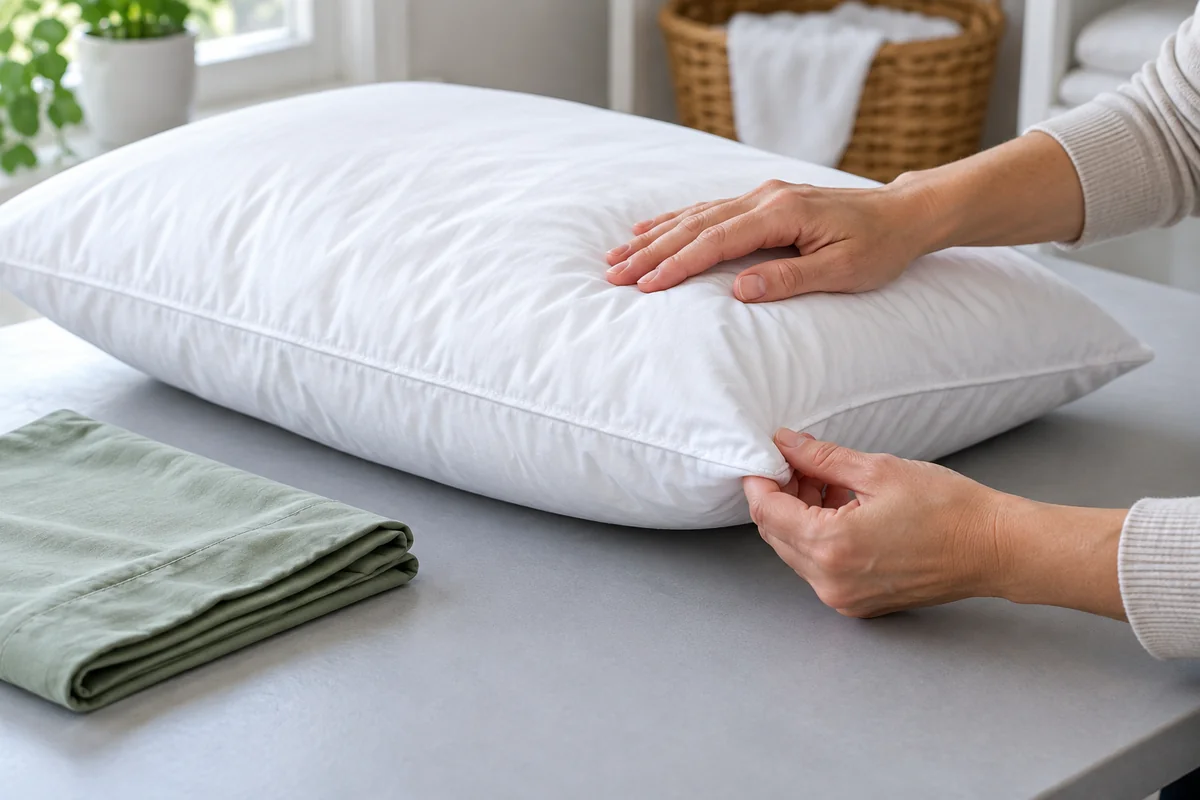
Check the complete item, not only the corner nearest the dryer door. Compare several areas, including thicker portions and compartment boundaries, using the maker’s inspection guidance. Do not put a pillow directly into a protector just because its outer fabric appears dry. A cover can conceal the condition you still need to assess. Keep the pillow accessible until the inspection is finished.
Look for a newly opened seam, uneven distribution, an area that still seems damp, or a change in odor. Those observations are reasons to investigate, not proof of a particular cause. Record what you found and the care process used. If further drying is permitted, follow that instruction; if the item does not recover as expected, ask the manufacturer before escalating heat or trying a different appliance.
Dryer balls, tennis balls, or other accessories should not be added simply because a general article recommends them. Check the pillow and appliance guidance for the actual use. An accessory does not override a no-tumble restriction or repair a torn shell. Similarly, manual reshaping should follow the product’s directions rather than aggressive pulling at a seam. The goal is to finish an approved process, not force every pillow to resemble a newly unwrapped one.
What should you do with a nonwashable insert?
Keep the insert out of any process that its instructions prohibit. If only its cover can be washed, handle that cover separately. If limited spot cleaning is permitted, follow the specified method and drying directions for the insert rather than soaking a larger area to make it look uniformly wet. If no wet-cleaning permission is given, obtain model-specific guidance before applying liquid.
A removable cover can make routine care more manageable, but it does not guarantee that an internal spill is fixable at home. Describe how far the liquid traveled and what you have already tried. A provider who hears only dirty cover may give an answer that does not address a saturated core. Keep the distinction explicit in a phone call, email, or service handoff.
Do not use baking soda, steam, fragrance spray, or a household disinfectant as an assumed universal alternative. Each introduces a separate compatibility question, and none automatically establishes that the interior is clean or dry. This guide does not supply a decontamination protocol. If the manufacturer’s permitted process cannot address the condition, ask about the next appropriate option, including whether continued use is suitable. A clean-looking outer cover cannot answer that question for the insert.
How do you decide when another wash is not the answer?
Separate three concerns: a remaining mark, a changed structure, and uncertainty about the inside. A cosmetic mark does not prove that a stronger wash is needed. Lost loft or an uncomfortable shape may not be a cleaning problem. An unexplained internal condition may require advice that an ordinary laundry cycle cannot provide. Giving each concern its own description is more useful than calling the pillow ruined or still dirty.
Review the record of the first process before repeating it. Which instructions were followed? Was the measured detergent compatible? Did the equipment report a problem? Was the permitted drying method actually completed? If the process was interrupted, explain where it stopped. Do not conceal an attempted treatment when asking for help, because that history can change the advice a manufacturer or provider gives.
Replacement is a condition-and-use decision, not a universal calendar rule in this guide. Consider whether the shell is intact, the pillow can be cared for as instructed, and it still serves its intended purpose. Follow any manufacturer replacement guidance that applies to the model. Do not treat a wash, a deodorizing step, or a new pillowcase as proof that a damaged or unresolved item is suitable for continued use.
How can a household keep pillow care organized?
Use a record that connects the item to its instructions without adding unnecessary work. A photograph labeled with the room and model can be enough. Include whether the complete pillow is washable, which parts separate, and where the care directions are stored. For similar pillows with different fills, a clear record prevents the mistaken assumption that everything on one bed takes the same cycle.
Set a reminder to inspect care needs rather than automatically washing every pillow on the same date. Some products have specific cleaning intervals or limits; follow those instructions. Covers and protectors may have a different routine from their inserts. Keep spare compatible bedding available so a cleaning decision does not become a rushed attempt to finish every layer before bedtime.
When one person starts and another finishes, hand over the actual state: cover washed and waiting to dry, insert not washable and set aside, or whole pillow still awaiting its final inspection. Avoid a vague message such as bedding done. Do not put an unresolved item into the ready-to-use storage area. A brief, accurate handoff keeps the next person from undoing a careful material distinction by completing the wrong step.
What changes for body, travel, or multi-part pillows?
An unusual shape adds a handling question, not a new washing permission. A long body pillow can have a washable case surrounding a completely different insert. A compact travel pillow can hide a shaped core, removable cover, attachment clip, or multiple materials. Identify the assembled product and its parts before deciding that small means easy or large means suitable for commercial washing.
For a long or heavy item, plan how it will move between the preparation area, equipment, and permitted drying location. Check the route and clear a clean surface before starting. Do not drag the case along the floor or pull a filled item by one corner just because the usual laundry basket is too small. If you cannot handle the item appropriately through the whole process, discuss that limitation with a suitable provider before wetting it.
For a multi-part support pillow, photograph the original arrangement and count the components. Keep left and right pieces, different thicknesses, or differently shaped inserts identifiable without marking the material with an unapproved ink. A clean cover placed around the wrong arrangement is still a reassembly mistake. Match the parts to the original instructions rather than assuming all inserts are interchangeable.
Keep intended use separate from cleaning advice. This article does not assess whether a specialty pillow provides appropriate support or is suitable for a particular person. Follow the product’s use instructions, and direct questions about a prescribed or specialized support item to the relevant provider. Household laundering guidance cannot establish that its function remains appropriate after damage or a change in shape.
What should you ask before taking a pillow to a laundry service?
Ask about the exact item, not just pillows as a category. Explain the model, filling, removable parts, label directions, and current condition. Confirm whether the provider can accept it and perform the required process. A service that handles ordinary clothing or bed linen does not necessarily accept every pillow construction, specialist material, or contamination concern.
Prepare the same information you would use at home: label photos, a list of separate components, and the name of any product already applied. Ask how parts will remain matched and whether any component should stay with you. Confirm charges and collection arrangements before leaving the item. Do not infer a price, completion time, or acceptance policy from a photograph of commercial equipment.
Fresh Spin’s wash-and-fold page explains its in-store drop-off process, including using the Ash entrance and ordering in the mini-mart. This article does not promise pillow acceptance. Use the contact page to ask about your exact pillow and its care requirements before planning a visit. Keep any hazardous or specialist concern explicit instead of placing the item in an ordinary laundry bag without discussion.
How do these decisions work in everyday examples?
Imagine two plain-looking bedroom pillows. One has a label permitting machine washing of the whole item. The other has a washable cover around a nonwashable core. The correct first step is not to put them together because their size and color match. Separate their care routes, plan the first pillow’s complete process, and wash only the permitted layer of the second. These are hypothetical examples, not reported customer results.
Now imagine a washable pillow with an open seam and a small surface mark. Its washing permission does not resolve the damaged shell. Address the structural question before deciding about the stain. Putting it through a gentle cycle is not a substitute for a sound enclosure. If a repair is appropriate, it needs to suit the construction; if it is not, more cleaning effort may not be useful.
Finally, imagine a pillow whose label is missing after years of use. You have a receipt but cannot tell which version was purchased. Send the manufacturer the receipt details and photographs rather than selecting the nearest-looking current product. If the identity remains uncertain, leave the washing decision unresolved. That may be less convenient than a one-line recipe, but it avoids presenting a guess as an instruction.
What are the answers to common pillow-washing questions?
Does a washable pillowcase mean the pillow can be washed?
No. The case and pillow are separate items, and a protector or zippered cover may add another set of instructions. Read the label for each part. A case can be removed and cleaned while an insert remains outside the laundry process; do not transfer the case’s washing permission to the filling.
Can every foam pillow be hand washed?
No. Hand washing still exposes the material to water. Some product instructions allow only cover washing or limited insert care. Identify the exact model and follow its permissions. Do not assume a basin is a safe workaround for a nonwashable core, and do not generalize one adjustable pillow’s directions to another design.
Should I use the hottest cycle to make a pillow cleaner?
Use the permitted care settings, not a temperature selected to satisfy an unverified hygiene claim. If your concern requires disinfection or another special procedure, ordinary household instructions may not answer it. Ask for guidance appropriate to the item and situation instead of exceeding its temperature limits or declaring it sanitized afterward.
Can I put the pillow away when the cover feels dry?
Not on that observation alone. Complete the manufacturer’s drying and inspection instructions for the filled item. A dry outer surface does not establish the condition of every inner area. Keep the pillow out of a protector or storage bag while an unresolved drying question remains, and do not invent a universal drying time.
What information is most useful when asking for help?
Provide the brand and model, clear label photos, the affected layer, the condition before cleaning, and the exact products and settings already used. Include whether parts were separated and whether drying was completed. That concise history lets the person advising you distinguish a cover problem from an insert problem without relying on assumptions.


