
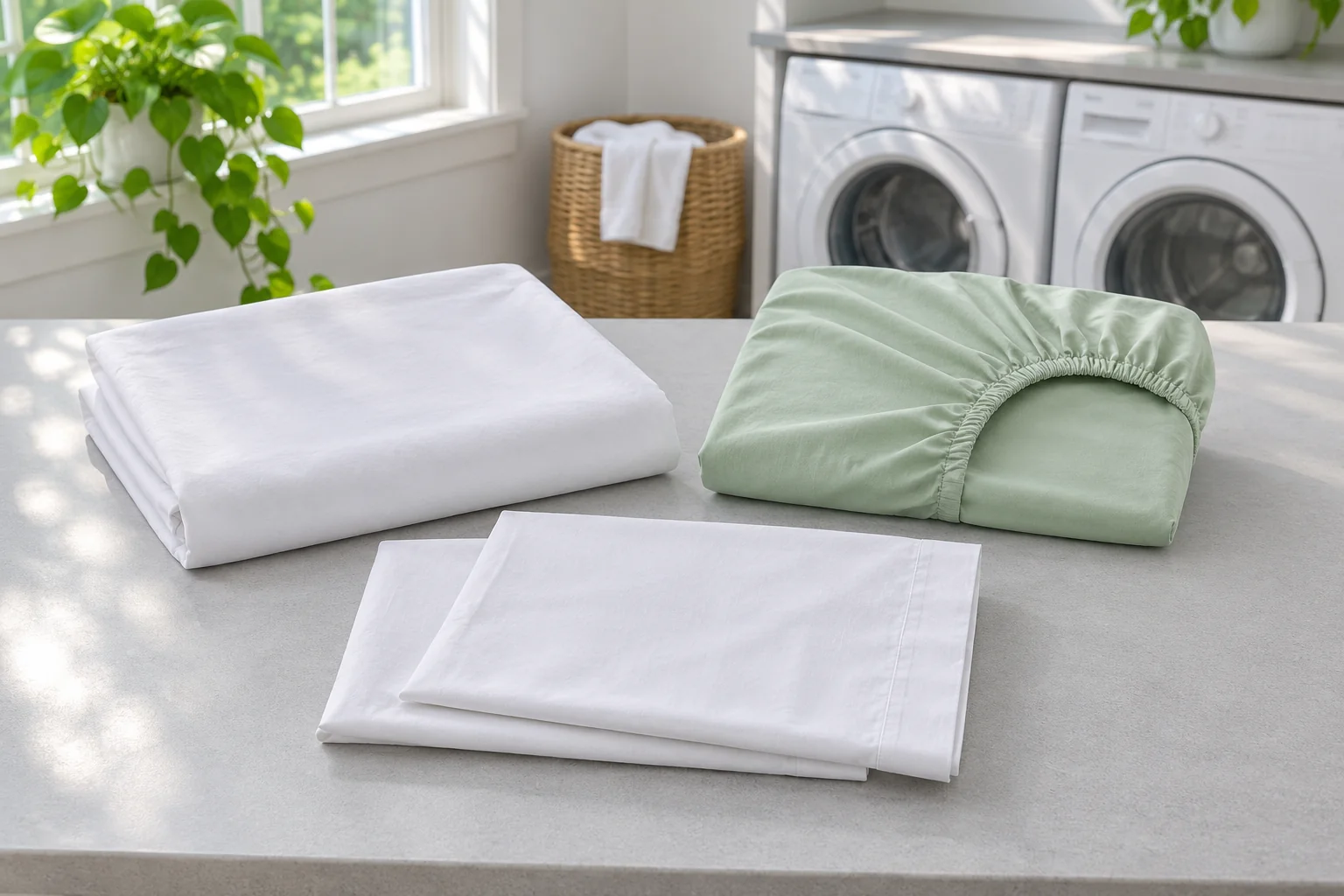
Wash bed sheets according to the instructions on the actual set: sort compatible pieces, check fitted corners and pillowcase openings, treat visible marks, measure detergent, and leave room for the fabric to move. After washing, separate tangled pieces and use the permitted drying method. Check corners, hems, and any folded layers before putting sheets back on the bed or into storage. A sheet that feels dry across its broad center can still need attention where fabric is gathered.
This guide covers ordinary flat sheets, fitted sheets, and removable pillowcases. A comforter, pillow filling, waterproof protector, or electric blanket is a different item with a different cleaning decision. The aim is a repeatable sheet routine, not one supposedly universal temperature or a promise that every stain will disappear. The examples below are planning examples, not results from tests performed at Fresh Spin.
What should you check before starting a sheet load?
Start with the item, not the washer dial. Find the sewn-in label, identify which bed the sheet belongs to, and read both the washing and drying instructions. Record anything that will affect a shared load: cold-only washing, a gentle cycle, no bleach, low tumble heat, or a prohibition on tumble drying. Take a photograph of a fading label while it is still legible. That is more useful on a later laundry day than trying to remember what a similar-looking set required.
Check each piece separately when sets have been mixed over time. A white pillowcase bought later may not be made like the white fitted sheet beside it. Decorative edging, embroidery, contrasting trim, and an elasticized skirt are also reasons to look beyond the broad fabric description. If one item needs a different process, put it aside now instead of discovering the conflict after detergent has gone in.
If the label is missing, look for the exact product on the maker’s website or contact the maker with a photograph and purchase details. Do not choose a hot wash simply because a sheet looks sturdy. Our care-symbol guide can help translate a readable label; it cannot reconstruct missing instructions for an unidentified fabric.
Why do sheet-care instructions sometimes disagree?
An appliance article describes a range of laundry that a machine may handle. A sheet manufacturer’s instruction is narrower: it concerns that maker’s fabric, finish, dye, construction, and intended care. The broad article is useful for understanding the controls, but it is not permission to exceed the textile’s limits.
For example, Brooklinen’s care guide specifies cold washing and low tumble drying for its Classic Percale, Luxe Sateen, Washed Linen, and Brushed Flannel sheets. It also distinguishes bleach and ironing instructions. That is a concrete reason not to turn a general statement about cotton into a hot-water rule for every cotton set.
A practical order of decisions is: establish the sheet’s limits, check the washer manual for a suitable cycle, then check the detergent instructions for dosing and placement. If a machine’s preset exceeds the sheet’s limits, see whether the setting can be adjusted. If it cannot, choose a compatible permitted process or another machine. A cycle name is not more authoritative than the instructions for the object being washed.
How do fabric names change the decision?
Use the fiber label to identify the set, but do not let a familiar marketing name finish the decision for you. Percale and sateen describe different constructions; neither word alone gives a complete wash recipe. A jersey sheet may feel like a T-shirt, but that resemblance does not tell you the permitted drying temperature. A brushed sheet can be cotton, a blend, or another composition. Read the complete description rather than selecting only the most familiar word.
For cotton or linen, look for the maker’s actual temperature and drying limits. For a polyester blend, note the blend and any finish instructions instead of assuming all synthetic bedding is interchangeable. For a set sold as bamboo, read the fiber wording closely. The Federal Trade Commission explains the distinction between actual bamboo fiber and rayon or viscose made from bamboo. The retail word alone is not a care instruction.
If the set is silk, has special trim, or requires a process outside ordinary machine washing, stop using this general workflow as your complete recipe. The separate silk pillowcase guide addresses that narrower item. Keep a simple note for each set: bed size, product name, wash limit, drying method. You do not need an elaborate fabric database; four accurate entries can prevent repeated guesswork.
How should you sort sheets and pillowcases?
Build loads around compatible care instructions and colors, not around the idea that everything came off the same bed. Place ordinary pillowcases with sheets only when their labels agree. Keep a separate pile for a decorative sham, a protector, or a duvet insert. Those pieces may have been used together, but that does not make them equivalent laundry.
Whirlpool’s sheet-washing guide recommends washing sheets separately from towels, comforters, and other items, and distributing them without overloading. Its guidance identifies lint and pilling as reasons to keep towels out. Use that distinction when planning baskets rather than adding a few heavy towels to fill whatever space appears to remain.
For a household with several beds, make a quick sorting list before leaving the bedrooms. For example: one light-colored cotton set, one dark set with cold-only instructions, and one special-care pillowcase. Those are three decisions, even if there are only two beds. After sorting, count the pieces. Write down whether the set includes one or two pillowcases and whether there are two fitted sheets for a split bed. This is a simple way to distinguish a missing item from a different set configuration later.
What needs attention inside fitted corners and pillowcases?
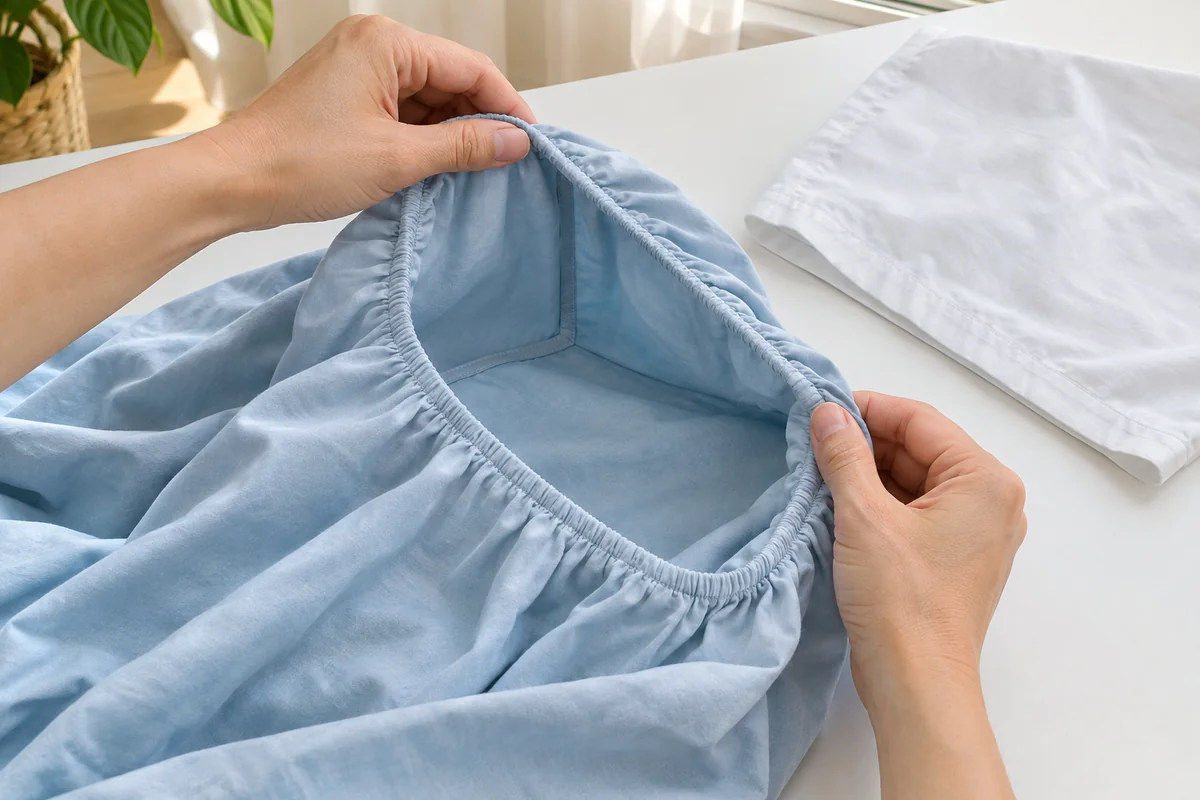
Unfold the fitted sheet completely before loading it. Open each elasticized corner and look inside the gathered pocket. Small clothing items, tissues, and other objects can be hidden there after bedding has been bundled for transport. Remove anything that is not part of the sheet load. Inspect the seams while the corners are open; a loose thread or small tear is easier to notice here than in a compact bundle.
Open pillowcases too. An envelope closure can fold over itself, and a case may contain a second thin cover that needs separate instructions. Identify what is actually in your hands. Do not treat a pillow protector as an ordinary pillowcase merely because both are white and rectangular. If there is a zipper, follow the item’s care directions and check that its surrounding fabric is intact.
For transport, you can keep the set together in a basket, but undo any bundle before washing. Avoid tying sheet corners into a tight knot as an improvised anti-tangle method. A useful preparation routine is to lay one item across the basket, inspect it, and then place it loosely into the sorted pile. Repeat for the remaining pieces. This also gives you a chance to find stains before the entire load is wet.
How should you handle visible marks before washing?
Look especially at the pillowcase face, the upper edge of the flat sheet, and the fitted sheet’s sleeping surface. Note the location of a mark so that you can inspect the same place after washing. If you know what caused it, use a product whose instructions cover that type of stain and the sheet’s fabric. If you do not know, avoid stacking several treatments in the hope that one will work.
Read the stain product’s directions for dilution, contact time, colorfastness testing, and whether it should be rinsed before washing. Check those directions against the sheet label. A treatment recommended for plain white cotton is not automatically suitable for a colored trim or a different fiber. Work on a manageable area and keep the rest of the sheet off a dirty floor or countertop while you treat it.
Before drying, inspect the recorded spot again. If it remains, decide whether another label-compatible treatment is reasonable before using heat. Do not promise yourself that one cycle must remove an old mark. A pale stain, actual loss of color, and damage to the cloth are different problems. When the fabric is deteriorating or the treatment instructions are unclear, asking the maker is more useful than making the whole load progressively hotter or stronger.
How much detergent should a sheet load get?
Measure the product you are actually using. A cap from a previous bottle is not a standard unit, and the apparent height of a loose sheet pile is not a precise dosing guide. Check the current package, including its concentration and instructions for the machine type. Use the machine’s instructions for the dispenser or other placement. Do not substitute a remembered rule from another detergent.
Tide’s washing-machine FAQ identifies load size and soil level as factors in the amount needed. For your own routine, record the product and the marked dose used, not just “one scoop.” That makes a later adjustment reviewable if the result is unsatisfactory. It also helps another household member repeat the same process without guessing.
Consider two different loads: a single set being washed on schedule and several compatible sets with visible soil. They should not receive an identical dose merely because both are called bedding. Conversely, adding detergent is not a substitute for splitting a load that is too large. Keep stain treatment and wash detergent conceptually separate, and account for any product instructions that address pretreatment. There is no useful universal tablespoon amount for every product, load, and machine.
Can you use bleach, softener, or extra laundry additives?
Make additives an explicit decision rather than a habit. First check whether the sheet allows the product category. Then read the product’s own fabric restrictions and machine instructions. White color alone is not permission to bleach. A sheet with white fabric and colored embroidery may need a different decision from a plain white sheet, even when they are washed at the same temperature.
The Brooklinen examples above allow only non-chlorine bleach for several sheet ranges. That does not establish permission for a different brand or for every item sold by the same brand. “Color-safe” on a bottle also does not override “do not bleach” on a textile. When two sets have different restrictions, either use a process both permit or separate them.
You do not need to add softener, fragrance boosters, dryer sheets, vinegar, or a homemade mixture to make a routine complete. If you choose an optional product, establish that it is compatible and use its directions. Do not mix laundry chemicals or improvise combinations. For a troubleshooting wash, write down what went in. Otherwise, if the sheet feels different afterward, you will not know which of several simultaneous changes to investigate first.
How do you choose a washer and load it?
Choose by the actual load and the machine’s instructions, not by a universal claim that a named bed size always fits. A thin twin set and several thick fitted sheets are visibly different loads. A washer door that can be closed does not prove the load is appropriate. Consult the machine’s loading guidance and separate sets when that is needed.
A Whirlpool cycle guide explicitly cautions against tightly packing the washer because it can interfere with rinsing and spinning. Treat that as a reason to check the instructions on the actual model, not as a numerical capacity promise for every machine. Place prepared pieces loosely rather than pushing a compact bedding bundle into the drum.
Keep the load plan flexible. If your intended combination does not fit according to the instructions, split it before starting. Do not let the fact that the pillowcases match persuade you to force them into an unsuitable load. Matching pieces can be reunited after drying. For a shared washer, inspect the drum before loading, and ask about an unclear control before paying or starting. This is the moment to resolve a setting question, while the bedding is still easy to remove.
Which wash cycle and temperature should you select?
Choose a compatible cycle from the machine’s own guide. Do not assume that “bedding,” “bulky,” and “sheets” mean the same thing on every model. Whirlpool’s cycle overview explains that different cycles vary their wash action and other settings. It is useful background, but the controls and permitted adjustments on your machine still need checking.
Read the preset after selecting a cycle. If the sheet says cold, a warm preset needs attention. If the item requires gentle care, a faster general-purpose program is not automatically an acceptable shortcut. A normal cycle may be appropriate for one set while a different set needs gentler handling. Select from the overlap between what the textile permits and what the machine is designed to do.
Use a short written decision path: “This set permits machine washing; this model’s guide names this suitable cycle; these selected settings remain within the label.” If one part is unknown, resolve it rather than relying on the word cotton or the appearance of the fabric. This guide does not prescribe a sanitizing protocol for illness, pests, or contaminated bedding. Those situations require specific guidance beyond an ordinary household sheet routine.
What should you inspect when the wash finishes?
Unload one piece at a time and account for everything on your sorting list. Open the fitted corners again and separate anything caught inside. Check the pillowcase closures and the marks you noted before washing. This brief transfer inspection is an opportunity to catch a problem before the load becomes a single dryer bundle.
If a sheet is unusually wet, check the machine’s instructions and any displayed error before starting another process. Do not assume that more dryer heat is the correct answer to a wash or spin problem. If an additional spin is permitted by both the item and machine instructions, follow those instructions; otherwise seek help with the equipment. Avoid pulling hard on an elastic corner to lift the entire weight of a wet sheet.
If you find an item that should have been separated, stop and reconsider its drying method. It does not become dryer-safe because it has already been through a wash. Keep the washed pieces on a clean surface during this review. For a trip to a shared laundry, have a separate clean bag ready so the finished bedding does not need to return to the same dirty transport container without cleaning it first.
How can you reduce sheets balling up in the dryer?
Separate and open the pieces before they go in. Do not transfer the entire wet load as one compressed mass. Check whether the fitted sheet has enclosed smaller items, and pull those free. The goal is to start with distinct pieces, not a ready-made ball. Keep any special-care item that cannot tumble dry out of the dryer load.
Whirlpool’s guide to sheets balling up discusses separating sheets, avoiding an overloaded dryer, and checking the load during drying. Apply the relevant suggestions within the dryer and textile instructions. No accessory can guarantee that every fitted sheet will stay open through every tumble.
If the load has twisted together, stop the dryer using its normal controls before reaching inside. Separate the pieces, inspect the trapped areas, and redistribute what still needs drying. Record whether the problem happened with one set or several, and whether small pieces were enclosed by a fitted sheet. That information helps you plan the next load. Simply extending the same tangled cycle does not address the reason that part of the fabric was enclosed.
How do you know that sheets are ready to put away?
Use the label-approved drying method and inspect the item, not just the timer. Check the broad sheet surface, each fitted corner, the elasticized edge, thicker hems, and the folded opening of every pillowcase. Separate layers so you are assessing the fabric that was inside a fold as well as the exposed side. A quick touch to the top of a stack is not the same inspection.
When you are uncertain whether an area is still damp, open it out and reassess rather than immediately folding it into a dense package. Continue the permitted drying process if needed, then inspect that area again. Do not turn a specific dryer’s elapsed time into a universal promise: load size, fabric, selected settings, and tangling can differ from one wash to the next.
Parachute’s bedding-care guide says linens should be completely dry before they are folded for storage. Make that the final gate for the set. If one pillowcase still needs time, set aside the finished pieces on a clean surface and finish that case separately as appropriate. There is no need to keep already finished items in a cycle solely to preserve the matching set as a unit.
What if you need to air-dry the sheets?
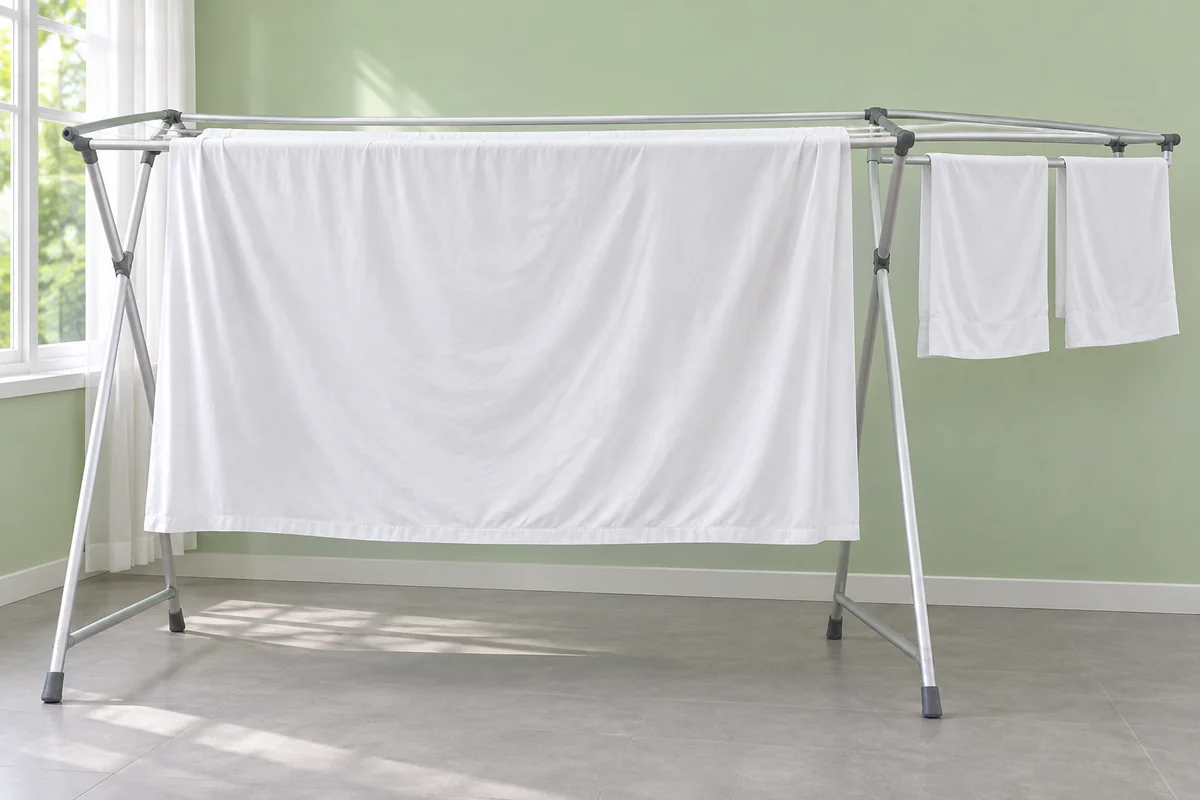
Plan the space before washing, especially if the care label prohibits tumble drying. Check that the line or rack is clean, stable, and suitable for the weight and dimensions of the item. Arrange the sheet so it is supported and not trailing on a floor or outdoor surface. A cramped corner with a sheet folded into many layers needs a different plan from an open drying area.
As it dries, inspect the overlapped areas and reposition the fabric where appropriate. Follow any instruction about shade, hanging, or flat drying; do not assume that every air-dry symbol means the same arrangement. Keep the fitted skirt open enough to inspect its gathered sections. A pillowcase should not remain tightly folded inside another item simply because they were hung together.
Allow a schedule margin. If you need the bed made before the permitted method can finish, use a clean spare set rather than putting questionable bedding on the mattress. Having that backup changes the decision from “How can I rush this?” to “What does this item actually need?” It is a planning convenience, not a requirement to buy a particular brand or an assurance about exact drying time.
How should you troubleshoot a set that no longer fits?
First confirm the identity of the sheet and bed. Check the size label, the mattress dimensions, and whether a topper has changed the depth being covered. Make sure the sheet is oriented correctly. A full sheet mixed into a queen set or a short side placed along the mattress length can look like a laundry problem until you check the basics.
Then compare the care history with the label. Write down any recent change in wash temperature, drying setting, or product. Do not pull a tight corner aggressively over the mattress while trying to diagnose the issue; inspect the elastic and seams instead. If the set changed unexpectedly after care that followed its instructions, contact the manufacturer with the product identity, photographs, and the settings used.
Avoid presenting stretching, soaking, or rewashing as a guaranteed way to reverse a size change. Those are additional treatments with their own consequences, and they may not be allowed. For future purchases, compare the actual fitted-pocket depth with the bed setup, not only the size name on the package. That check helps distinguish a fit mismatch from a change that occurred during laundering.
What if sheets feel rough, look wrinkled, or have visible residue?
Name the observation before choosing a remedy. Is it a loose particle, a visible streak, a small raised pill, a crease, or a change in the overall feel? Those observations are not interchangeable. Photograph the problem in clear light and note whether it affects one item or every item from the load. Check whether the same mark was present before washing.
Review one variable at a time: product and dose, loading, selected cycle, drying method, and storage. If you suspect an unresolved rinse problem, consult the machine and detergent guidance for the next step rather than adding another scented product. If the issue is a crease, follow the sheet’s ironing instructions if ironing is desired; a wrinkle does not by itself establish that a sheet is dirty.
For pilling or damage, avoid aggressive scraping or cutting without suitable product guidance. Inspect whether the underlying cloth is thinning. Repeatedly treating a worn area as a stain can distract from the actual condition of the fabric. Keep realistic expectations: changing the laundry routine cannot guarantee restoration of a damaged finish, lost dye, or worn elastic. A clear description helps a maker give more relevant advice than “the sheets are bad.”
How can you organize finished sets without losing pieces?
Count the pieces again before putting the load away. Match them by size and set, then fold in a way that fits the shelf you actually use. A fitted sheet does not have to become a perfect rectangle to be stored sensibly. Bring matching corners together, smooth the broad fabric, and keep the bundle manageable without forcing the elastic into a tight knot.
Label the shelf by bed size if similar colors make identification difficult. Keep the product-care note where the person doing the laundry can find it. If you store a fully dry set inside one of its pillowcases, make sure the method does not hide a missing second case or mix two sizes. The organizing method should make the next bed change easier, not conceal what the bundle contains.
Keep one record of a successful routine: the product identity, chosen machine settings, detergent and measured dose, and drying method. This is your household reference, not proof of a universal best method. When you replace one piece of a set, update the record. That small maintenance step prevents the new item from inheriting old instructions merely because it has been placed on the same shelf.
How often should you plan a sheet wash?
Maytag’s sheet-care guidance treats regular washing as part of bedding care. A weekly planning slot is a practical starting routine for many households, but actual use and soiling matter. A visible spill or a wet sheet should not wait merely because the next calendar reminder is several days away.
Separate the schedule from the wash recipe. Washing more often does not authorize hotter water, additional bleach, or a cycle the label prohibits. A spare set can make it easier to change the bed while the used set goes through its permitted process. If household circumstances require a specific hygiene procedure, obtain appropriate guidance rather than treating this everyday scheduling suggestion as a medical protocol.
What should you bring for a laundromat sheet load?
Bring the sorted bedding, the label photographs, the product with its dosing instructions, and a clean container for the return trip. Decide which pieces are not part of the ordinary sheet load before leaving home. Keep special-care cases and waterproof items identifiable so they do not accidentally join a compatible-looking pile.
At the machine, read the posted instructions and check the actual controls. Ask about an unclear setting or load before starting. Do not assume every machine has the same capacity or programs. Leave enough flexibility in your visit to inspect the wash, untangle the drying load if necessary, and finish any damp corners before packing.
For Fresh Spin visit details, use our contact page. If you are considering drop-off wash-dry-fold, ask about the specific bedding and disclose its care requirements before handing it over. This guide does not promise acceptance of every fabric, a particular machine size, a price, or a completion time.
Frequently asked questions about washing bed sheets
Can the flat sheet, fitted sheet, and pillowcases go together?
Yes, when their instructions, colors, and the machine’s loading guidance are compatible. Being sold as a set is useful context, but check any replacement piece separately. Split the load if needed; matching items do not have to remain together throughout washing and drying.
Does a king-size sheet always require a larger machine?
There is no reliable universal answer based on the bed-size name alone. Check the actual fabric volume, the rest of the load, and the machine’s instructions. Do not publish or rely on a capacity claim that has not been verified for the equipment being used.
Should a new set be washed before use?
Follow the manufacturer’s first-use guidance. Brooklinen, for example, advises washing its sheets before using them. Keep the packaging or photograph the product information so you can identify the set later, then use the same careful label check you would for subsequent washes.
Can I wash the pillow itself with its case?
Do not assume so. The removable case and the filling have different care decisions. Use the pillow-washing guide for that item, and keep this sheet workflow focused on the removable fabric pieces it actually covers.
What is the most useful final check?
Account for every piece, inspect the previously marked areas, and check the corners, hems, and closures for remaining moisture. Only then remake the bed or store the set. That final inspection connects the whole routine: you know what went in, what came out, and whether each piece is ready for its next use.


