
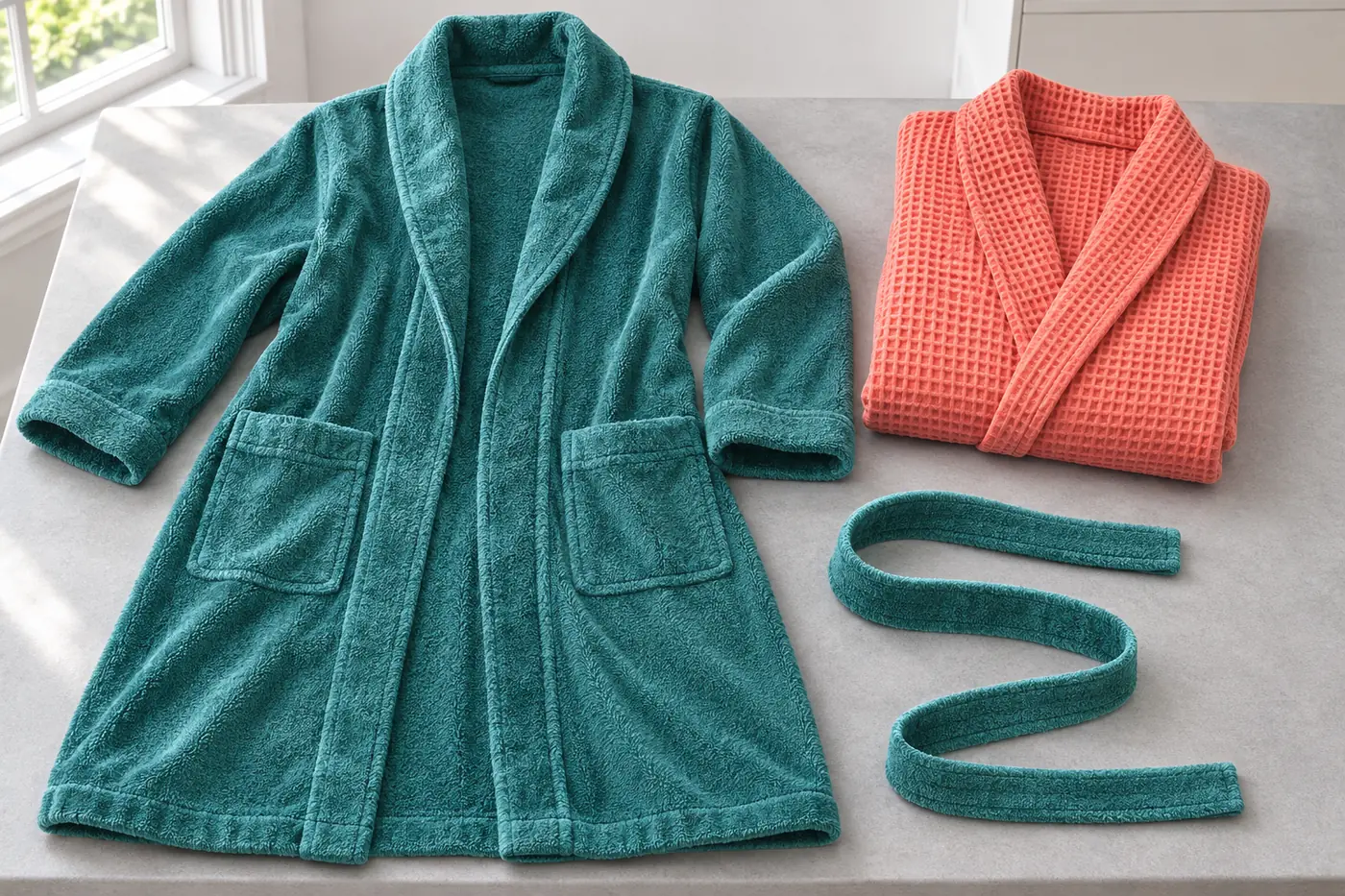
To wash a bathrobe, follow the care label for the complete garment, empty the pockets, prepare the belt and closures, and choose a compatible detergent, load and drying method. Do not treat every robe like a white bath towel. Terry, waffle, gauze, fleece and silky dressing gowns can require different handling, and the hood, collar, pocket seams and belt need attention before you call the job finished.
A useful robe-care routine answers three questions in order: may this particular robe be washed, what can go through the same process with it, and how will you dry every part completely? Answering the drying question before starting avoids a wet, heavy garment with nowhere suitable to go. The steps below separate those decisions instead of prescribing one temperature or cycle for everything called a robe.
What should you check on the label before washing a robe?
Find both the fiber label and the care instructions. They may be sewn into different places, such as a side seam and the inside neckline. A fabric description explains what the robe contains; the care instructions describe the process its maker permits. Photograph the instructions while the garment is dry and easy to handle, especially if the print is already fading.
Read the entire sequence rather than stopping at machine washable. Check water temperature, mechanical action, bleaching, tumble drying, natural drying and ironing. A machine-washable robe can still prohibit tumble drying or bleach. Instructions for a lining, decorative trim or removable accessory may add another restriction. Where the components differ, identify whether they can be separated before deciding on a shared routine.
GINETEX’s care-symbol guide explains that the number inside a wash tub is a maximum temperature, while bars underneath indicate reduced mechanical treatment. A crossed-out washing symbol is not an invitation to try a delicate cycle. If the symbols are unfamiliar, our laundry care-label guide can help you identify the question to resolve before the robe gets wet.
If the label is missing, use a product number, order history or photograph to ask the manufacturer for the correct instructions. Do not substitute directions for a similar-looking robe, even from the same company. Until you identify the garment, keeping it out of an experimental machine load is the more conservative decision.
Why are terry, waffle, gauze and fleece robes different?
Look at the construction as well as the fiber name. Terry has visible loops. Waffle has a grid-like texture. Gauze can have light, layered fabric. Fleece has a raised, soft surface that may feel plush without being towel-like. These descriptions help you notice potential snags, folded layers and hidden damp areas; they do not, by themselves, provide washing instructions.
A robe also has a garment shape rather than the flat shape of a towel. Sleeves can turn inside out, the belt can separate from the body, and the collar or hood can fold over itself. A pocket that looks dry from the outside may still need checking along its seam. Treat these as inspection points, not reasons to automatically choose a more powerful wash or hotter dryer setting.
Sort your actual robes into care-compatible groups. A lightweight waffle robe and a thick terry robe may share a color but not a useful drying schedule. A fleece robe and a silk dressing gown may both be lounge clothing yet have different care restrictions. Keeping a short note of each robe’s approved process is more useful than memorizing a general rule for the category.
What do actual manufacturer examples tell you?
The examples show why the exact garment matters. Parachute’s cotton robe details specify cold machine washing with mild liquid detergent, low tumble drying and no bleach. Its separate Cloud Cotton Robe page identifies two-ply cotton gauze and includes a no-ironing instruction. Those are product-specific directions, not permission to apply the same settings to every cotton robe.
Brooklinen’s robe-care section lists cold washing and low tumble drying for its Super-Plush, Organic and Dreamweave Waffle robes, but the bleach directions differ: Super-Plush allows non-chlorine bleach when needed, while the other two say not to bleach. The same section advises against fabric softeners because of absorbency and warns about contact with benzoyl peroxide products.
For a different construction, L.L.Bean’s Winter Fleece Zip-Front Robe is described as polyester fleece that can be machine washed and dried. That short product description does not establish an exact temperature, cycle or drying time. Use the care tag supplied with the garment for those details.
When an online page and the sewn-in label seem to disagree, pause and ask the maker which instructions apply to your version. Colors, trims and product revisions can complicate a visual match. Save the response with the label photograph so the next wash does not restart the same uncertainty.
What should you do before the first wash of a new robe?
Check the robe while its identifying information is still available. Match the product name and any care leaflet to the sewn-in label, then remove detachable packaging without cutting permanent stitching. Look for a sash packaged separately, a spare button or another accessory that should not accidentally enter the washer. Keep the care information somewhere you can retrieve it after the packaging is gone.
Brooklinen’s robe guidance calls for washing before use. Where your own manufacturer gives that instruction, make the first wash a planned care cycle rather than a quick rinse chosen from habit. Inspect the garment beforehand so an existing loose seam or mark is not later confused with a change caused by washing.
Use this first cycle to establish a practical handling routine: where the belt will go, how the robe will fit in a permitted load, and which drying arrangement you can actually provide. Do not add extra products to create a hotel-like feel. The goal is an appropriately cleaned, fully dry garment, not a scent or finish copied from another robe.
How do you prepare pockets, belts and closures?
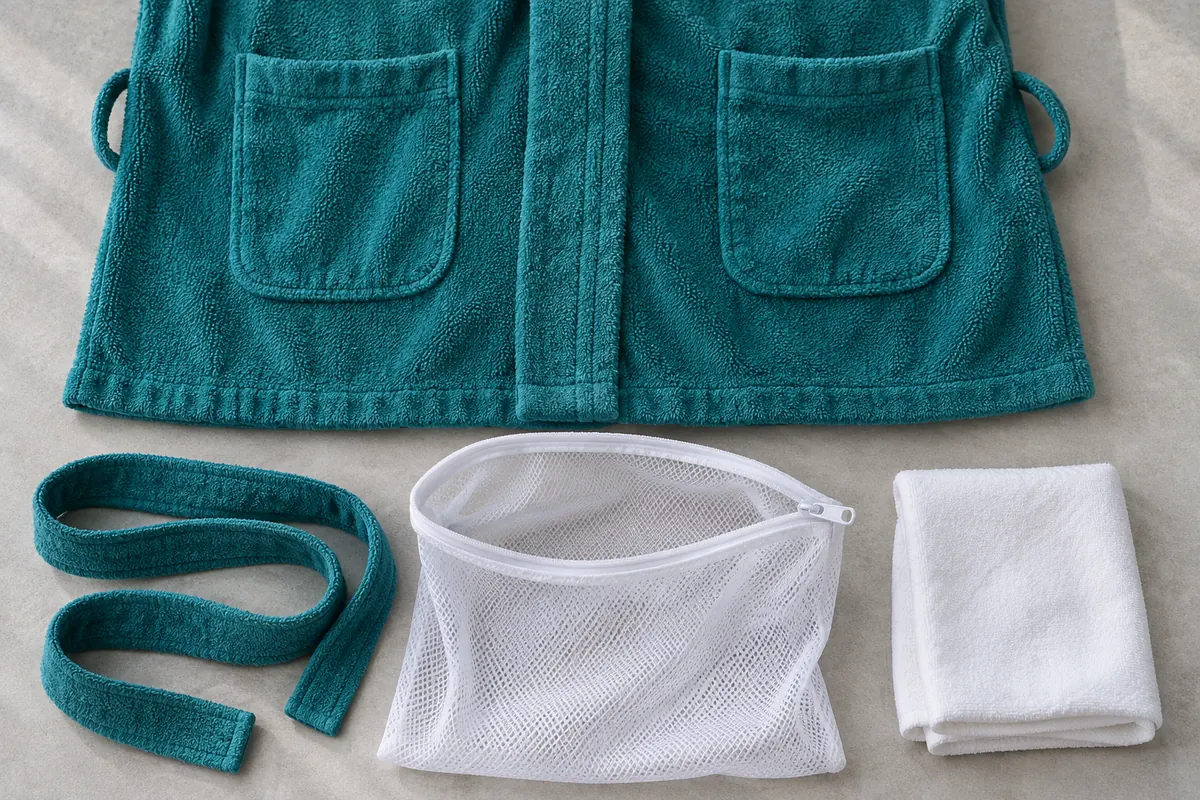
Lay the dry robe on a clean surface and check every pocket by hand. Remove tissues, lip balm, hair accessories and anything else left inside. Inspect the pocket corners and the place where each belt loop attaches. A loose loop or partly detached seam is easier to notice before the garment is wet and folded into a load.
If the belt is designed to slide out, remove it and keep it with the robe’s laundry plan. Check whether it has its own care information or different trim. For a compatible washable belt, a suitable mesh bag can help keep the small piece identifiable during the wash; it does not change which cleaning method is allowed. Leave enough room in the bag for the belt rather than knotting it into a dense bundle.
Do not cut a sewn-in belt or force decorative fasteners apart. Follow any closure instructions provided with the robe. A zip-front garment deserves a check for damaged teeth, trapped fabric and a working slider before loading. Buttons and ties should follow their own garment directions rather than a universal rule to fasten every closure.
Make a simple count before washing: one robe, one detachable belt, and any removable accessory actually included. That is particularly useful when two people own similar robes. Keeping components accounted for prevents an otherwise clean garment from returning to the closet with the wrong belt or a missing part.
Should you deal with stains before the full wash?
Inspect the collar, cuffs, pocket openings and front panels in good light. Those are practical places to look for the residue or marks you want the wash to address. Identify what you know about a mark: recent food, a cosmetic spill, an unknown patch or a change in color. Do not assume every visible change is removable soil.
Use a pretreatment only when both the robe’s instructions and the product label allow it. Follow the stated application, contact-time, rinsing and laundering directions. A product intended for a washable cotton item may not be appropriate for a delicate lining or decorative finish. If the product calls for a hidden-area check, complete that check before applying it to the visible mark.
Avoid improvising combinations of cleaners or extending a treatment because the first attempt did not work. Record what was applied so you do not accidentally repeat or mix a process later. If a mark follows contact with a product that can alter color, more detergent may not address the underlying problem. Ask for garment-specific advice rather than repeatedly escalating the treatment.
After the permitted wash, inspect the marked area again before choosing the next step. If it remains, reassess the cause and instructions. A useful stopping point is when the next treatment would be a guess or would exceed what the label permits.
How much detergent should you use for a bulky robe?
Use the dose on the exact product for the actual load and soil level, together with the washer’s dispensing instructions. A robe’s large visual size does not automatically justify an extra capful. A thick garment can occupy much of a basket while still being only one part of the dose calculation. Measure rather than using the amount you remember from an unrelated laundry load.
The American Cleaning Institute’s detergent guidance notes that both too much and too little detergent can leave clothing less clean. It points readers to the product dose and fabric-care instructions. That supports a label-based decision, not a fixed spoonful for every robe or a promise that reducing detergent always solves stiffness.
Check the formulation as well as the format. A packet has a defined dose; a liquid or powder requires its own measuring directions. Do not assume a detergent compartment accepts every format. If the robe maker specifies a mild liquid or excludes particular additives, use that requirement when choosing among products compatible with your machine.
For comparing labels and usable cost per load, see our laundry detergent comparison guide. Treat fragrance, price and cleaning suitability as separate questions. A stronger scent is not evidence that the robe was rinsed properly or that the hood has dried.
Can you wash a robe with towels or other clothing?
Only combine items when their care requirements and the machine’s loading directions are compatible. Start with temperature and cycle, then consider color, surface texture, closures and available space. The fact that two items live in the bathroom does not establish that they belong in the same load.
For example, a robe requiring a mild process should not be added to a towel load whose chosen program exceeds that requirement. A robe with exposed loops also deserves a check of neighboring items for rough fasteners or damaged trim. Separate pieces when you cannot resolve the conflict without compromising one of their instructions.
Think about the end of the wash, too. If a lightweight robe and thick towels have different drying permissions, plan to separate them before starting the dryer. Put the robe’s belt where it will be easy to find rather than letting it disappear into a folded towel. A load that is convenient to start should still be manageable to finish.
You do not need to add unrelated clothing just to make the drum look full. Conversely, do not assume every machine will handle a single heavy garment well. Consult its guidance for loading and balance; if the approved load arrangement is unclear, ask before running it. There is no universal number of towels that should accompany a robe.
How should you load the washer without bunching the robe?
Unfold the robe before placing it in the drum. Check for a sleeve trapped inside the body or a belt wound tightly around the garment. Load according to the machine’s instructions, allowing the item the space and arrangement that model requires. Being able to shut the door is not, on its own, a useful capacity check.
Whirlpool’s top-loader instructions describe loose, even placement around the basket and warn against wrapping long items tightly around an agitator. For a robe, that makes the long body and belt worth noticing during preparation. The example does not establish settings for a different washer; follow the manual and posted directions for the machine you are using.
Select the program after checking the robe’s permitted mechanical action and temperature. A heavy terry garment does not automatically call for a heavy-duty cycle. A delicate program is likewise not permission to machine wash a handwash-only robe. The machine provides a menu of processes; the garment instructions determine which ones are eligible.
If the washer signals an imbalance or another problem, follow its stop and adjustment procedure. Do not try to defeat a lock, reach into moving equipment or keep restarting an unexplained error. Recheck the load arrangement and seek help with the machine when necessary.
What changes when a robe requires handwashing?
First decide whether you can handle the complete garment through washing, rinsing and drying. A lightweight dressing gown and a large terry robe present very different practical tasks. If you cannot safely support the wet garment or provide its permitted drying setup, get advice before filling a basin. Handwashing is not automatically the easier option.
Follow the garment’s specified temperature and detergent requirements. Use a clean container large enough for the intended process without forcing the robe into a tight ball. Prepare any detergent solution as directed, support the garment during handling and avoid treating an uncertain decorative area as though it were plain fabric. Do not borrow a soaking time from a different item.
Rinse as the care instructions require and handle the wet robe without twisting it into a rope. Where gentle pressing is allowed, support the fabric while removing excess water. If the maker supplies another method, follow that instead. Arrange the drying surface or hanger before lifting the robe out so you are not carrying a dripping, heavy garment around looking for somewhere to put it.
Silk, wool and mixed-material dressing gowns need their own complete-garment directions. A familiar home method for a silk pillowcase or a wool sweater does not establish permission for a robe with lining, trim or another construction.
How do you choose between tumble drying and air drying?
Use the robe’s drying instructions, not whichever method seems fastest that day. When low tumble drying is specified, do not replace it with high heat because the robe feels heavy. When tumble drying is prohibited, a low-temperature setting does not remove that prohibition. Washing permission and dryer permission are separate decisions.
For an allowed dryer load, check that the robe is unfolded, the sleeves are free and the belt is not tightly wrapped around it. Follow the appliance’s loading and maintenance directions. If the robe shares the dryer with compatible items, inspect and remove each as appropriate rather than letting a dry lightweight piece remain solely because another item is still damp.
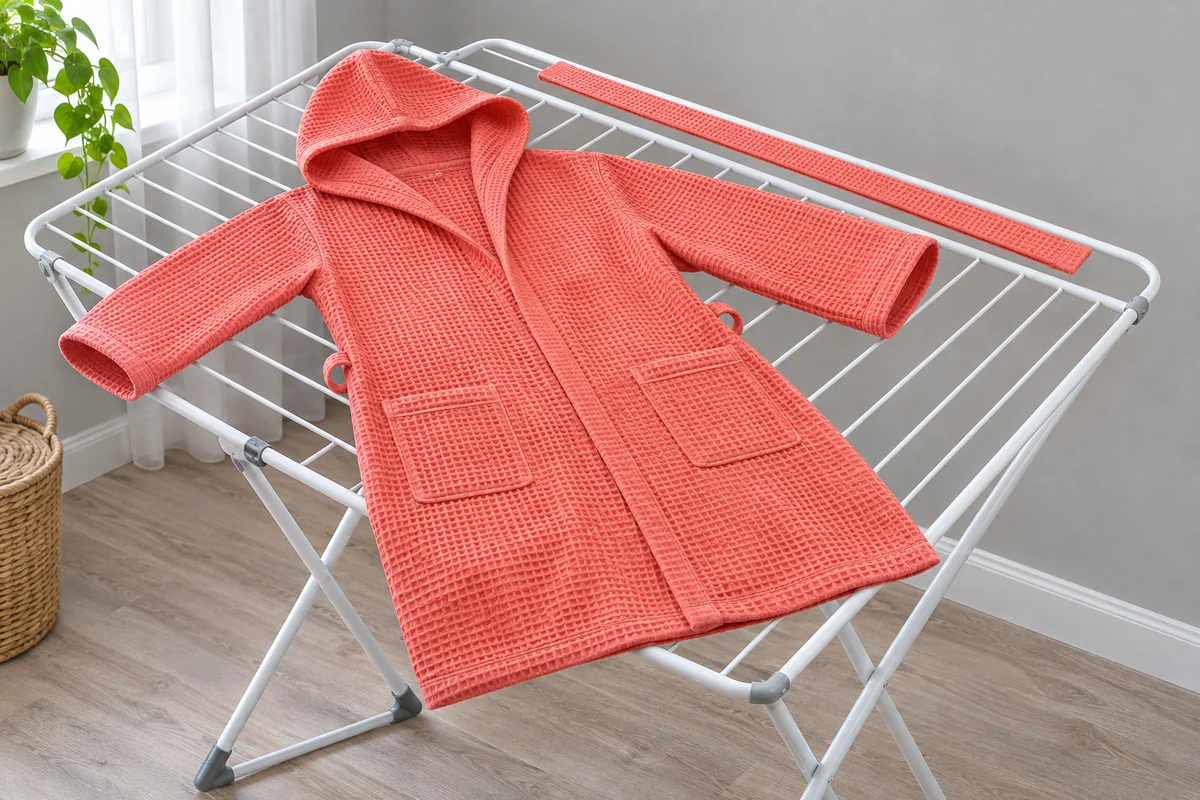
For allowed natural drying, follow the specified shape and position. Hanging, flat drying and drying in shade are different instructions. Choose a support that accommodates the robe rather than draping it into a dense heap. Open folds so you can inspect them later, and keep the wet garment from resting on a dirty surface.
No general article can supply a reliable minute count for your robe, machine and room. Treat a timer as a reminder to check, not proof of dryness. Plan enough time to inspect the garment and complete the permitted drying process before wearing, packing or storing it.
Where should you check for dampness before putting a robe away?
Check the thickest and most folded parts, not just the broad back panel. Open the hood if there is one. Inspect the shawl collar, cuff turns, pocket corners, waistband seams and any overlapping front panels. Check the belt separately, especially its thicker ends and any part that was folded inside a bag.
A useful sequence is to spread the robe out, identify each component, and move through them in the same order every time. That prevents a dry-looking surface from distracting you from a tucked sleeve. If you find a damp area, return the item to its allowed drying method with that area opened or repositioned as the instructions permit.
Do not cover a still-damp robe with another garment or fold it into a storage basket simply because you need the dryer or rack. Decide where it can finish first. For a household with several robes, label-free sorting can be as simple as keeping each belt beside its own garment until both are ready.
Once the robe is completely dry, give it a final check for the original mark, loose seams and missing components. This is also the right time to note what worked, such as which approved load arrangement was easy to handle. Avoid recording an exact drying time as a rule that must work on the next wash.
How do you protect terry loops and handle a snag?
Before washing, distinguish a loose surface loop from an opening seam or a hole. Do not pull on the loop to see how far it goes. If you are unsure what has come loose, ask the maker or a repair professional rather than cutting into the fabric. A small cosmetic snag and structural damage need different decisions.
For its robes, Brooklinen advises not pulling snags or loose threads and describes trimming long strands. Keep that advice scoped to the product and the type of loose strand involved; it is not a direction to cut belt-loop stitching, embroidery or a load-bearing seam. Resolve damage that could worsen before putting the robe through another wash.
Look for the cause as well as the visible thread. Check a damaged zipper on another item, a rough accessory or a fastening that caught the robe while it was worn. Removing the immediate source of snagging is more useful than repeatedly trimming the same area without understanding what is happening.
Preserve the garment’s usable condition rather than chasing a perfectly uniform surface at any cost. If a loop repair or trim would require guessing about the construction, stop. Not every appearance change should be treated with scissors, stronger washing or additional products.
What if a waffle or gauze robe looks smaller or more textured?
Compare the dry garment with its own prior fit and care history, not with a different weave. Texture, dimensions and the way a robe hangs are separate observations. Check whether the cuffs, length, front overlap and belt position still work as expected. A photograph taken before washing can make that comparison less dependent on memory.
Do not iron a textured robe merely to make it look flatter. The Cloud Cotton example above specifically prohibits ironing. If your robe permits pressing, follow its temperature and method; if it does not, leave the iron out of the troubleshooting plan. Smoothness is not a universal sign that a robe has been cared for correctly.
If the fit has changed, review the settings actually used rather than the ones you intended to select. Record detergent, wash program and drying method before contacting the manufacturer. Avoid stretching, prolonged soaking or reheating as an assumed way to reverse the change. The maker can help distinguish expected behavior from damage or a care mismatch.
What should you do with a fleece or silky dressing gown?
Identify the actual garment instead of grouping every soft robe under the same instructions. A fleece robe may have a zipper, while a silky one may have a contrasting lining, lace or a separate sash. Check those parts for their own restrictions. A surface that feels luxurious does not tell you whether the item is machine washable, handwashable or professionally cleaned.
For a washable fleece robe, use the approved process and inspect the raised surface after drying. Do not assume an iron will improve a flattened patch. Our fleece-care guide explains related fabric decisions, but the robe’s own label remains the authority for that garment and its closures.
For a silky dressing gown with uncertain fiber content, do not choose detergent by appearance. Satin describes a fabric structure, not a universal cleaning method. Find the fiber and care information first. If separate components cannot safely share a process, ask for item-specific advice instead of choosing a compromise cycle and hoping each part tolerates it.
How often should you wash a robe?
Base the decision on actual use and the garment’s instructions rather than a fixed number of calendar days. A robe used briefly over clean clothing is not exposed in the same way as one worn against damp skin, during food preparation or while using hair and skin products. Visible soil, spills and the way the garment is used give you more useful information than a universal wear count.
Between washes, arrange a damp robe so it can dry by a method its care instructions permit. Do not leave it compressed in a heap and expect the next wearing to solve that problem. Keep the belt from becoming a tightly folded wet bundle. If your bathroom does not provide a workable drying arrangement, choose another suitable place rather than storing the robe damp.
For a guest robe, keep track of whether it is freshly cleaned and fully dry rather than judging only by its appearance on a hook. A simple separate storage place for ready-to-use garments helps avoid confusion. If an illness, workplace or other special situation requires a specific laundering protocol, follow that guidance rather than treating this ordinary household routine as a disinfection procedure.
What if the robe feels stiff, smells wrong or still looks dirty?
Start with observations. Is the issue a visible mark, a feel across the whole garment, an odor concentrated in the hood, or a change in the raised surface? Record when you noticed it: immediately after washing, after drying or after storage. Those distinctions help you decide which part of the process needs checking without claiming one cause from a single symptom.
Review the basics before adding another product. Was the robe eligible for the cycle? Was the dose measured from the exact detergent label? Was the load arranged as the machine requires? Were the hood, cuffs and belt fully dry before storage? Correct a known process error where the instructions allow, rather than using extra fragrance to cover an unexplained result.
If the garment still needs washing, use an approved process and reassess afterward. Do not escalate automatically to bleach, vinegar, a hotter wash or an improvised mixture. A persistent issue may need guidance from the garment maker, detergent maker or a cleaner who can inspect the item. Repeatedly running the same unsuccessful treatment is not a substitute for identifying the problem.
What should you ask before taking a robe to a laundry service?
Bring or send the care-label information, not just the word robe. Explain the material, detachable parts, any existing damage and what treatment has already been used on a stain. Ask whether the service accepts that particular care requirement and how the belt or other components should be included.
For a local question, use the Fresh Spin contact page to confirm the item-specific requirements before bringing a special-care robe. This guide does not promise that a particular garment, cleaner, stain or process is accepted. Get that answer before treating a general service listing as approval for a silk lining, delicate trim or handwash-only item.
If you will use a self-service machine, check its posted instructions and make a complete wash-and-dry plan. A larger drum does not override the garment label. Keep any belt or accessory identified, and bring a clean container for the fully dry robe afterward so the finished garment does not go back into a dirty laundry bag.
What are the most common robe-washing questions?
Can a white bathrobe automatically be bleached?
No. Color does not supply bleach permission. Read the complete garment’s instructions and the bleach product’s fabric restrictions. The named robe examples above include both non-chlorine-only permission and a prohibition on bleaching. Do not transfer one product’s instruction to another white robe.
Should I keep the belt tied around the robe in the washer?
Follow the garment’s directions. If the belt is removable, keeping it separately identified can simplify handling; an eligible belt may fit in a suitable mesh bag. Do not tightly bundle the robe with its belt, and do not detach a part that is sewn in. Check both pieces before storage.
Does a mesh laundry bag make a robe machine washable?
No. A bag is an accessory, not a replacement for washing permission. Check whether the robe may be machine washed before choosing any bag or cycle. A large garment stuffed into a small bag also defeats the practical goal of keeping it reasonably open for its permitted cleaning process.
Can I use the same dryer setting as my towels?
Only if that setting is allowed for the robe and the load is suitable for the machine. Check the robe independently, including its lining and trim. Separate items with different drying permissions or finish times rather than letting the towel routine decide the robe’s care.
What if only the belt or one cuff is still damp?
The robe is not ready to be stored as a complete set. Continue the permitted drying method for the damp part, opening folds or separating a detachable belt where appropriate. Do not pack the wet component inside the dry body and assume the moisture will disappear in the closet.
Is a strong clean fragrance proof that the robe is ready?
No. Check the actual task: whether soil was addressed, the garment was rinsed through its approved process, and every component is dry. Fragrance is not a substitute for examining a stained cuff or a damp hood. Choose products by their compatibility and directions, not by the strength of the scent.
What is the shortest reliable robe-care checklist?
Identify the complete garment’s instructions, inspect its condition, empty pockets, account for detachable parts, measure compatible detergent, select an allowed wash process, and finish the specified drying method. Check the hood, collar, cuffs, pockets and belt before storage. When one of those decisions is uncertain, resolve that question instead of guessing a universal setting.


