
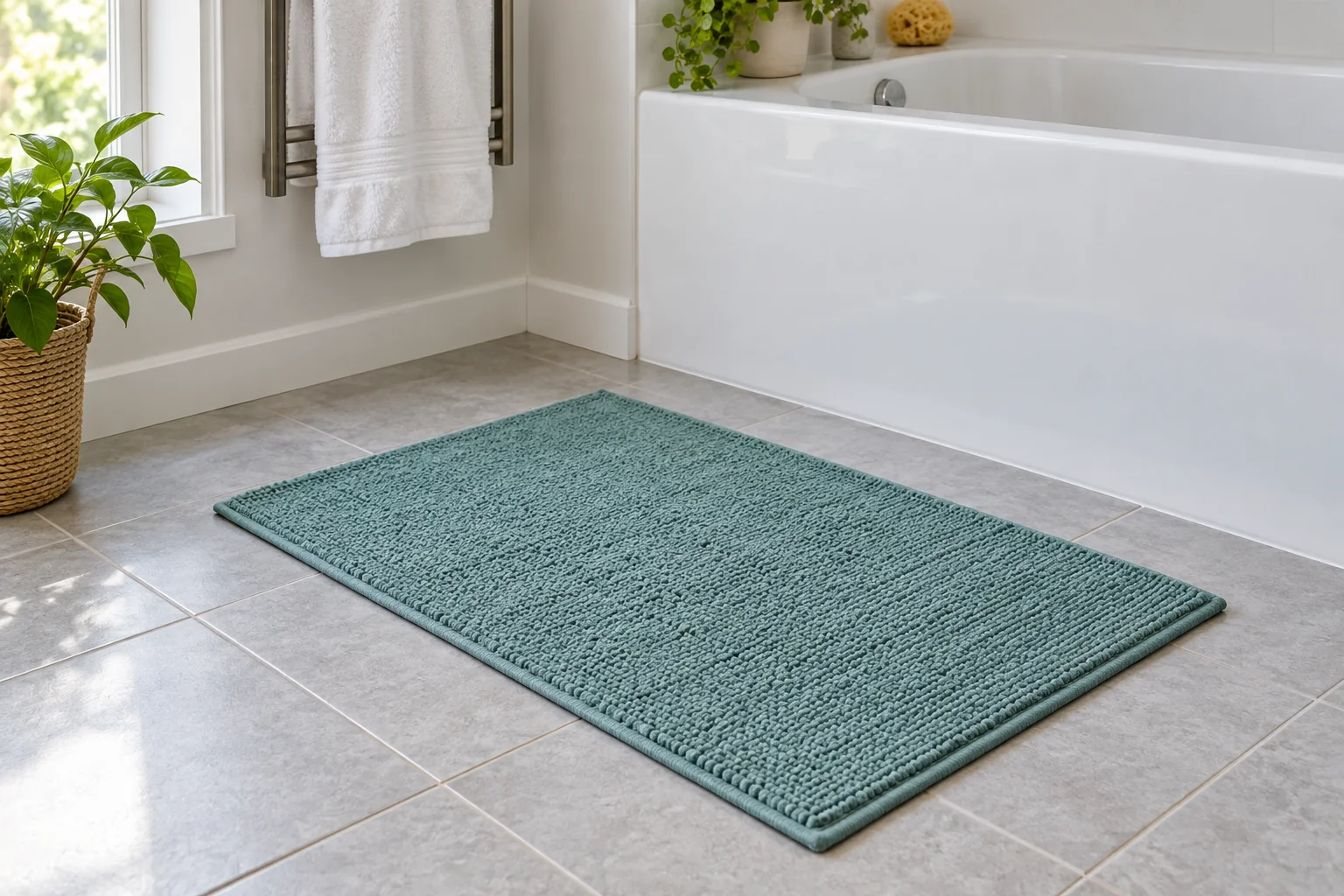
Wash a bath mat only after checking both its care instructions and the washer’s instructions for that type of item. Identify the surface, backing, filling, and any separate pad; inspect their condition; remove loose debris; and choose a compatible cleaning method. Dry every component as directed before putting it back on a clean, dry floor. A fluffy bath rug, a foam mat, a removable cover, and a rigid bath stone should not automatically follow the same laundry routine.
This guide covers ordinary household bathroom floor mats. It does not provide a disinfection protocol for illness, sewage exposure, or commercial facilities. It also does not assume that a mat used inside a bathtub is the same product as a textile rug outside it. The goal is to help you reach a practical decision before you load a machine, not to assign one temperature to everything sold for the bathroom.
What kind of bath mat do you actually have?
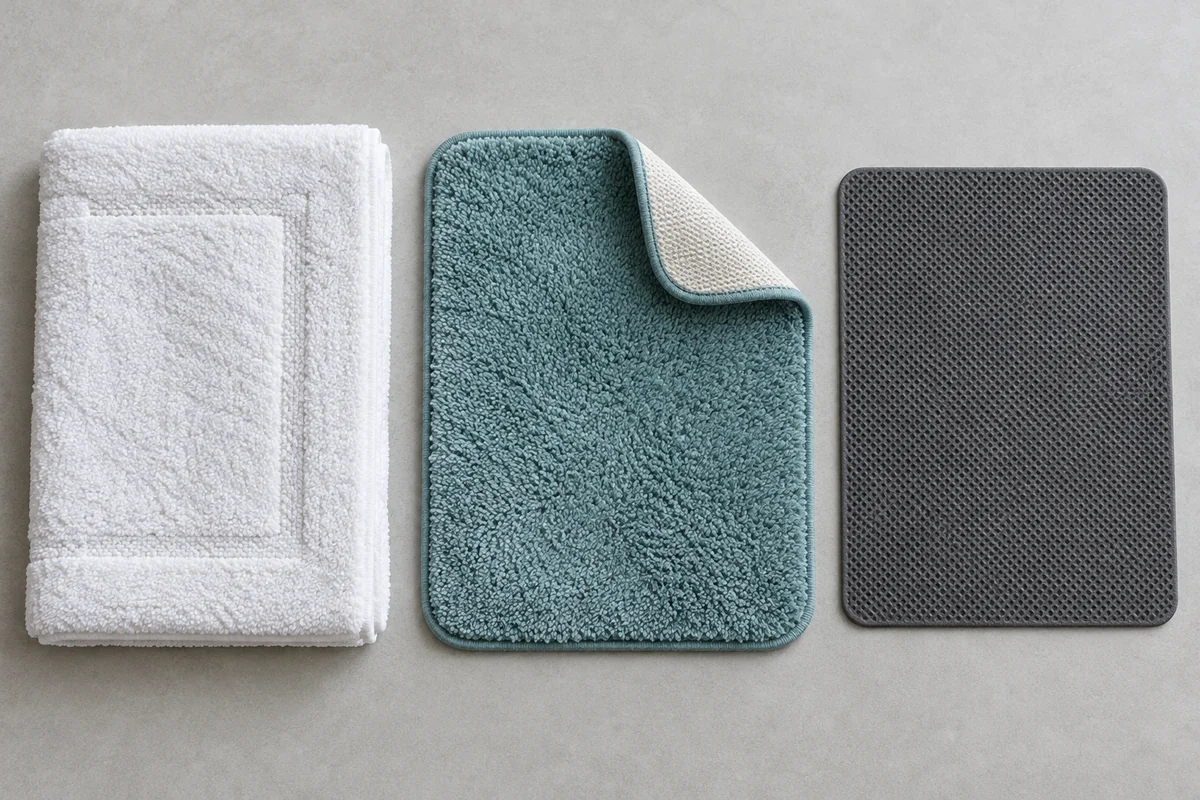
Start by lifting the mat and looking at both sides. A towel-like cotton mat may be a single textile layer, while a similar-looking rug may have a bonded backing. A thick, cushioned mat may contain foam beneath its fabric face. Some systems have a removable fabric cover and a separate base. Write down what you can identify without pulling layers apart or damaging the edge. Color and softness alone do not establish the construction.
Find the sewn label and any original product information. Record the brand, product name, fiber content, and care instructions separately. A fiber label is not a complete cleaning instruction: a cotton face does not identify the material underneath it. If the label has faded, search using the exact product number or ask the manufacturer with photographs of the front, back, and label. Do not substitute instructions for the nearest-looking product in a search result.
For a multi-piece system, count the pieces before separating them. You might have a washable cover, a pad, and an additional floor underlay. Keep their instructions attached to the correct component in your notes. It is easy to remember that a product is advertised as washable while forgetting which part that statement describes. Make an explicit list: the part being washed, the permitted method, and the drying method that follows it.
Keep rigid stone, wooden platforms, and suction-cup bathtub mats out of a textile laundry load unless their own instructions specifically direct otherwise. For example, Dorai’s Bath Stone guidance discusses the stone and its supporting pad as a system with its own care and placement requirements. That is a different starting point from laundering a cotton rug. This guide does not translate stone-care treatments into fabric stain-removal recipes.
Why must the mat label and machine manual both agree?
The mat maker can describe how its product should be cleaned, but that does not authorize every washing machine to handle it. The appliance manual may restrict backed rugs, waterproof items, or particular load types. Read the manual for the machine you will actually use, not an article about another model. When an instruction is unclear, ask the manufacturer or the laundromat before starting. A large drum is not evidence that every mat is acceptable.
Samsung’s published appliance safety guidance includes a warning against washing rubber-backed throw rugs or doormats because detached backing can cause problems such as drainage errors. That warning illustrates why checking the appliance matters; it is not a claim that every bath mat contains rubber or that every machine has identical restrictions. If your machine’s instructions prohibit the item, choose another manufacturer-approved route rather than overriding the restriction with a gentle cycle.
Make the decision in two columns. In the first, list what the mat permits: machine washing, hand washing, surface cleaning, and any limits. In the second, list what the machine permits for that construction and load. Proceed only where the instructions overlap. If there is no overlap, a different cycle name does not resolve the conflict. You need another suitable method or advice about that exact item.
For shared equipment, posted instructions and staff acceptance are another practical check. Bring the label information and describe the backing honestly. Do not fold a questionable underside inward to make the item appear to be a towel. Clear information protects the machine, other customers’ laundry, and your own mat. If a service declines the item, ask what characteristic makes it unsuitable so you can select a better care route.
What damage should stop the laundry plan?
Inspect the underside on a clean, well-lit surface. Look for loose particles, peeling areas, separated layers, torn seams, and edges that no longer lie flat. Photograph damage before handling the mat further. Do not scrape aggressively to see how much will come off. If material is already shedding, set the mat aside and ask the maker whether it should be retired. Washing is not a repair for a failing backing.
Check the face as well as the back. Long loose threads, an open seam around filling, or a torn corner may change how the mat can be handled. A visible stain and structural damage are different problems. You can reasonably investigate a stain on an otherwise sound washable item; a damaged item first needs a decision about continued use. Avoid letting the desire to remove a mark distract you from the condition of the whole mat.
Also consider how the mat sits in its normal place. Does it bunch at the bathroom door, curl at the corner, or move when the door brushes it? Record that before laundering so you can compare afterward. Do not promise yourself that a wash will flatten or restore grip. When a mat no longer functions properly in the space, replacing or changing the setup may be more appropriate than repeatedly trying stronger cleaning.
If the mat has an unusual chemical spill, stop the ordinary laundry process. Identify the substance and follow its handling instructions before deciding what happens next. Do not add bathroom-floor cleaner, paint residue, or an unidentified spill to a shared wash load. A laundry care label addresses normal care of the product; it is not a complete response plan for every substance that might land on it.
How can you prepare the mat without making more work?
Set up three places before you start: one for the unwashed mat, one for any separate pad, and one for the cleaned item to dry. Choose surfaces that can handle the work and keep the route clear. Put a spare mat in service only if it is suitable for the floor and lies properly. This small preparation prevents the common problem of finishing a wash and then discovering there is nowhere appropriate for a wet, bulky item.
Remove ordinary loose hair and debris using a method the product instructions allow. Whirlpool’s bath-mat guide starts with removing loose dirt and checking the care label, and stresses that materials require different settings. Keep this preparation separate from aggressive brushing or treatment. If the mat’s pile catches on a tool or the backing starts shedding, stop and reassess rather than treating resistance as a reason to work harder.
Examine stains before choosing products. Note whether you know their source, what has already been applied, and whether the mark is on the face or the backing. A useful note is specific: makeup near one edge, an unknown dark mark on the underside, or a known product spill. “Dirty” is less helpful when you later need advice. Avoid layering treatments simply because the first one did not produce an immediate visual change.
Keep the care label accessible throughout the job. A phone photograph can be easier to consult than turning a wet mat repeatedly. If several mats look alike, give them simple identifiers in your notes, such as upstairs green or downstairs white. Do not attach improvised markers that may bleed into the fabric. The purpose is to keep the right instructions with the right item, especially when different people share the laundry work.
How should you select detergent and pretreatment?
Choose a detergent that fits the mat instructions and the machine, then follow the product’s dosing directions for the actual load. Measure it; do not estimate from how dirty the bathroom feels. The care decision should be made before opening several bottles. If the mat requires a particular kind of detergent, check that description on the product you have rather than assuming that all liquids, powders, or fragranced products are interchangeable.
For an identified stain, check both the stain-treatment label and the mat’s restrictions before applying anything. Confirm whether the treatment is suitable for the surface and whether the maker calls for a colorfastness check. Follow the specified amount, contact time, and rinsing instructions. Do not use a generic stain guide as permission to treat a foam core or bonded backing. Our stain-removal guide can help frame questions, but the finished item’s limits still control.
Do not create a homemade mixture of bathroom cleaner, vinegar, bleach, or other products. CCOHS advises against mixing cleaning products and recommends reading their handling instructions. Keep bathroom-surface cleaning and textile treatment as separate tasks. If a mat has already contacted a cleaner and you do not know how to proceed, seek product-specific advice instead of adding another chemical to counteract it.
Keep expectations realistic. A permanent discoloration may remain even when the permitted cleaning process is complete. Before escalating, compare the result with your original photo and ask whether the remaining issue is a stain, damage, residue, or a change in the material itself. Repeating different treatments without identifying the problem can turn a limited cosmetic issue into an unclear care situation. There is no need to force a spotless result at any cost.
What is different about removable covers and pads?
A two-piece system needs two care decisions, not one. Ruggable’s bath-mat instructions distinguish a machine-washable cover from a pad that must not be machine washed or tumble dried. The page also excludes fabric softener and chlorine bleach for the cover. Those are instructions for that system, not universal rules for unrelated mats. Check the current label for your exact product and contact the maker if published directions appear inconsistent.
Separate components only as designed. Lay them in different work areas, keeping the underside of an unwashed pad away from the cleaned cover. Take a photograph of the original arrangement if reassembly is unfamiliar. The photo is a memory aid, not a replacement for assembly instructions. Do not put extra layers, improvised adhesives, or an unrelated underlay into the system without checking compatibility.
Plan the return to service around the slower component. A cover may be ready while its pad is still drying. Mark the job unfinished until both are ready and the floor beneath them has been cleaned and dried. Avoid reassembling simply to clear counter space. If a second compatible cover is part of your household routine, remember that it does not make a damp base ready for use.
When communicating with another household member or a laundry service, say “cover only” if that is the part authorized for washing. Include a picture of the component and its instructions. A bag containing the entire assembled system can easily create ambiguity. Keep the non-laundry part at home when appropriate, and do not expect someone to identify every detachable construction by appearance alone.
Can you combine a bath mat with towels?
Decide by compatible care and load requirements, not by the fact that both items came from the bathroom. Compare temperature, cycle, color, detergent, and drying restrictions. If one item needs a treatment that the other prohibits, separate them. If the mat’s instructions require washing alone, follow that direction. The plan should also fit the machine manual; adding towels is not a way around a restriction on the mat itself.
Consider lint, shedding, and unusual soil before combining items. An old mat losing material is not an appropriate companion for otherwise cleanable towels. Keep an item with an unidentified spill out of the routine load while you investigate it. For normal towel scheduling and care decisions, use our guide to how often to wash towels separately. A towel schedule does not automatically set the schedule for a mat with different construction.
If the machine instructions call for a balanced load, follow their loading guidance for the permitted items. Do not assume that a fixed number of towels works in every washer. Consider the actual bulk and the machine’s limits. If you cannot assemble a compatible load without overfilling or mixing conflicting care requirements, choose a different approved arrangement. Convenience is useful only after compatibility has been established.
How do you choose the cycle and start the load?
Use the specific instructions you gathered rather than a remembered household default. Product directions genuinely differ: IKEA’s listed TOFTBO model specifies warm machine washing and low tumble drying, while other systems have different limits. This example is not a setting recommendation for your mat. Match the exact model and label before using a manufacturer’s instructions, including any revisions or regional differences.
Lay out the allowed settings in plain language before touching the controls. Note the wash temperature, cycle, permitted spin, and any required drying arrangement. Then compare those with the available controls. A similarly named cycle on another machine may not be equivalent. When you cannot identify the permitted option, ask before starting rather than guessing that the closest name is close enough.
Load according to the appliance instructions and leave the item able to move as intended. Do not force a folded bundle through the opening or press it down merely to close the door. Remove any loose packaging or unrelated objects from the work area. Once started, remain alert for the machine’s own warnings or unusual movement. Follow its stop and troubleshooting instructions if a problem occurs; repeated restarts are not a substitute for resolving an unsuitable load.
At a laundromat, check the selected machine and program before paying and starting. Ask about the particular mat, backing, and allowed settings, not simply whether the business has large washers. Keep the answer associated with that machine and that item. Our self-serve laundry page provides the service starting point; it is not a blanket approval to wash every bathroom rug or backed product.
What if the mat requires hand or surface cleaning?
Follow the maker’s method without turning “hand wash” into an improvised long soak. Confirm whether the instruction permits immersion, specifies a product, or calls only for wiping a surface. A component that needs surface cleaning should not be submerged simply because it fits into a bathtub. Keep the work area free of residue from earlier bathroom cleaning, and use tools suitable for the product rather than a harsh brush selected for tile.
Before wetting a bulky item, consider how you will support and move it afterward. Have an appropriate draining or drying area ready, and avoid a route that drips across a walking surface. If handling it safely is difficult, ask for help or seek a suitable service instead of starting a process you cannot finish. A smaller cleaning area is not automatically a safer option if it leaves you wrestling with a heavy wet mat.
Keep notes on the approved method for the next wash, especially if it differs from the rest of the household laundry. Record what the manufacturer instructed, not a new rule inferred from one successful attempt. If a product must be rinsed, complete that step as directed before drying. Do not skip part of the method because the surface already looks clean or because another component is ready to put back.
How should you dry a mat without guessing?
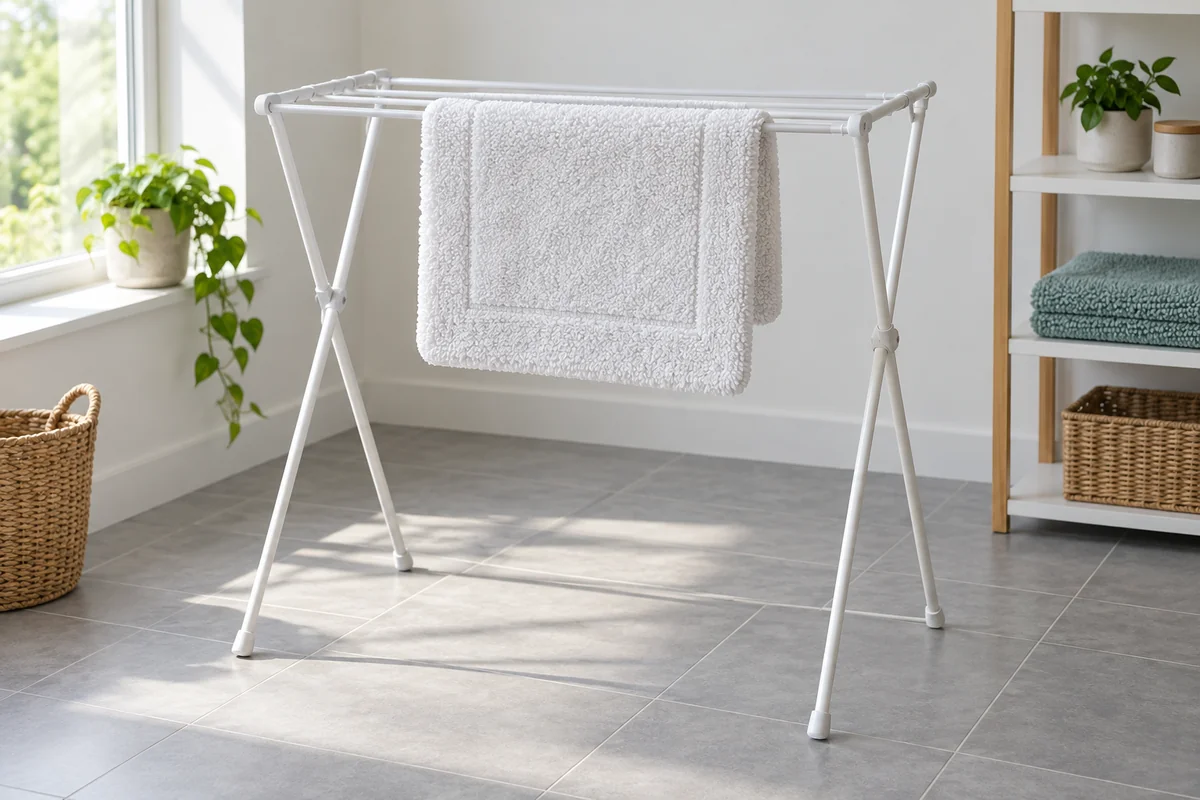
Read drying permission independently from washing permission. A machine-washable item is not necessarily tumble-dryable, and permission for one heat level does not authorize another. Choose the location and equipment before the wash starts. If directions call for flat drying, arrange support accordingly; if they permit hanging, make sure the setup accommodates the item. Do not convert a slow drying process into a high-heat shortcut.
Check the whole item rather than judging the top surface alone. Look at edges, folds, seams, the underside, and any separate components. Give the mat the drying time its actual condition requires instead of relying on a universal number of hours. Different rooms and products make fixed promises unhelpful. If you need the bathroom immediately, use a suitable dry replacement while the original finishes, rather than putting the damp item back early.
Keep drying mats out of walkways and away from unapproved heat sources. Do not drape one over a space heater or use an appliance in a way its instructions prohibit. Leave enough room to inspect the mat and move around it. When drying space is consistently a problem, that is useful information for your next purchase: a product’s care requirements need to fit the room where you actually maintain it.
Once drying is complete, compare the mat with its before photo. Inspect seams, backing, flatness, and any previously noted defect. If it has changed shape or begins shedding, do not assume that further drying or another wash will correct it. Resolve the condition question before returning it to use. This final inspection is separate from deciding whether the stain has faded.
What must be checked before putting it on the floor?
Prepare the floor and the mat as a pair. Remove loose debris beneath the old position, clean the surface with an appropriate floor product, and let it dry before replacing the mat. Keep the floor-cleaning product off the textile unless it is explicitly suitable for that use. Gorilla Grip’s bath-rug guidance warns that water under its rug can cause slipping and calls for a dry, smooth floor and dry underside.
Reassemble only the components intended for the system, in the maker’s specified orientation. Check that the mat lies flat and does not interfere with the door. Do not conceal a curled edge under another rug or add an unapproved sticky layer as a quick fix. If the floor material or surface finish is incompatible with the backing, laundering will not solve that mismatch; ask the product and floor manufacturers about suitable alternatives.
Return the bathroom to a usable state: put away cleaning supplies, remove temporary drying equipment from the route, and deal with any water left on the floor. A finished laundry job includes that reset. Make sure anyone helping knows which mat is ready and which is still being assessed. This is particularly useful when the household owns several nearly identical mats and one has been taken out of service.
How do you build a workable cleaning schedule?
Start with the manufacturer’s maintenance instructions, then consider actual use. A mat in a rarely used guest bathroom has a different routine from one repeatedly stepped on throughout the day. Choose a regular time to inspect the mat, its underside, and the floor beneath it. The inspection should determine whether the planned wash is enough, whether care is needed sooner, or whether damage calls for a different decision.
Use a simple rotation record if it helps: location, last completed cleaning, and any unresolved issue. Mark completion only after drying and reassembly, not when the washer finishes. Keep the record short enough that it is realistic to maintain. You do not need a spreadsheet for one mat, but a brief note can prevent confusion when several bathrooms or family members share responsibility.
Schedule around the drying bottleneck. If the permitted method needs a space that is unavailable on your normal laundry day, choose another day or another suitable product for future use. Do not solve the scheduling problem by ignoring care instructions. A spare can make the routine easier, but only if there is room to dry and store it properly. Buying more mats without a finishing plan simply moves the backlog.
How should you troubleshoot an unsatisfactory result?
Separate the symptoms before deciding on another wash. A visible mark, a stiff feel, an odor, poor drying, and loose backing are not interchangeable. Record what you noticed and compare it with the steps actually used: product, dose, cycle, companions in the load, and drying method. This gives the manufacturer or service something concrete to work with instead of a vague report that washing did not work.
If you suspect leftover detergent, check the detergent directions and machine guidance before adding any more. If the problem is a wet underside, address the unfinished drying rather than masking it with fragrance. If material is coming apart, return to the condition assessment. Do not label every disappointing result “mildew” or “bacteria” based on appearance or smell alone. Ordinary household troubleshooting is not a laboratory identification.
Set a stopping point for experimentation. After a correctly followed permitted method fails to solve a problem, ask the maker what is reasonable next. Explain earlier treatments, including ones that seemed ineffective. Repeatedly changing several variables makes it harder to understand the result. Some items are better replaced, and some marks are permanent; neither conclusion means you should force an increasingly aggressive cleaning process.
What should you ask before using a laundry service?
Ask whether the service accepts your exact type of mat, including its backing, foam, or detachable pieces. Share the care label and describe damage, unusual soil, and previous treatments. Confirm what part you are leaving and what method is permitted. Do not assume that a business offering wash-and-fold also offers rug restoration, surface cleaning for rigid mats, or repair of deteriorating backing.
Fresh Spin offers in-store drop-off wash-dry-fold. Its service instructions direct customers through the Ash entrance to place the order in the mini-mart. Discuss the bath mat and its care requirements before leaving it; acceptance, handling, price, and collection timing should be confirmed for the item. A general service description is not a promise that every bath mat can be processed.
For a question before your visit, use the contact page and have a label photograph ready. Keep your request practical: identify the construction, dimensions, number of pieces, and any drying restriction. If the answer is no, retain that information for selecting a different care route. The useful outcome is an appropriate plan, not getting the item accepted regardless of its limitations.
What should you check when replacing a difficult-to-maintain mat?
Use your current care problem to make a concrete shopping checklist. If your washer excludes the existing construction, investigate an alternative that is compatible with the equipment you have. If drying space is the obstacle, compare the stated drying method with the support and space available at home. Read the care information before buying rather than relying on the word washable in a product title. Keep a copy of those instructions with the purchase information.
Measure the usable floor area and check the door’s path. Consider whether the mat requires a separate pad and whether that pad is suitable for the floor material. Include the whole system in the maintenance decision: a simple cover is not the whole job if its base requires a different cleaning arrangement. Avoid choosing solely by thickness or how a product looks in a staged photograph. The bathroom layout and care routine matter as much as appearance.
Compare practical tradeoffs without expecting a universal winner. A detachable cover can separate textile washing from base maintenance, but it adds a reassembly step. A single textile piece may simplify identification, yet still have care restrictions. A rigid product follows another maintenance route entirely. Choose the arrangement whose instructions you can consistently follow, and keep the old mat out of use if its condition was the reason for replacement.
What are the answers to common bath-mat questions?
Can every rubber-backed bath mat be machine washed?
No. Check the exact mat instructions, its present condition, and the appliance manual. A label on one product cannot authorize another product or override a machine restriction. If the backing is failing or the instructions conflict, do not treat a gentle cycle as a workaround. Ask about another approved method or replacement.
Does a cold wash make an unidentified mat safe?
No. Temperature is only one part of compatibility. Construction, backing, filling, agitation, spin, and drying restrictions may still be unknown. Try to identify the product before cleaning it. If that is impossible, seek item-specific advice rather than treating the lowest available temperature as permission to proceed.
Can a memory-foam mat follow the cotton-towel routine?
Not automatically. Check instructions for the finished foam mat, including whether it can be immersed or machine washed and how it must be dried. A soft fabric cover does not make the internal construction equivalent to a towel. Keep it separate from the towel plan until those requirements are established.
Should I wash the pad whenever I wash its cover?
Inspect both, but follow separate instructions for each component. The pad may need wiping or another specified method rather than the cover’s machine cycle. Arrange the work so that neither a dirty nor a damp pad is put back beneath the cleaned cover. Reassemble only when the whole system is ready.
Can I return a clean-looking mat while it is still damp?
Finish the required drying first and check the floor underneath. A dry-looking surface does not establish that the underside or separate base is ready. Use a suitable dry replacement if needed. Do not let a schedule or an unexpected visitor turn an unfinished drying step into a permanent shortcut.
What information should I keep for the next cleaning?
Keep a clear label photo, the exact product identity, and a short note about the permitted method. Add any unresolved damage or treatment question. This is more useful than a generic “bathroom load” reminder because it preserves the differences between your mats. Update the note when the manufacturer provides clarification or the item’s condition changes.


