

To wash microfiber cleaning cloths, check their care instructions, separate them from lint-shedding laundry, use a compatible detergent without fabric softener, and choose the permitted wash and drying settings. Dry them completely before putting them away. The important details are what the cloth cleaned, what its manufacturer allows, and whether the next job needs a clean, lint-free finish. A glass cloth, a greasy kitchen cloth, and a specialty mop pad should not automatically receive the same treatment.
This guide covers reusable household cleaning cloths. It is not a cleaning protocol for healthcare, hazardous spills, industrial chemicals, or professional coating removal. It also does not replace instructions for eyeglass cloths, camera equipment, coated screens, or powered cleaning accessories. Those products can have requirements beyond the fabric itself.
The goal is a repeatable routine: identify, sort, wash, dry, inspect, and store. You do not need a complicated collection of laundry additives. You do need a way to tell which cloths are ready for use and which still need attention.
What should you check before washing microfiber cloths?
Start with the label or the packaging for the exact product. Write down whether it permits machine washing, its maximum wash temperature, its drying method, and any prohibited products. If the tag is difficult to interpret, use our laundry care label guide as a starting point, then confirm unfamiliar instructions with the cloth manufacturer.
Do not identify a care routine by color or softness alone. A blue cloth might be a general-purpose wipe, a polishing cloth, or part of a cleaning system. A pad may include backing, fasteners, foam, or edging that has different limits from the cleaning face. Check the whole item, not just the word microfiber on a sales listing.
If you own several kinds, photograph each product label once and keep the pictures with a short description. For example, note that the thin gray squares belong to the glass kit and the green textured squares came from another package. This is especially useful after tags become faded or the original cardboard wrapper is discarded.
When identification is uncertain, put that cloth aside rather than assigning it the hottest setting tolerated by the rest of the load. Find the order history, package photograph, or manufacturer support page. A missing label is a reason to narrow the instructions, not a reason to assume that all synthetic cleaning cloths are interchangeable.
How should you sort cloths by cleaning job?
Make the first decision before everything lands in one laundry basket. Separate ordinary dusting and finishing cloths from heavily soiled cleaning cloths. Whirlpool specifically recommends separating heavy soil from cloths used for light dusting, as well as keeping microfiber apart from other fabrics that can transfer lint. Its microfiber washing guide provides a useful starting framework.
For a practical household system, assign three places: ready to use, waiting to wash, and needs a decision. The third place is for a cloth with an unknown cleaner on it, an unreadable label, or a questionable condition. That prevents an uncertain item from quietly becoming part of an otherwise straightforward load.
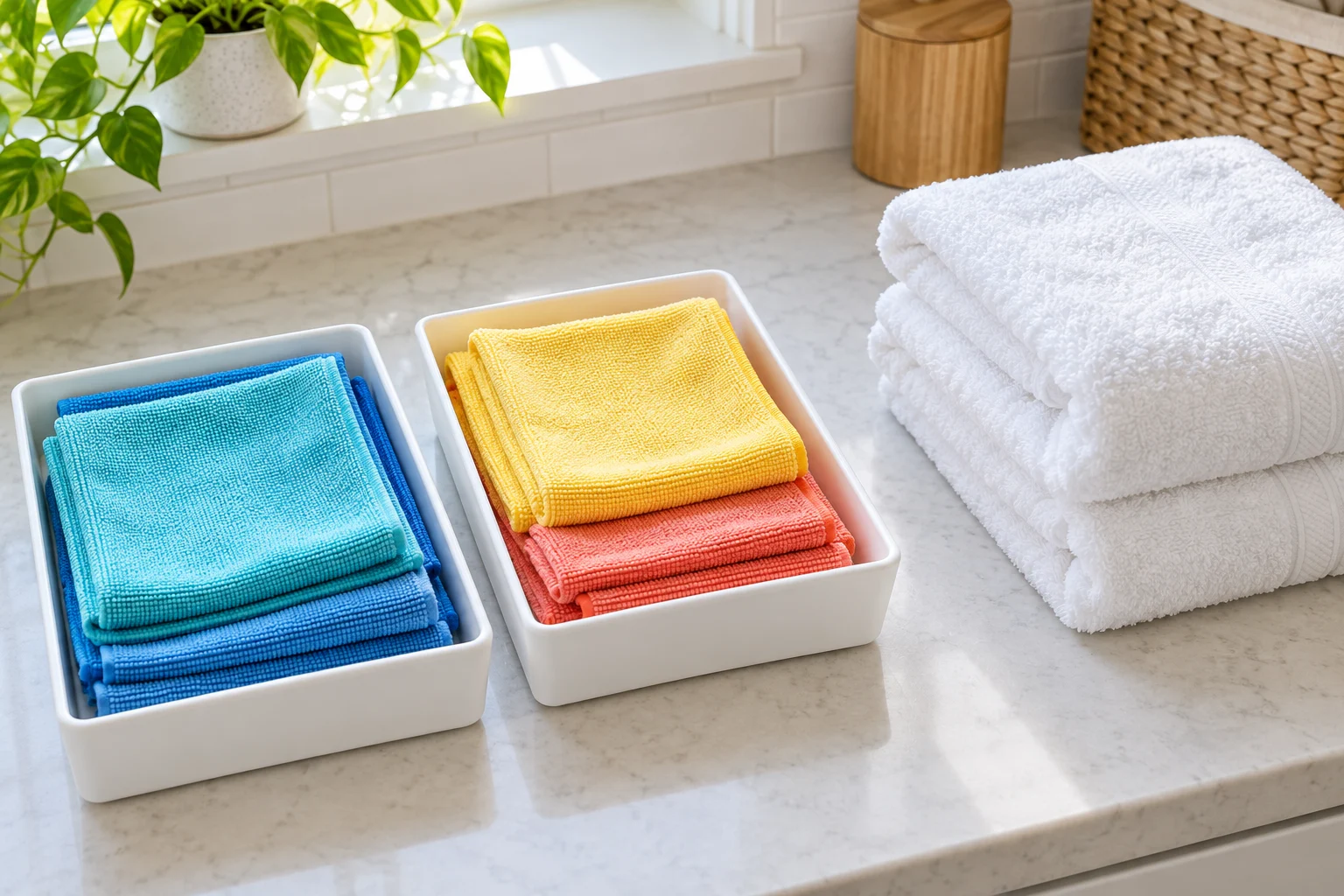
Within the washable group, sort by compatible care directions and job. Keep bathroom-use cloths identifiable instead of relying on memory after a busy cleaning session. Reserve another identifiable set for glass or finishing work. These are organizational choices, not a claim that a color system disinfects anything.
Choose a code that your household can actually remember. Blue for glass and green for general cleaning is one possible arrangement, but there is no universal household color standard you must follow. If you already own only one color, separate labeled storage containers can do the same organizational job. Do not buy replacements solely to create matching colors.
Discuss the system with anyone sharing the supplies. A neatly arranged cabinet does not help if one person treats every cloth as interchangeable. A short note inside the cabinet can name each group and say where used cloths go. Keep clean and used containers visibly different so that the next person does not have to investigate every folded square.
Can you wash microfiber with bath towels or clothing?
For a mixed collection of cleaning cloths, a separate compatible microfiber load is the conservative choice. The Rag Company’s care instructions specify non-linting wash companions and exclude cotton. That is a product-specific instruction worth checking, especially if the cloth will be used where stray fibers are noticeable.
Sorting only by light and dark colors misses this issue. A white bath towel and a pale polishing cloth may look like a reasonable color match, yet have different laundry roles. Likewise, a small cleaning cloth is not automatically a suitable addition to a clothing load just because there is room in the drum.
If your manufacturer explicitly permits other laundry companions, still consider the next task. A cloth used for a rough utility wipe has different finishing expectations from one used on a mirror. You can follow a permissive label while choosing a more selective load for the cloths that need to stay visibly lint-free.
Do not stretch a load by adding incompatible items merely to make it look full. Wait for enough compatible cloths when their condition allows, or use an appropriate small-load or hand-care option. The decision should balance a workable routine with the care requirements, not treat maximum basket volume as the only measure of efficiency.
Which detergent should you use, and how much?
Read both the cloth instructions and the detergent label. Avoid a detergent-and-softener combination when the cloth requires no fabric softener. E-Cloth explicitly makes that distinction in its washing guidance. A product can be sold as laundry detergent while also containing an additive your cloth’s instructions exclude.
Use the dose for the product, machine, load size, and soil conditions described on the label. The American Cleaning Institute notes that both excess detergent and too little detergent can leave laundry less clean than an appropriate dose. Its detergent guidance supports measuring rather than automatically filling the cap.
There is no useful universal teaspoon recommendation for every bottle and every washer. A small set of thin cloths is not equivalent to a full load of thick textiles, and different products have different directions. Keep the measuring tool that belongs with the detergent instead of substituting an unmarked cup and guessing.
Before starting, ask four questions: Does the cloth permit this product? Does the washer require a particular detergent type? Which marked amount fits this load? Where does the machine tell you to put it? Answering those questions is more useful than choosing a product because its name sounds specialized.
If your cloth maker calls for its own cleaner, distinguish a required instruction from a suggested product. Ask the manufacturer about alternatives when the wording is unclear. Do not assume that buying a dedicated microfiber wash will correct damage, an incompatible drying setting, or a cloth that still contains debris from an unsuitable task.
What temperature and cycle are appropriate?
Use the settings allowed for the exact cloth. A maximum temperature is an upper limit, not a requirement to use that setting every time. For example, Vileda’s Pro Clean product instructions permit washing up to 60 degrees Celsius and specify similar colors, no softener, and unfolded drying. That does not establish a universal temperature for every microfiber item.
Separate products when their instructions cannot be satisfied by the same cycle. If one item has a cooler limit and another needs a particular manufacturer-directed process, do not average the temperatures or assume a compromise will meet both requirements. Treat them as different care groups.
Read the machine’s cycle description instead of relying on the name alone. A setting called quick wash is not automatically the correct substitute for a normal cleaning cycle, and a setting called sanitize is not permission to exceed the cloth’s limits. The appliance manual and cloth instructions need to work together.
For repeat loads, record the compatible settings beside the cloth identification note. Keep the note specific enough to be useful: product, temperature option, cycle, and permitted drying method. Avoid a vague instruction such as wash hot, because another person may interpret that differently on a different machine.
How do you resolve conflicting care advice?
Check whether the advice actually describes the same product. E-Cloth allows other laundry companions in its general guidance, while The Rag Company calls for non-linting companions. Those statements are not a reason to ignore both manufacturers. They are a reason to keep each recommendation attached to the products it covers.
Use this order of questions when two instructions appear to disagree:
- Is the item identified? Match the label or model, not just the general material name. A recommendation for a dusting accessory may differ from one for a general cleaning cloth.
- Is the instruction current and specific? Prefer the product’s supplied directions and ask the maker to resolve a conflict with its website. Save the answer rather than silently choosing whichever method is easier.
- Does the machine support the process? A permitted cloth treatment still needs to be compatible with the appliance instructions. Do not translate a hand-care suggestion into a machine additive without checking.
- Are you comparing a limit with a routine? Up to a stated temperature describes a boundary. It is not necessarily the recommended setting for every soil level or every wash.
For example, imagine one package says air dry and another permits tumble drying. You may be able to wash them together if all wash requirements match, then separate them for drying. Alternatively, keeping the entire process separate may be easier for whoever handles the load. The important decision is made before washing, when you can still organize the handoff, rather than after an unidentified mixed pile comes out of the machine.
How do you machine-wash an ordinary household load?
Use this sequence for cloths whose instructions allow machine washing and whose soil belongs in ordinary household laundry. Stop before loading if you cannot identify what is on a cloth. This sequence is not a way to process solvent-soaked, fuel-contaminated, or otherwise hazardous cleaning materials.
- Identify the load. Set aside specialty pads and uncertain products. Check that the remaining cloths have compatible wash and dry instructions.
- Inspect each cloth. Unfold it and look at both sides. Remove ordinary loose debris that can be handled safely. Do not put a cloth with embedded sharp material into the load.
- Check the washer. Follow its loading instructions and look for items left from the previous load. Do not assume someone else has checked the drum.
- Measure the detergent. Use the relevant label directions and the correct dispenser or loading location. Leave prohibited additives out.
- Choose compatible settings. Confirm the temperature and cycle before pressing start. Do not carry over settings from a previous clothing load without checking.
- Inspect after washing. Separate anything that still has unresolved soil or an unexplained condition. Send only the appropriate cloths to the chosen drying method.
Arrange the steps so there is a clean destination ready before the cycle finishes. A clean basket and an open drying space make it easier to keep washed cloths separate from the ones waiting their turn. That small preparation avoids the common organizational problem of returning everything to the same undifferentiated pile.
When someone else takes over halfway through, leave the drying instructions with the load. Knowing that the wash is finished is not the same as knowing which dryer setting is permitted. A clear handoff is particularly useful for households where one person starts the washer and another puts laundry away.
When does hand washing make sense?
Hand care can be a practical option for a few lightly used cloths when the product permits it. Whirlpool describes hand washing for lightly soiled dusting cloths. Do not treat that narrow example as an adequate process for every cleaning task or as a substitute for a required machine-wash routine.
Choose a container you can use and clean appropriately. Check the cloth instructions for water temperature and whether detergent is part of the permitted method. Keep the task separate from food preparation. Have a place ready to drain and dry the cloths rather than improvising once everything is wet.
Work with the cloth opened out so you can inspect its surface. Follow any product-specific soaking or handling directions rather than extending the process indefinitely. After rinsing as directed, assess the cloth before putting it back into service. If the soil remains unresolved, move to the manufacturer’s recommended cleaning process.
The tradeoff is attention: hand washing a few suitable cloths may be convenient, but handling a large mixed collection individually can make sorting and consistency harder. Choose the method because it fits the product and the work, not because hand washing sounds automatically gentler or more thorough.
How should you dry and store the cloths?
Dry according to the product instructions. The Rag Company permits low heat, no heat, or hanging for its microfiber towels and prohibits ironing. Do not turn that into permission for a higher dryer setting simply because the cloth feels damp when you are ready to leave.
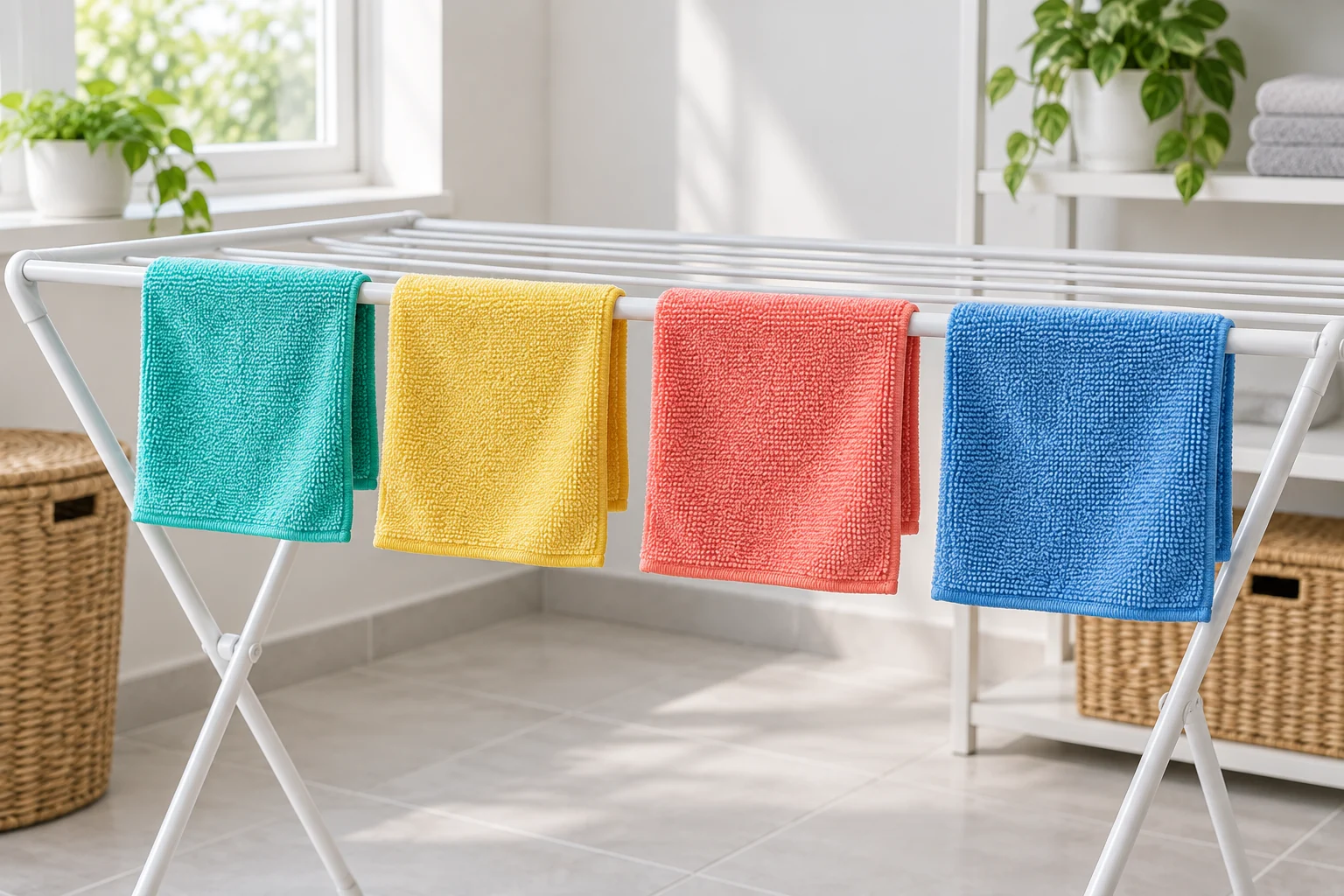
For air drying, use a clean support and open the cloths rather than leaving them in a compressed pile. Vileda’s Pro Clean directions specifically call for unfolded drying. Choose a location where the cloths can remain separate from the used collection and will not be mistaken for ready-to-use supplies before they are dry.
Make a complete-drying check part of putting them away. The CDC’s household laundry guidance calls for detergent, the recommended temperature, and complete drying. Fold and store only after that step, rather than using a closed storage bin as a place to finish drying.
Keep your storage arrangement simple. Put the ready cloths in their assigned clean space and keep the needs-attention group elsewhere. If you use a container with a lid, make sure its role is clean storage, not temporary storage for damp used cloths. Clean the container appropriately when it needs it.
A small rotation can make this easier: one group in use, another being washed or dried, and a clean reserve. The number you need depends on your actual tasks. Start by noticing when you run out, rather than buying a large collection that makes the storage system harder to manage.
What should you do after accidental fabric softener use?
First identify what was added and which cloths were affected. E-Cloth advises rewashing its products after accidental fabric softener or dryer-sheet use. That gives a defensible starting point for those products, but it is not a guarantee that every unknown cloth can be restored by the same treatment.
Set the affected group aside and read its recovery instructions. Record the detergent or softener involved, whether the cloth was tumble dried, and whether the problem appeared immediately afterward. These details make a manufacturer-support question much more useful than simply saying the cloth no longer works.
Do not stack several internet remedies into one recovery attempt. A rewash, a soak, a boil, and a chemical additive are different interventions, with different compatibility questions. Trying all of them at once makes it harder to tell what happened and may exceed the product instructions.
After a permitted recovery wash and drying, inspect the cloth before assigning it to a demanding finishing task. If it remains unsuitable, ask the maker about the next step or retire it from that task. Keep the decision proportionate to the cloth’s intended use rather than repeatedly escalating heat or chemistry.
Why is a washed cloth still leaving lint, streaks, or residue?
What if you can see lint?
Review the load history before changing detergent. Was the cloth mixed with a shedding towel, stored against fuzzy fabric, or placed in a basket containing loose fibers? Those are different points in the workflow. Fixing only the wash step will not address a storage mistake that happens afterward.
Inspect the cloth in good light. If loose visible lint can be removed using a method the manufacturer permits, do that before deciding the fabric is ruined. Avoid aggressive scraping or treating a delicate finishing cloth like a scrub pad. Set it aside from glass work until its condition is appropriate.
What if the cloth leaves a smear?
Do not assume the cloth is the only variable. Consider the surface-cleaner instructions, how much product was used, and whether a finishing step was required. Compare the task with a known-clean cloth used according to the surface manufacturer’s directions. This is a practical troubleshooting check, not a laboratory performance test.
Change one part of the routine at a time. For example, correct the detergent dose on the next compatible wash without also switching every cleaner and cycle. Keeping a simple record of the change can help you decide whether the problem follows the cloth or the way the surface is being cleaned.
What if there is an odor or a greasy feel?
Do not put the cloth back in the clean group while the issue is unresolved. Recheck what it cleaned, the product’s washing directions, and the handling between use and laundering. An odor does not identify a particular microorganism, and the absence of an odor does not prove disinfection.
Use a recovery process only when the manufacturer permits it for that product and soil. If you cannot identify the contamination, stop and get appropriate advice. A household guide cannot determine whether an unknown substance is safe for your washer, dryer, skin, or next cleaning surface.
When should you replace or reassign a cloth?
Assess function and condition, not just age. Look for torn edges, loose material, embedded debris, or changes that make the cloth unsuitable for its intended job. A calendar alone cannot account for the difference between occasional dusting and frequent demanding cleaning.
A cosmetic mark is not automatically a reason to discard a cloth, but do not confuse a stain with unresolved soil. Consider whether the mark is stable after the permitted care process and whether the cloth performs appropriately. When uncertain, ask the manufacturer rather than declaring it clean based only on its appearance.
Reassignment is a deliberate choice, not a way to hide a problem. A clean cloth no longer suitable for a lint-sensitive finishing task might have another appropriate use, provided it has no hazardous contamination or damaging debris. Label or store it differently so it does not drift back into the original group.
Retire a cloth when you cannot establish a safe, suitable next use or when the maker’s advice is to replace it. Keep unknown chemical contamination out of a casual reuse system. Saving a small cleaning accessory is not worth risking a surface or mixing an uncertain material into other laundry.
How often should you wash microfiber cleaning cloths?
Base the schedule on the product and the task, not a single rule for every cloth in the house. Manufacturer guidance varies by product and use. A cloth that has just performed a messy cleanup should not be managed as though it only made a light finishing pass on an already-clean surface.
Use a task-based handoff: after cleaning, decide whether the cloth goes to the permitted between-use care routine, the laundry group, or needs-attention storage. Make that decision while you still remember what it touched. Waiting until the next laundry day can leave you guessing about several identical cloths.
For a predictable routine, list the cleaning jobs you actually do in a week and identify where each used cloth goes. You do not need a detailed household spreadsheet. A few task names beside the storage area can reveal whether you need more clean cloths available or simply a clearer wash-and-dry sequence.
If your routine repeatedly leaves you without a ready cloth, adjust the rotation or laundry timing. Do not solve the shortage by quietly returning used cloths to the clean stack. The practical objective is knowing which tool is ready, not meeting an arbitrary number of uses before laundering.
Does washing microfiber mean it has been disinfected?
No household washing instruction in this guide is a promise of sterilization or validated disinfection. The CDC distinguishes cleaning from sanitizing and disinfecting. A cloth that looks clean is not a measurement of germ reduction, and a microfiber label does not establish a healthcare cleaning protocol.
For situations requiring disinfection, follow the relevant public-health, product, and setting-specific directions. Do not invent a stronger laundry process by combining chemicals. The CDC warns against mixing bleach or disinfectants with other cleaners. This guide deliberately provides no homemade disinfecting mixture.
That distinction matters when asking for help. Say what the cloth was used for and what standard the next use requires. Routine household laundering, a delicate screen-cleaning accessory, and a regulated workplace cleaning tool are different questions. The word microfiber does not make one answer appropriate for all three.
What does a workable routine look like in different households?
A few cloths used for ordinary dusting
Consider a household with several labeled cloths used only for light dusting. The main decisions are whether the product permits hand care and where it will dry. A small, clearly separated routine may be simpler than adding those cloths to unrelated clothing. This is an example arrangement, not an observed customer result.
A larger weekly cleaning session
Suppose several people clean different rooms on the same day. Start with assigned cloth groups and separate collection points. Before washing, one person checks product compatibility and unresolved soil. Another person can handle drying if the instructions stay with the load. The benefit of this arrangement is clarity about responsibility, not a promised time saving.
A mixed drawer with no remembered instructions
Sort by identifiable product first, not by an imagined universal temperature. Photograph recognizable labels, look up known purchases, and set uncertain pieces apart. Rebuilding the care information may be more useful than buying another additive. Keep future packaging details so the same uncertainty does not recur with the next set.
Cleaning cloths plus a household laundry backlog
Treat those as two planning tasks. Decide how the cleaning cloths need to be handled, then organize the ordinary clothing and linens separately. Combining everything into one bag may simplify transport, but it removes the distinctions that whoever handles the laundry needs to know.
What should you compare before buying replacement cloths?
Compare the care requirements before comparing package size. A cloth that needs a separate process you cannot realistically maintain may be a poor fit, even if its purchase price looks attractive. Check whether its washing directions fit your available machine settings and whether its drying directions fit the space and time you actually have.
Look for accessible product instructions, not just a broad promise that the cloth is reusable. Can you identify the exact model later? Are restrictions explained clearly? Does the seller distinguish a general cleaning cloth from a specialty polishing accessory? Those questions help you build a collection with fewer unknowns.
Think about replacement in small groups. If your existing glass cloths still meet their purpose but the general cleaning group needs replacement, there is no organizational reason to start over. Keep the useful group and choose replacements that can be identified easily. Record their instructions before combining them with older supplies.
A useful comparison note has four lines: intended task, care requirements, storage group, and any unresolved question for the maker. It need not include a speculative lifespan, a claimed number of washes, or a promised reduction in cleaning time. Choose based on the information available for the actual product rather than treating marketing claims as evidence about your household’s results.
Can Fresh Spin help with the rest of your laundry?
Fresh Spin offers drop-off wash-dry-fold for customers who want help with laundry. For service, enter through the Ash Entrance and place your order in the mini-mart. Keep specialty cleaning cloths separate and explain what they have been used for before requesting service.
This article does not establish that Fresh Spin accepts every microfiber cloth, cleaning chemical, or specialized care requirement. Contact Fresh Spin to confirm whether your particular items and instructions can be accommodated. Bring or send the product directions instead of asking staff to infer them from the fabric’s appearance.
Separating questions before the visit makes the request clearer: which items are ordinary laundry, which need a specific process, and which should not enter a general laundry load. You can get help with a clothing backlog without treating uncertain cleaning materials as part of that same request.
What are the answers to common microfiber laundry questions?
Should I wash a new cloth before using it?
Check the product instructions. Both E-Cloth and The Rag Company advise washing new products before first use. Keep the packaging until you have recorded the care directions and any first-wash color guidance.
Can I boil any microfiber cloth to restore it?
No. A recovery method described for a named product is not permission to apply it to unknown cloths, pads, backing materials, or contamination. Use only the method authorized for your exact item; this guide does not recommend a general boiling process.
Does a hotter wash always solve a problem?
No. First identify whether the issue is soil, lint, an incompatible product, storage, or physical condition. A higher temperature does not answer all of those questions, and it must never override the cloth’s care limit.
Can I wash every color together?
Follow the color-separation and first-wash instructions for the products you own. A collection of similar-looking squares is not necessarily a single product batch. Keep unfamiliar new cloths out of an established load until their directions are clear.
Do I need to replace my whole collection at once?
Not simply because one cloth has a problem. Identify the affected items, investigate the cause, and assess each appropriate care group. A sorting or storage correction may be the relevant action; replacement is a condition-based decision.
What information should I give the manufacturer?
Provide the product name, label photograph, cleaning task, products used, wash settings, drying method, and the observed problem. Include whether the issue affects one cloth or the whole group. That gives support a specific situation to assess.
What is the simplest checklist to keep?
Keep six prompts beside the supplies: identify the product, separate the task groups, check the detergent, confirm wash and dry settings, inspect the result, and return only ready cloths to clean storage. The checklist supports your product instructions; it does not replace them.


Leave A Comment