
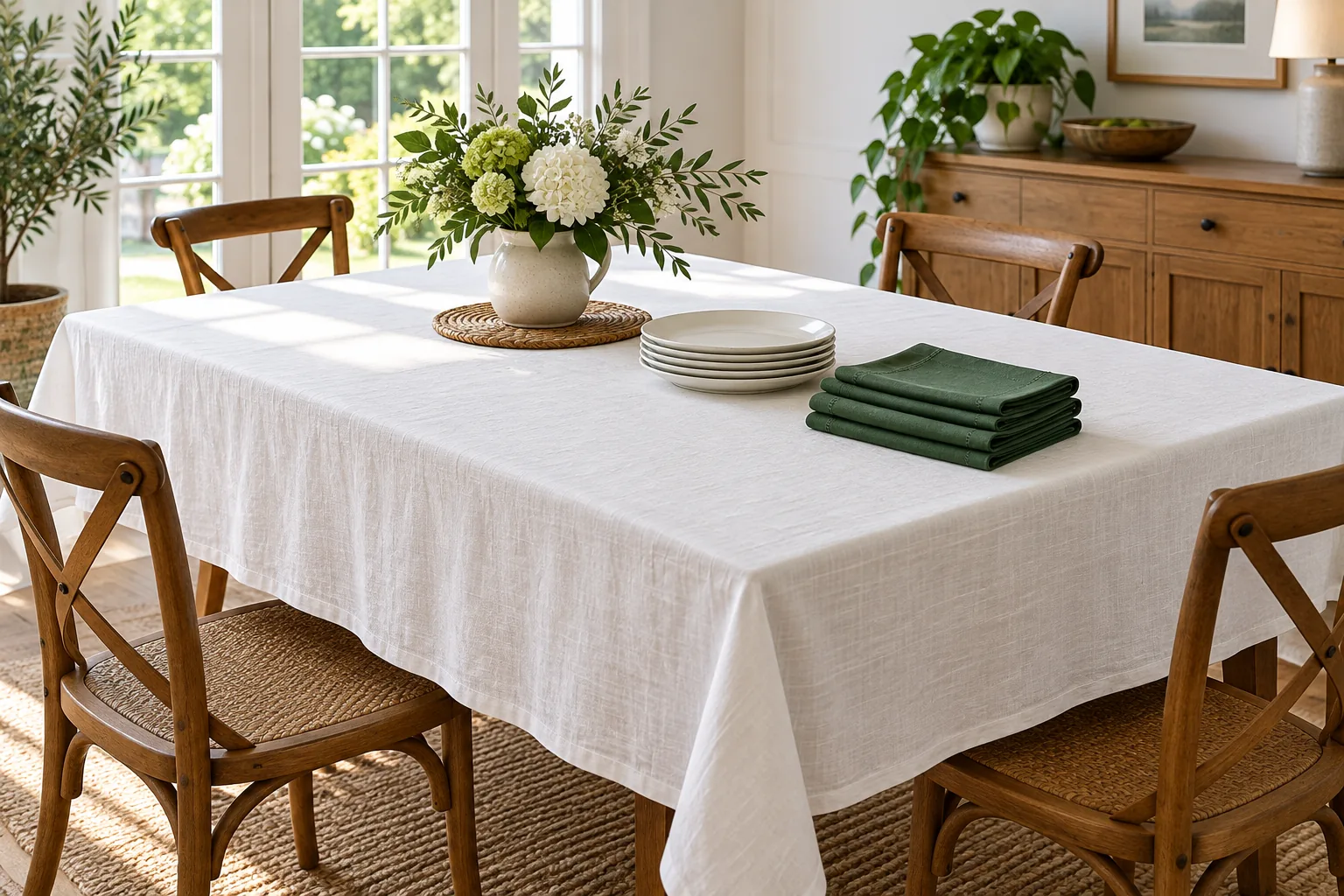
Wash tablecloths and cloth napkins according to the care instructions for each piece, not a single setting for everything called table linen. Separate washable everyday pieces from coated cloths, delicate decorations, and heirlooms. Remove loose food, identify stains before treating them, choose compatible detergent and machine settings, and inspect before drying or ironing. Store the pieces only when completely dry. A matching appearance does not guarantee matching care requirements.
This guide is for household tablecloths, fabric napkins, and similar unpadded table textiles. It does not provide a food-service sanitizing protocol or instructions for conserving historic textiles. It also does not turn a wipe-clean coating, a hand-wash label, or an unknown antique into a machine-washable item. The useful starting point is a decision: which pieces can follow an ordinary laundry route, and which need a different plan?
What should you check before washing table linens?
Spread each piece on a clean surface with enough room to see its edges. Look for a sewn label, a printed care instruction, or the manufacturer’s product page. Record the fiber content separately from the care instructions. Cotton describes a fiber; it does not tell you everything about a colored border, a coating, embroidery, or the construction of the finished tablecloth. A product name and a clear photograph of the label are more useful than guessing from how the fabric feels.
Check the whole piece, including the underside. Look for loose threads, open hems, worn folds, attached beads, metallic trim, and patches of coating that are peeling or sticky. Do not pull at damage to test its strength. A tear you notice before washing is a reason to reassess handling, not a reason to select a more intensive cycle. Photograph a pre-existing defect if you will ask a cleaner or the manufacturer for advice.
Next, read the washing, bleaching, drying, and ironing instructions as separate decisions. Permission to machine wash does not automatically permit tumble drying, and permission to iron does not identify the correct side or temperature. Matouk directs customers to the care label and individual product page because instructions vary by item. Use the same product-specific approach when your set comes from another maker.
If you cannot find the instructions, pause before applying a treatment. Ask the maker using photographs, approximate purchase date, and any identifying information. For an unbranded or inherited piece, explain that the material and finish are unknown. Being unsure is a valid category in your sorting plan; it should not become an automatic cold delicate load.
How do you separate everyday, coated, and heirloom pieces?
Make three working groups before deciding on loads. The first contains intact everyday pieces with clear washing instructions. The second contains pieces with special finishes or construction, such as coated tablecloths, embroidered napkins, and lined runners. The third contains valuable, fragile, historic, or unidentified textiles. These groups describe what you know about the items; they are not three predetermined washer cycles.
For the first group, compare actual instructions and sort compatible pieces together. For the second, look up the specific finish or design before proceeding. A water-repellent surface and an ordinary woven cotton surface can look similar in a photograph while needing different treatment. Do not assume that a decorative placemat can be processed like a napkin merely because both sit beside the same plate.
The third group may need a textile conservator or a cleaner experienced with that particular material. The Canadian Conservation Institute explains that cleaning historic textiles is irreversible and identifies fragile and composite materials that should not be washed. That conservation guidance is a reason to stop experimenting with an heirloom, not a set of household restoration instructions.
Consider use as well as value. You may decide that a fragile inherited cloth is for display while a washable replacement handles meals. That is a practical choice, not a failure to get the original perfectly white. Keep any history, maker information, and earlier cleaning records with the item. Those details help a specialist assess it without having to reconstruct what happened after an unsuccessful home treatment.
What should you do immediately after a meal?
Clear the table in a deliberate order. Remove plates, cutlery, napkin rings, clips, and decorations before gathering the fabric. Check folded napkins for food and small objects. Carry the tablecloth so loose crumbs stay contained, then remove loose debris over a suitable collection area. Do not drag the cloth across a rough edge or use it as a bag for the entire table setting.
Separate the pieces with spills from the rest and identify the source while it is still easy to remember. A short note such as coffee with cream, tomato sauce, or candle wax is more useful than simply marking an item dirty. Record any product already applied by a guest. Do not add another treatment until you know what is on the fabric and whether the next product allows that sequence.
Deal with the piece according to its care route. A coated surface may call for wiping rather than laundering. A washable napkin may permit a compatible pretreatment. An unidentified embroidered cloth may call for advice before either. Prompt attention means making that decision promptly; it does not mean pouring the nearest cleaner onto every mark.
If laundry must wait, do not apply a product whose instructions require washing it out before you will be able to do so. Keep the item identifiable and separate from clean storage. Plan enough time to complete the treatment you choose, including its rinse or wash stage. This prevents a short after-dinner task from becoming an unattended overnight chemical soak.
Which stains need different decisions?
Use the spill’s source to choose an appropriate manufacturer’s method rather than assembling a general stain cocktail. A greasy gravy mark, a wine spill, and transferred fabric dye are not the same problem. Their treatment also depends on the tablecloth: an instruction suitable for plain washable fabric may be unsuitable for a coating or colored stitching.
For example, Clorox’s gravy guidance starts with removing excess gravy and describes a particular product-based treatment. Treat that as an example of a complete method to assess against your item’s restrictions, not permission to use that product on every table textile. Check the current bottle for compatibility, contact time, and washing directions before starting.
For several stained tablecloths, keep a simple stain list by item so one piece is not forgotten. Clorox’s tablecloth guidance includes a rinse stage for pretreatment residues. The important planning point is to distinguish pretreating from machine washing and not carry an improvised quantity of spotting product into the wash.
Do not use the iron to disguise a stain or make the item look ready before inspecting it. Wax, old yellowing, and an unknown mark deserve particular caution because a confident-looking home recipe may not fit the finish. For broader stain categories, consult the stain-removal guide, while keeping the actual textile and product instructions in control.
How should you sort a matching tablecloth and napkin set?
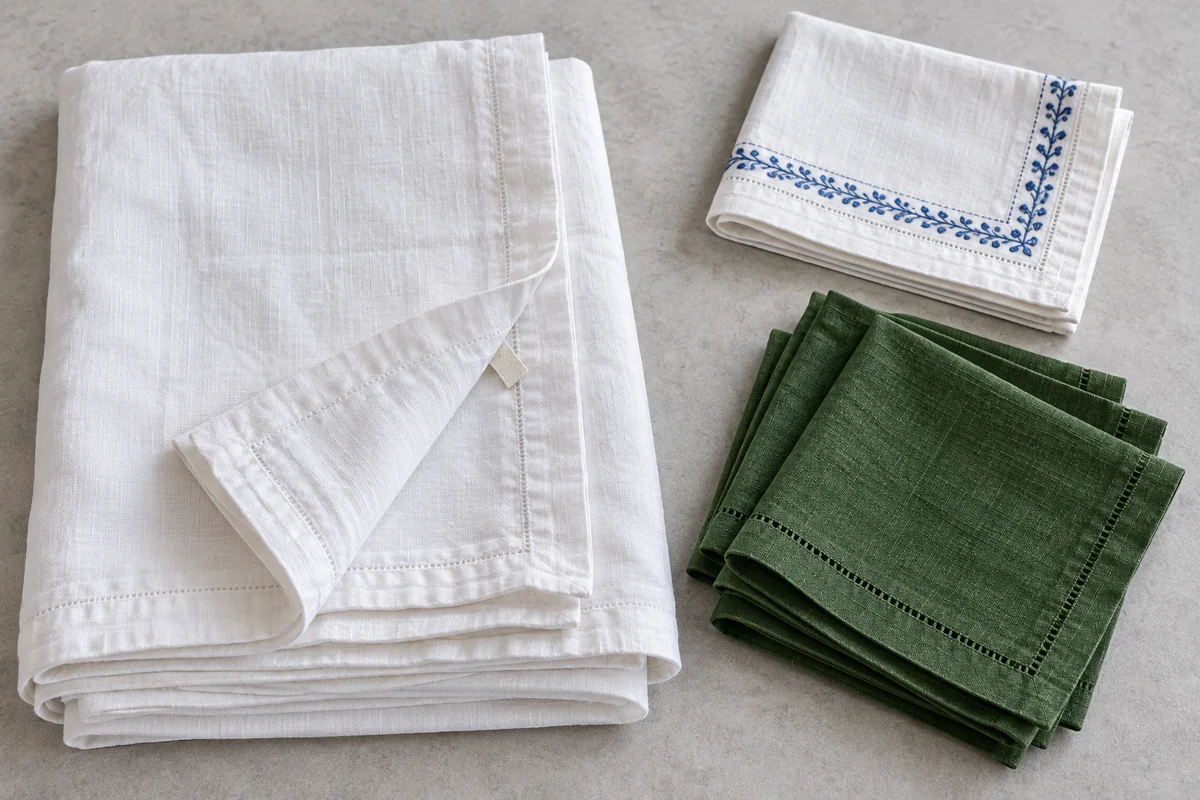
Start with care compatibility, then color, condition, and soil. A matching tablecloth and eight napkins might belong together, but a stained napkin that needs a separate permitted treatment should be handled before you assemble the load. A white cloth with a deep-colored embroidered border is not equivalent to an undecorated white cloth for every product choice.
Build a small load list: item name, number of pieces, required wash route, drying route, and any unresolved stain. This need not become a permanent spreadsheet. A note beside the laundry basket is enough to prevent a hand-wash runner from joining machine-washable napkins or a hang-dry cloth from moving automatically into a dryer with the rest.
Keep fine table fabrics away from unrelated items with hard fasteners or rough surfaces. SFERRA’s linen-care guidance advises separating fine linens from items such as denim and hardware that can damage them. It also recommends processing matching table pieces together for consistent wear. Neither suggestion overrides different labels, an unsuitable load size, or a piece needing special attention.
Count the napkins before loading and again when putting the set away. A missing napkin is easier to locate while baskets are still separate than just before guests arrive. If the set must be split into compatible batches, keep the batches identified. This is especially useful when several similar white sets have different borders or different finishing requirements.
What detergent and additives should you choose?
Choose a laundry detergent compatible with the textile and the washer, and measure it using the product’s instructions for the load and soil level. A small napkin load should not inherit a dose selected for a large unrelated wash. If the machine requires high-efficiency detergent, use an appropriate product rather than trying to compensate for an unsuitable formula with a smaller amount.
Whirlpool’s laundry instructions emphasize care tags, sorting, and product directions. Use those sources of information together. The detergent bottle describes use of that product; the textile label may prohibit an ingredient or process that the detergent maker permits for other fabrics. If the two do not agree, select a compatible alternative instead of inventing a compromise.
Bleach, oxygen products, fabric softener, and finishing aids are optional decisions, not requirements for making a table look clean. A white background does not prove that colored thread or a surface finish is bleach-safe. Some table-linen manufacturers explicitly prohibit whitening products or softeners for their own pieces. Read those restrictions before treating a persistent mark as evidence that the load needs more additives.
Do not combine cleaning products into a homemade spot-treatment mixture. CCOHS warns against mixing cleaning products, including bleach with acids or ammonia. Keep original containers available so you can follow their directions and identify an earlier treatment accurately. A kitchen sink full of unidentified products is not a substitute for a suitable laundry method.
How do you choose the wash cycle and temperature?
Read the care requirements for all pieces in the proposed load before selecting a program. The right choice must accommodate the most restrictive compatible item, but that does not mean every incompatible item can simply be included on a gentler setting. A wipe-clean surface or a dry-clean instruction is not converted into machine-wash permission by selecting delicate.
Cycle names are not universal specifications. Read the washer’s description of agitation, spin, and available temperature options. Whirlpool’s cycle guide describes why settings differ by fabric and load. Consult the manual for the machine you are actually using rather than translating a program name from someone else’s appliance.
For a new set, note the label-approved cycle and drying route after the first successful wash. That record makes the next wash easier without replacing the label. If a later load includes a different cloth or different soil, review the decision rather than automatically repeating the saved program.
When a stain method specifies a rinse or soak temperature, keep that instruction attached to that step. Do not assume it also specifies the wash cycle, and do not exceed the item’s maximum permitted temperature to chase a stain. If a product requires conditions the textile cannot tolerate, it is the method that needs changing, not the textile’s limits.
How should you load a large tablecloth?
Unfold the cloth and check that the load can move as the machine manufacturer intends. A large rectangle folded into a dense bundle is not ready to wash just because the door closes. Check the machine’s loading guidance and limits for the selected program, which may differ from its advertised maximum capacity. Do not estimate a safe load from the number of dinner guests the cloth serves.
Garnier-Thiebaut’s wash-and-care instructions tell users to unfold linens and avoid overloading the washer or dryer. Apply the practical point without borrowing its product-specific temperatures for a different brand. If there is not appropriate space, split compatible pieces or choose another suitable washing arrangement.
Keep small pieces accounted for. Napkins caught inside the folds of a larger cloth are easy to overlook during transfer. Before drying, separate the pieces and compare the count with your starting list. Look at hems and borders while the fabric is accessible rather than discovering tangled or damaged items after everything has been folded.
If the washer signals an imbalance or another fault, follow its instructions. Do not defeat a lock or repeatedly restart a troubled cycle without addressing the cause. The appliance manual is the appropriate source for redistribution and load limits. A tablecloth’s size does not justify bypassing a machine safeguard.
What changes for coated or stain-resistant tablecloths?
Identify the finish by its product information, not by a water-beading experiment. Different finishes have different care instructions, and a cloth sold as easy care may still have restrictions on soap, softener, drying, or pressing. Keep the care card when purchasing such a piece, or save the exact product page with the receipt.
Garnier-Thiebaut provides a useful example of why the distinction matters: its coated cotton instructions call for routine wiping with a damp sponge and water, with separate occasional washing directions. Its Green Sweet range has another care route. Those branded methods are not interchangeable, and neither should be generalized to vinyl, laminated cloth, or an unidentified finish.
Before treating a spot, ask whether the manufacturer’s routine-cleaning method has been followed and whether it permits a stain remover. Do not scrub a surface merely because a stain is still visible. If the coating is damaged, changing detergent may not address the problem. Contact the maker with photographs and explain what has already been applied.
Keep these pieces out of a mixed table-linen load until their requirements are clear. An ordinary cotton napkin may allow tumble drying while the tablecloth does not. Write the drying distinction on your temporary load note so it survives the transfer from washer to dryer. The moment of transfer is where an otherwise correct wash can become an unsuitable finishing process.
What about embroidery, lace, and decorative borders?
Inspect the decoration separately from the base cloth. Thread colors, attached details, and openwork may introduce restrictions that the plain fabric would not have. A label describing the finished product is more useful than a general cotton or linen temperature chart. Do not choose bleach solely from the color of the largest area.
Keep the preparation proportional to what you know. For a modern piece explicitly approved for machine washing, follow any manufacturer instruction about a protective bag or similar handling. That protection does not make an otherwise unsuitable piece washable. If the label says hand wash, do not assume a machine’s hand-wash-named cycle is an equivalent process.
For valuable or historic decoration, stop short of testing a series of chemicals at home. The Canadian Conservation Institute’s basic textile guidance distinguishes conservation cleaning from ordinary household laundry. An old textile can require more cautious handling than its familiar appearance suggests.
When requesting advice, send a photograph of the entire piece and close views of the border, reverse, label, and damaged area. Say whether the textile is intended for continued table use or preservation. Those are different goals. A suitable recommendation should consider the item’s condition and intended use, rather than promise that all discoloration can be removed.
How do you inspect before drying?
Make inspection a separate step rather than moving the entire wet load into the dryer automatically. Open each piece and look at the known stain locations under useful light. Check both sides where possible. Compare with the notes you made after the meal, because a folded hem or a patterned area can hide a remaining mark.
If a stain remains, pause the affected piece’s finishing process. Decide whether the original method allows another treatment, whether the fabric has changed, and whether you need advice. A lighter stain is not automatic permission to increase concentration, soaking time, or temperature. Follow the product’s limits and stop if treatment changes color or texture.
Keep completed and unresolved pieces separate. A clean napkin can proceed on its permitted drying route while a stained one waits for a decision. Mark the count on your list so the household does not accidentally set out a partial matching set. You do not need to hold the entire set indefinitely while one piece is being assessed.
Be especially careful after a guest or another household member has used an unknown solvent. GE Appliances warns against washing or drying items treated with combustible or explosive substances. A stain looking smaller, or a fabric feeling dry, is not a clearance to put chemical-contaminated material into an appliance. Obtain product- and equipment-specific guidance first.
How can you dry and finish the pieces without rushing?
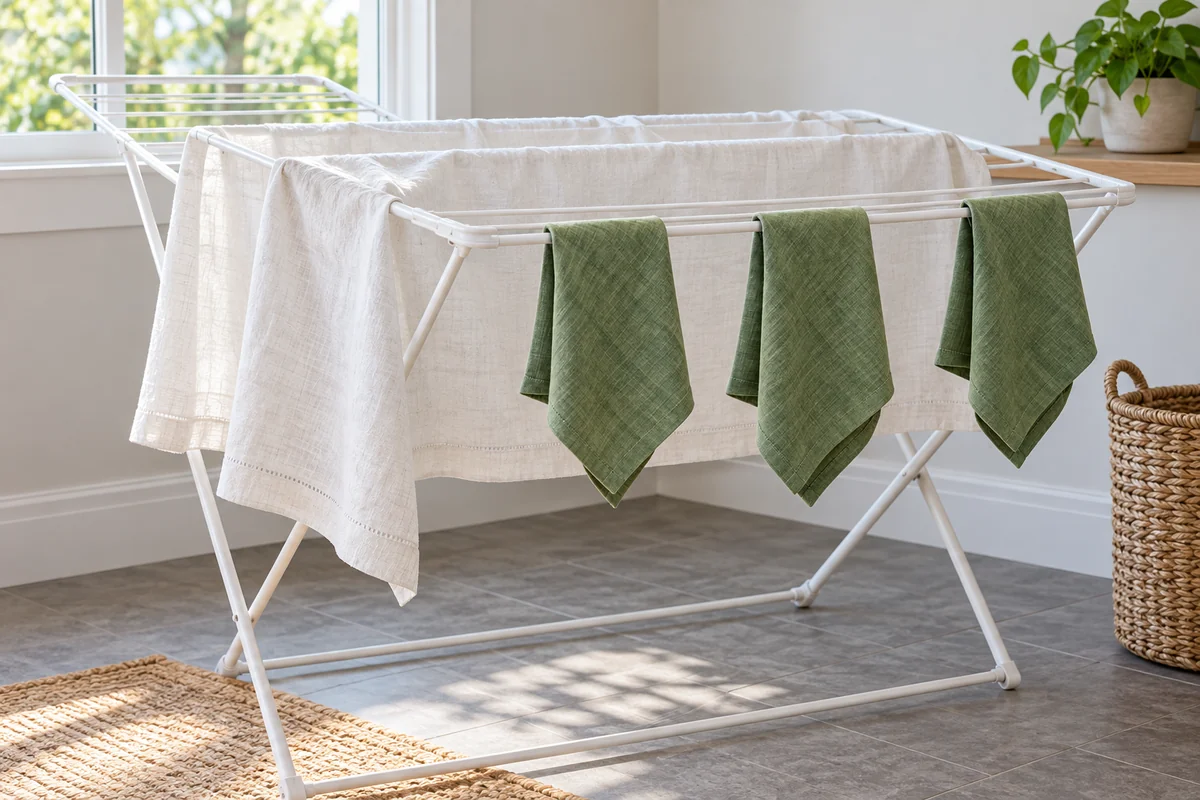
Separate the load by drying instructions before switching on a dryer. Set aside hang-dry pieces and items that still need stain assessment. For tumble-dry-permitted items, choose the authorized setting and leave the space required by the appliance instructions. Do not use extra heat simply to get a large cloth ready before dinner.
Plan the handoff from drying to finishing. If the manufacturer directs removal while slightly damp for ironing, have a clean finishing space ready. If you are not going to iron, complete the permitted drying process before storage. Slightly damp for immediate finishing is not the same as ready for a closed drawer.
A flat tablecloth and a relaxed linen texture are different presentation choices. Decide what the event actually needs before committing to ironing every piece. An everyday meal may not require a formal finish. For a celebration, complete any allowed pressing ahead of setup so hot equipment and long lengths of fabric are not competing with food preparation.
Set aside enough supported space for the finished cloth. Do not let its newly cleaned length collect debris from the floor while you work on the next section. Keep unprocessed, drying, and finished pieces in clearly separate places. This simple separation prevents confusion without requiring a dedicated laundry room or an elaborate organizing system.
How should you iron a tablecloth or cloth napkin?
First confirm that ironing is permitted, the correct temperature, and whether the maker specifies the reverse side or a pressing cloth. Inspect the item for remaining stains before applying heat. Do not treat a hot iron as a cleaning tool. Decorative surfaces and coatings may have specific restrictions that ordinary woven fabric does not.
Check the iron before using it on the set. Follow its manual for water, cleaning, and safe placement. Rowenta’s care instructions describe model-dependent maintenance and warn against abrasive cleaning accessories. Do not transfer an online descaling recipe to an appliance whose manufacturer prohibits it. Resolve a dirty or leaking iron before working on the tablecloth.
Arrange the work so the fabric is supported and you can move one section at a time. Keep the cord and hot soleplate away from loose folds and other people. Put the iron in its prescribed resting position when adjusting the cloth. Do not leave it face down while searching for another napkin or answering a message.
Let the finished item cool and ensure it is dry before packing it away. If wrinkles remain, decide whether they matter for the intended use before repeating heat treatment. A neatly laid out, care-compliant cloth is a better result than damage incurred while pursuing an unnecessary perfectly flat finish.
How should you store a complete set?
Use storage that is clean, dry, and suitable for the item, and keep the pieces identifiable as a set. Check seams and folded layers for retained moisture before closing a drawer or container. Do not pack away a slightly damp stack merely because its outer napkin feels dry. Finish drying first.
For ordinary household sets, record the piece count and size where you can see them without unfolding everything. A note such as one rectangular cloth and eight napkins makes event planning easier. Keep care instructions with the set, especially when several similar cloths have different coatings or finishing requirements.
For valuable textiles, storage materials and support deserve specialist attention. Winterthur’s textile conservation guidance discusses protective handling and storage for collections. Do not improvise an archival solution from ordinary packaging based only on its clean appearance. Ask for advice appropriate to the textile, its condition, and available storage space.
Separate a piece awaiting repair or further stain advice from ready-to-use linens. Include a brief note explaining why it is set aside and what was last done. This avoids an unfinished item being used for the next meal or treated again by someone unaware of its history. Review the set before the next occasion rather than during table setup.
What should you arrange before the next gathering?
Count usable pieces and check the tablecloth’s fit before selecting the final table setting. Do not rely on a nominal package size if you need a precise drop. Lay out the actual cleaned cloth and decide whether it fits the table and seating arrangement as intended. If the set is incomplete, plan an intentional alternative rather than rushing an unsuitable treatment on the missing piece.
Choose linens whose care requirements fit the time and equipment you will have afterward. That might mean using an everyday washable set instead of an embroidered heirloom for a busy meal. The decision is about your routine, not a claim that one fabric is universally better. Check the label before buying a replacement, not only after the first spill.
Plan a place for used linens and a short note-taking method for spills. Keep treatment products in their labeled containers away from food preparation. Decide who will handle washing so guests and household members do not each apply a different remedy. One identified method is easier to assess than a chain of undocumented treatments.
If using a laundry provider, ask about the actual items before leaving them. Bring the labels and identify coatings, decoration, stains, and prior treatments. Confirm acceptance, finishing expectations, charges, and the collection arrangement for the order. Do not infer specialist table-linen restoration or pressing from a general laundry service description.
For a shared household, a useful handoff note has four parts: the pieces being handled, the instructions already checked, any treatment already applied, and the next action still needed. For example, identify which napkin has a sauce stain instead of leaving a message that the whole basket needs attention. Name the exact product if one was used, rather than writing stain remover. Also say whether any pieces must stay out of the dryer. Keep that note with the work until the set is finished, then retain only the care information you will need next time. This prevents duplicated treatment and makes an interrupted laundry task easier to resume accurately.
Can Fresh Spin help with the laundry decision?
Fresh Spin offers in-store drop-off wash-dry-fold. Enter through the Ash entrance and place your order in the mini-mart. Before bringing special-care table linens, ask whether the specific items can be accepted and explain their labels, finishes, stains, and previous treatments. A general service listing is not confirmation that a coated cloth or heirloom can be processed.
For self-service planning, review the self-serve laundromat page and match your item’s care requirements to a suitable process. Do not assume that a larger machine changes what a textile permits. Use the contact and directions page for questions before traveling with an unusual item. Confirm the service and charge for your order rather than relying on an article to quote a price or promise a completion time.
What are the answers to common table-linen questions?
Can all white napkins be bleached?
No. White appearance does not identify fiber, finish, trim, or product compatibility. Read the finished item’s instructions and the proposed bleach product’s restrictions. If either prohibits the treatment, do not use it. A white cloth with colored decoration needs attention to the decoration too.
Should a brand-new tablecloth be washed before use?
Check its maker’s instructions. Some ordinary table linens require a first wash, while certain treated products do not. Keep the product identity clear so a general recommendation does not override a finish-specific instruction. Allow time for any required washing and drying before the occasion.
Can tablecloths and towels share a load?
Only assemble a load after comparing the items’ care requirements and the washer’s guidance. Fine table linens may need separation from rougher laundry. Convenience alone is not a good reason to combine an embellished cloth with unrelated items. Separate the load when compatibility is uncertain.
Is hand washing always safer for an antique?
No. An antique can be unsuitable for wet cleaning even by hand. Fragile fibers, unstable decoration, and unknown materials require assessment, not just a gentler-sounding method. A textile conservator can help determine whether cleaning is appropriate and what preservation goals should guide the decision.
What if a napkin still smells or feels coated after washing?
Review the product dose, rinse instructions, load, and previous treatments before adding another product. Keep the piece out of ready-to-use storage while you investigate. Follow the textile and appliance instructions for any repeat process; do not assume fragrance or softener will solve the underlying issue.
Can wrinkles simply be ignored?
For an everyday setting, a relaxed finish may be acceptable if the textile is clean, dry, and suitable for use. Ironing is a presentation choice when permitted, not an obligation to subject every piece to heat. For coated or decorated items, the care instructions remain decisive.
What is the simplest reliable routine?
Identify the pieces, separate incompatible care routes, record stains, wash by the applicable instructions, inspect before finishing, and store fully dry. Keep a count and care note with the set. That routine makes the next decision easier without replacing product-specific guidance or promising that every mark will disappear.


