
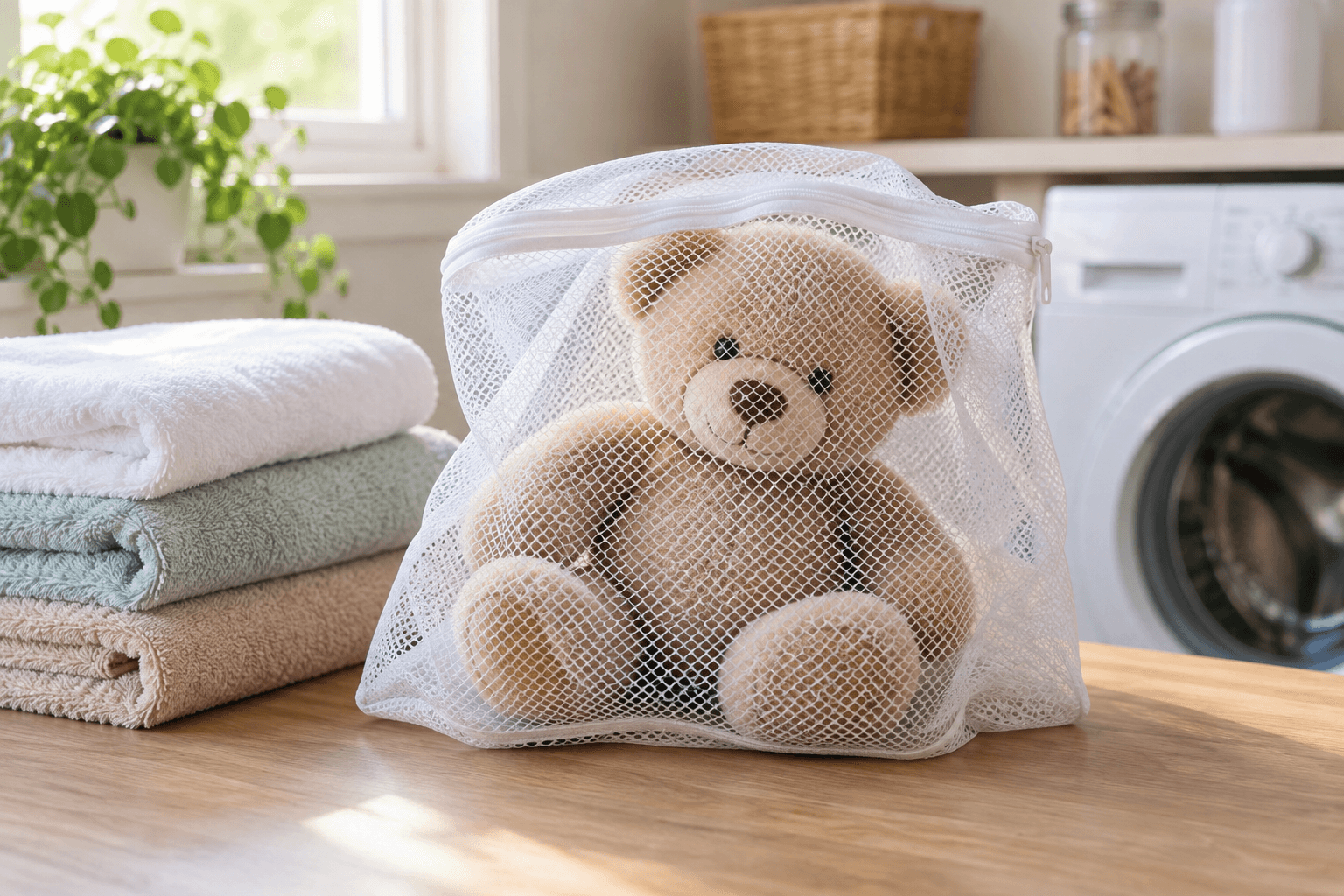
Quick answer: A stuffed animal can go in the washing machine only when its care label allows machine washing and the toy has no batteries, sound box, motor, or other electronic or mechanical parts. Read the label, inspect the toy, and repair or set aside anything damaged before washing. For a machine-washable plush toy, the American Cleaning Institute recommends protecting it in a secured mesh bag or pillowcase and using a cold, delicate cycle. The toy maker’s instructions always take priority over general laundry guidance.
Key takeaways before you start
- The care label is the first and most important decision point.
- A toy with a battery compartment, sound module, moving part, loose seam, or fragile attachment is not a routine washer load.
- A zippered mesh bag or securely closed pillowcase helps protect a machine-washable plush toy from excess rubbing and snags.
- Cold water and a delicate cycle are general guidance from the American Cleaning Institute for washable teddy bears and porous toys, not a substitute for the manufacturer’s label.
- Choose drying only after checking the label. Do not use high heat or guess at a drying method to save time.
Why stuffed animals need an individual decision
Stuffed animals are not all made the same way. One may be a simple fabric shell with sewn-in filling and a clear machine-wash instruction. Another may have glued eyes, a cardboard form, a battery compartment, a music box, a removable outfit, delicate trim, or a decades-old seam. Those differences matter more than whether the toy looks soft enough for a washer.
It is tempting to treat every plush toy like a small towel, especially after a spill, an illness in the household, a dusty shelf, or frequent play. That shortcut can create a larger problem. Water, agitation, heat, and tumbling affect fabric, filling, adhesives, seams, surface decoration, and internal components differently. A washer may be appropriate for one toy and damaging for another sitting beside it.
A useful rule is simple: make the decision toy by toy. Start with the manufacturer’s instructions, then inspect the condition of the actual item in front of you. If either step leaves a real question, do not force the item into a routine load. Choosing a more conservative path is often easier than repairing a torn seam or replacing a sentimental toy later.
Step 1: Find and read the care label
Look for a sewn-in care label on the back, side seam, bottom, clothing tag, or attached paper tag. If it says machine wash, follow the listed temperature, cycle, and drying directions. If it says hand wash, surface clean, spot clean, or do not wash, treat that as the instruction. General internet advice should never override the instructions from the company that made the toy.
Some labels use symbols rather than full sentences. If you cannot interpret a symbol, look up the manufacturer guidance for that item or contact the maker before proceeding. Avoid converting an unclear label into a guess. Labels can also become faded or detached over time, particularly on heavily used or older toys. In that case, identify the toy and seek the maker’s care information if possible.
When no label or reliable manufacturer instruction is available, you have less information, not more permission. Consider the materials, construction, age, and value of the toy. A basic, recently made fabric plush may still need a cautious approach; an old or irreplaceable item may be better handled using a method specifically approved by its manufacturer or by a qualified textile-care professional.
Step 2: Inspect the toy before any laundry decision
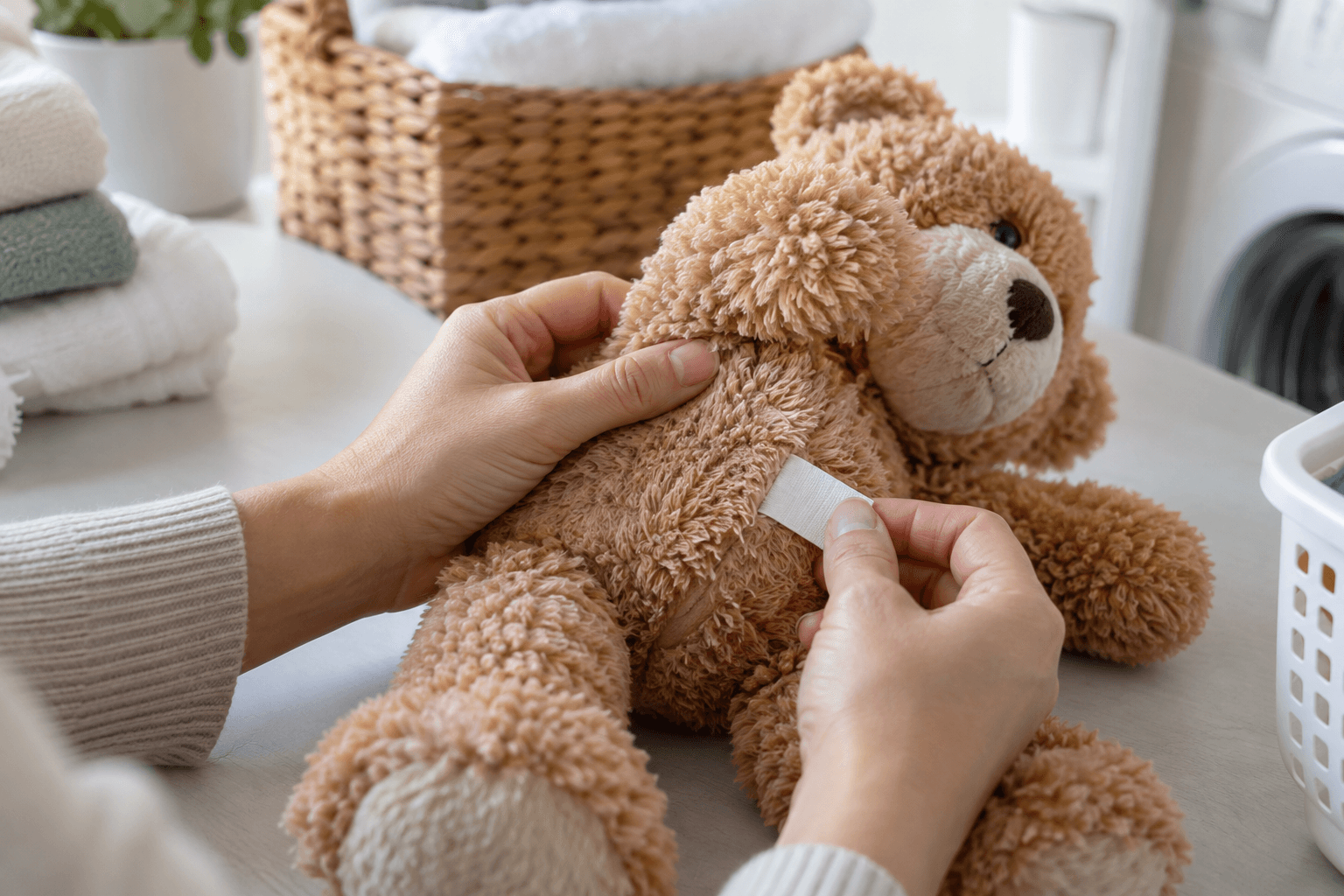
Set the toy on a clean, well-lit surface and examine it slowly. Check both sides, the ears, limbs, tail, embroidered features, clothing, and every seam. Look for split stitching, loose threads, detached accessories, thinning fabric, exposed filling, glued-on decorations, and hard objects inside. A small opening can turn into lost stuffing once it is exposed to water and movement.
The American Cleaning Institute recommends inspecting a teddy bear, including checking for split seams, before washing. That advice is practical for other plush toys as well. If a seam is open, repair it before considering washing. If you cannot confidently secure an attachment or identify what is inside the toy, do not use a machine cycle as an experiment.
Also check for pockets, removable clothing, loose accessories, tags that might transfer color, and any item that could catch. Remove only components that are intended to be removed and that can be safely put back. Do not pull apart a toy to make it washer-safe. If disassembly is required to remove a sound box or electronic part, the manufacturer should provide that direction.
Step 3: Stop for electronics, batteries, and mechanical parts
Do not place a stuffed animal in the washer when it contains batteries, a sound box, a light, a motor, a vibration unit, or another electronic or mechanical component unless the manufacturer gives a specific, safe cleaning method. Water and laundry equipment are not a substitute for a product-specific care instruction.
Battery compartments deserve extra attention. The U.S. Consumer Product Safety Commission provides consumer guidance on button and coin batteries because they can create serious safety hazards when accessible to children. That does not turn every toy into a laundry problem, but it does reinforce the need to inspect battery compartments and keep damaged or loose battery components out of a wash routine. If a battery compartment is broken, loose, corroded, or difficult to secure, stop and follow the manufacturer or product-safety guidance.
Hard or hybrid toys can be especially misleading. A plush exterior may cover a sound module, plastic frame, bead filling, or other structure that changes the care decision. Squeeze gently only to understand the construction; do not bend, twist, or manipulate a toy in a way that can cause damage. When you cannot tell what is inside, treat the uncertainty as a reason to avoid the machine.
Step 4: Decide whether machine washing is actually appropriate
Machine washing can be reasonable when all of the following are true: the label allows it, the toy has no electronic or mechanical components, the seams and attachments are secure, and the toy is not so fragile or sentimental that ordinary agitation would be an unacceptable risk. This is a decision framework, not a guarantee that every machine-washable item will look identical afterward.
Machine washing is not the right choice when the label prohibits it, the construction is unclear, the filling is exposed, an attachment is loose, the toy contains electronics, or the item has sentimental, collectible, or historical value that makes even ordinary laundry risk too high. In those situations, follow the maker’s instructions, consider the care method recommended by the maker, or pause until you have better information.
Do not use a vague online claim such as “all plush toys are washable” as evidence. That kind of advice ignores the fact that care labels, materials, and internal components vary. A clear no is more useful than a poorly supported yes when the item belongs to a child or has personal value.
Step 5: Remove loose soil and address visible spots
Cleaning begins before the washer. The American Cleaning Institute’s teddy-bear guidance suggests vacuuming loose grime from the toy. A gentle pass with a vacuum attachment can help remove surface dust while giving you another chance to notice a weak seam or detached decoration. Use a light touch and avoid pulling at fur, yarn, or loose trim.
For a visible spot on a machine-washable toy, the ACI guidance recommends pretreating the stain with a small amount of liquid detergent. Follow the detergent label and the toy’s care instructions. Apply only as directed, and do not turn pretreatment into an aggressive scrubbing session that damages the fabric pile or pushes a stain farther into the toy.
Not every mark should lead to a full wash. If the toy’s label says surface clean only, follow that direction. If you cannot verify a safe process for the material, do not add water, detergent, or heat based on an assumption. The purpose of a careful routine is to preserve the item as well as clean it.
Step 6: Protect a machine-washable toy in a bag or pillowcase
When the care label permits machine washing, containment is one of the simplest ways to reduce unnecessary friction. The American Cleaning Institute recommends placing machine-washable porous toys in a mesh bag or pillowcase that is tightly secured. A zippered laundry bag can keep the toy together; a pillowcase must be closed securely enough that the toy cannot slip out during the cycle.
The bag or pillowcase is not a repair tool. It cannot make a damaged seam, loose eye, glued accessory, or battery compartment safe for a washing machine. Its job is more limited: it creates a layer of protection around a toy that is already appropriate for machine washing.
Check that the container itself is in good condition. A broken zipper, ripped mesh, or worn pillowcase can fail during a wash. Avoid overfilling a bag. If several small toys are washable, use a setup that lets each item move without being crushed against sharp hardware or packed so tightly that the bag strains.
Step 7: Choose a conservative wash setup
For a washable teddy bear, the American Cleaning Institute advises using a cold-water delicate cycle with a small amount of detergent. Its Clean First Steps guidance similarly describes a cold, delicate cycle for machine-washable porous toys in a mesh bag or secured pillowcase. These recommendations offer a conservative starting point only when the toy label does not call for something different.
Use the amount and type of detergent specified by the detergent label and consistent with the toy’s care label. More detergent does not make a toy safer or cleaner. Excess product can be difficult to rinse from dense fabric and filling, while an overloaded or poorly selected load can increase physical wear.
Think about the full load, not just the toy. Avoid washing a protected plush item with rough hardware, heavily soiled work items, or objects likely to catch on its fabric. Do not pack the washer beyond the machine’s instructions. A modest, compatible load gives the protected item room to move without being pressed repeatedly against unrelated items.
For larger household laundry days, it can be useful to separate ordinary washable textiles from toys that need their own inspection and bagging. Fresh Spin’s self-service laundry page explains the self-service option, but it does not replace the toy maker’s care instructions. Bring the toy only when you have already made the machine-wash decision at home and can protect it appropriately.
Step 8: Check the toy before deciding how to dry it
When the wash is complete, remove the toy from its bag or pillowcase and inspect it again. Look for a shifted seam, loose filling, color transfer, an attachment that has loosened, or a spot that needs attention. The American Cleaning Institute advises checking for any remaining stain before putting a teddy bear in the dryer. That sequence avoids exposing an unresolved stain to a drying step before you have looked at it.
Drying is not a place to improvise. The ACI teddy-bear guidance notes that a low dryer setting may be used when appropriate. Follow the toy label first. If the label does not permit drying, or if the instructions are unclear, stop and use the manufacturer’s direction rather than choosing a cycle by guesswork.
Do not use high heat simply to shorten the process. Heat can affect materials and construction in ways that a general guide cannot predict. The right outcome is a toy cared for according to its label, not the fastest possible finish.
Common toy types that need extra caution
Sound, light, and battery-operated plush toys
These toys are not routine washer candidates. Remove them from the laundry decision unless the maker gives a specific cleaning method that accounts for their components. A removable battery alone does not prove the remaining toy is safe for a machine; the compartment, wiring, module, and construction still matter.
Older, collectible, or sentimental toys
Age can change the condition of fabric, elastic, thread, adhesives, and filling. A toy that has survived many years may not tolerate the same handling as a new machine-washable plush item. If its value is emotional, historical, or collectible, prioritize preserving it over convenience. Seek instructions for that particular maker or material before doing anything that cannot be reversed.
Toys with glued or hard-surface features
Plastic eyes, glued-on patches, decorative sequins, faux-leather details, cardboard forms, and hard shells can all alter the care decision. Check every attachment, not just the face. If you see a component that is not clearly sewn in or designed for water exposure, treat the toy as unsuitable for an ordinary wash until the manufacturer says otherwise.
Large plush toys and oversized animals
Size creates its own practical concerns. A large item may be difficult to bag, may not fit comfortably in the right machine, and may be harder to inspect after washing. Do not force an oversized toy into a machine that cannot accommodate it according to the machine instructions. Start with the manufacturer label, then choose an appropriate care option rather than making the size problem a laundry experiment.
Toys with removable clothes or accessories
Read the toy’s label and any label on removable textile parts. An outfit, ribbon, scarf, or accessory may have different care requirements from the toy itself. Remove only components intended to be removed. Keep them together, inspect them separately, and avoid assuming they can all follow the same wash and dry process.
A practical routine for parents and caregivers
When a child has several favorite plush toys, create a simple repeatable process rather than deciding in a rush. Put a small basket or bin aside for toys awaiting inspection. Before laundry day, check labels and construction one at a time. Separate clear machine-wash candidates from items that need maker instructions, repair, or a different cleaning method.
This routine helps avoid mixing a clearly washable plush toy with one that has a sound module or loose seam. It also makes it easier to explain the process to older children: their favorite toy gets special handling because the label and construction matter. That is more useful than a blanket promise that every toy can go in the wash.
For other household laundry decisions, Fresh Spin has information about drop-off wash-dry-fold laundry and frequently asked questions. This article is general care information, not a claim that Fresh Spin evaluates, repairs, or washes stuffed animals. Always confirm what a service accepts before bringing an unusual or sentimental item.
Frequently asked questions
Can I wash a stuffed animal in the washing machine?
Only when its care label allows machine washing and the toy has no electronic, mechanical, or damaged parts that make a normal cycle inappropriate. Inspect seams and attachments first. For a machine-washable plush toy, use a secured mesh bag or pillowcase and follow the label along with conservative guidance such as a cold, delicate cycle when applicable.
Can stuffed animals go in the dryer?
Check the toy label first. The American Cleaning Institute notes that a low dryer setting may be appropriate for a washable teddy bear, but the maker’s instructions control the decision. Do not choose high heat or a drying method based only on what works for towels or clothing.
Should I put a stuffed animal in a pillowcase?
For a toy that is already approved for machine washing, a securely closed pillowcase or zippered mesh bag can help protect it from extra rubbing and snags. It does not make a toy safe when the label says not to machine wash or when the toy has a damaged seam, fragile attachment, or electronic component.
How do I know whether a plush toy has electronics inside?
Look for a battery compartment, switch, speaker opening, light, motion feature, removable module, or product description that identifies a sound or electronic function. If you cannot tell what is inside, do not use the washer as a test. Find the manufacturer instructions for the exact toy or use the manufacturer’s recommended care method.
What if the stuffed animal has a loose seam?
Pause before washing. A loose or split seam can worsen during a cycle and allow filling to escape. Repair it securely if appropriate, or have it repaired, before reassessing the care label. A mesh bag is not a substitute for fixing a structural problem.
Can I wash a very old stuffed animal?
Older toys often need more caution because fabric, stitching, adhesives, and filling can degrade with age. If the toy is sentimental, collectible, or irreplaceable, do not assume a washer is safe. Seek guidance for the material or manufacturer and prioritize preservation over speed.
What detergent should I use?
Use a detergent according to its own label and the toy manufacturer’s instructions. The American Cleaning Institute’s teddy-bear guidance refers to a small amount of detergent for a washable toy. Do not add more product in an attempt to make up for an uncertain care decision.
Can I wash several stuffed animals together?
Only after inspecting each item individually and confirming its label permits machine washing. Do not assume that one machine-washable plush toy means every toy in the group is suitable. Keep protected toys in an appropriately sized bag or pillowcase and avoid overloading the washer.
Do I need to wash a stuffed animal after every outing?
The right care frequency depends on the toy, how it is used, and the manufacturer’s instructions. Do not create wear by repeatedly washing a toy that is not designed for it. Inspect it, address visible soil according to the label, and use a full wash only when the manufacturer guidance supports that choice.
Can a laundromat make a stuffed animal safe to wash?
No. The care decision belongs to the toy’s label, construction, and condition. A laundromat provides laundry equipment; it cannot change a toy with electronics, a prohibited label, a damaged seam, or an unknown internal structure into a machine-washable item. Review Fresh Spin’s Independence laundromat information for a visit, then bring only items you have already determined are appropriate for the machine.
Examples: how the decision changes from toy to toy
Example 1: A newer fabric teddy bear with a machine-wash label
Suppose a recently purchased teddy bear has a clear label allowing machine washing, no battery compartment or sound feature, secure eyes and seams, and no loose accessories. That is a stronger candidate for the washer than an unknown toy. Inspect it anyway, remove surface dust if needed, protect it in a secure mesh bag or pillowcase, and follow the manufacturer’s instruction. When the label is compatible with the American Cleaning Institute’s general guidance, a cold, delicate cycle with a small amount of detergent is the conservative choice.
Even in this straightforward example, do not skip the post-wash inspection. Remove the toy from its protective bag, look for a shifted seam or remaining visible spot, and read the drying instruction before selecting a dryer setting. A clear label makes the process easier; it does not eliminate the need to look at the actual item.
Example 2: A plush toy with a sound button
A toy may look like an ordinary stuffed animal while containing a button that plays a sound, lights a feature, or activates a mechanism. That function changes the decision. Do not assume that removing visible batteries makes the entire toy machine-washable. The product may still contain wiring, a speaker, a module, or an enclosure that should not be exposed to water or agitation.
Find the manufacturer’s directions for the exact product. If the directions do not provide a clear washable method, keep it out of the washer. This is not a case where a pillowcase, a gentle cycle, or a smaller load solves the underlying uncertainty.
Example 3: A favorite toy with a small open seam
When the label permits machine washing but the stuffing is beginning to show through a seam, the right next step is repair, not laundry. Water and agitation can enlarge an opening and distribute filling through the bag, machine, or other items in the load. Once the seam is repaired securely, reassess the toy against the label and the rest of this guide.
If the repair itself is uncertain, especially on a sentimental item, get help from someone who can make an appropriate textile repair. A quick wash is rarely worth the risk of turning a minor seam issue into permanent damage.
Example 4: A large plush animal with no readable label
Large plush toys can be difficult because their size may make them seem like an ordinary bulky-laundry problem. But size does not answer the care question. Without a readable label, you may not know the filling, internal structure, colorfastness, or drying limitations. Forcing the item into a large machine does not create the missing information.
Try to identify the brand and product, then look for the maker’s care guidance. If that information cannot be verified, choose the most conservative reasonable path rather than creating a high-risk wash test. This is particularly important when the item cannot be easily replaced or when its interior construction is unknown.
Example 5: A plush toy with removable clothing
Some dolls and stuffed animals include shirts, shoes, hats, ribbons, or other pieces. First determine whether the components are designed to be removed. If so, check each textile item for its own care label or manufacturer direction. A washable fabric toy may have an accessory that should not be washed or dried in the same way.
Keep small pieces together and avoid treating a removable accessory as an afterthought. This is where a simple inspection before laundry saves time: you can identify the separate care needs before a small item is lost, stretched, or damaged in a larger load.
A pre-wash checklist you can use every time
Before putting a toy in a bag or taking it to the washer, work through this checklist in order. If any answer is uncertain, stop at that point and seek the manufacturer’s guidance. The checklist is intentionally cautious because it is easier to move from a clear instruction to a safe wash than to recover from a rushed decision.
- Identify the toy. Confirm whether you know the brand, model, and approximate age. This is especially useful when the label is missing or faded.
- Read every available care instruction. Check both the toy and removable clothing or accessories. Follow the most restrictive relevant instruction.
- Look for an electronic or mechanical feature. Check for battery doors, switches, speakers, lights, vibration, moving parts, or a removable module.
- Inspect the structure. Examine seams, limbs, eyes, trim, ears, tails, decorative pieces, and the surface fabric for damage or loose parts.
- Decide whether the item is replaceable. A clearly washable everyday toy and an irreplaceable keepsake deserve different risk tolerance, even when they appear similar.
- Remove loose surface grime carefully. Use a gentle approach consistent with the care label. Do not aggressively scrub delicate fabric or trim.
- Address visible spots only as instructed. If the toy is machine washable, follow the detergent and toy-label directions. If it is surface-clean only, do not switch to a full wash.
- Prepare a sound protective layer. Use a clean, secure mesh bag or a pillowcase that can be tightly closed for a toy that is already approved for machine washing.
- Choose a compatible load. Keep the item away from rough hardware, heavily soiled items, and anything likely to catch on the fabric. Do not overload the machine.
- Check the drying instruction before you wash. Knowing the permitted next step prevents a rushed drying decision once the item is wet.
What this guide does and does not cover
This article is designed to help a household make an informed first decision about a stuffed animal. It explains why labels, construction, inspection, containment, conservative cycle selection, and drying instructions matter. It does not diagnose fabric damage, verify a particular brand’s warranty terms, repair toys, or provide a substitute for manufacturer-specific instructions.
It also does not promise that any machine-washable toy will come out looking new. Laundry changes materials through water, movement, and drying, and outcomes depend on the item and its label. The goal is a repeatable, cautious routine that reduces avoidable mistakes, not a universal claim that every plush item can be cleaned in the same way.
For broader questions about planning household laundry, review Fresh Spin’s laundromat FAQ and choose services based on verified current information. For the care of a particular toy, the maker remains the primary source.
Sources and scope
This guide summarizes general consumer-care guidance and does not replace an individual toy’s label or manufacturer instructions. The American Cleaning Institute’s teddy-bear washing guidance informed the inspection, pretreatment, mesh-or-pillowcase, cold delicate cycle, and low-dryer discussion. Its Clean First Steps guidance informed the discussion of machine-washable porous toys. The U.S. Consumer Product Safety Commission’s battery information informed the caution around battery compartments and accessible battery components.
Leave A Comment