
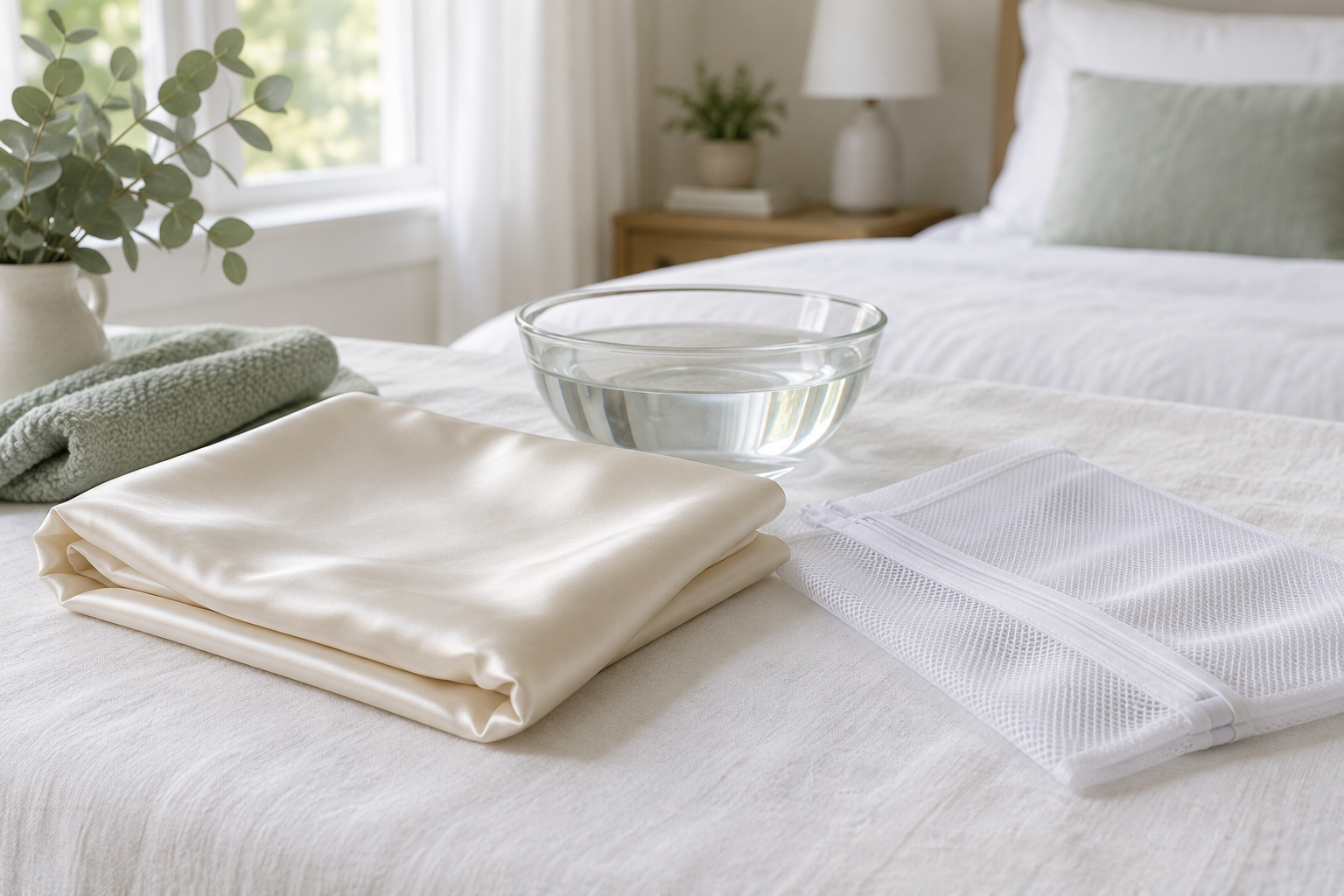
Wash a silk pillowcase only by the method on its care label: use a silk-compatible detergent, gentle handling, and the specified water temperature, then follow the separate drying instructions. If washing is permitted, hand washing offers close control; machine washing is appropriate only when the maker allows it. A mesh bag does not make a dry-clean-only item washable. Air drying away from direct sunlight is the approach supported by the pillowcase manufacturers cited below.
The practical challenge is not finding one universal silk setting. It is deciding which instructions apply to the pillowcase you own, setting aside enough time to finish the job, and avoiding a stronger treatment when the first result disappoints. This guide turns those decisions into a repeatable routine. It covers washable pillowcases, not the pillow filling, decorative silk cushions, or every item sold as satin.
Start with the label sewn into the case and the care page for its exact model. Brand examples here illustrate differences; they are not interchangeable permissions. The household examples are planning scenarios, not Fresh Spin experiments or reports of customer results.
What should you check before the pillowcase touches water?
Remove the pillow and find the fiber-content and care labels, often inside the opening. Photograph them while the case is dry and easy to handle. Read washing, bleaching, drying, and ironing instructions separately. Permission to wash says nothing by itself about permission to tumble dry. When a symbol is unfamiliar, use the Fresh Spin laundry care-label guide before choosing a cycle.
Look at the whole item rather than just the main fabric. Inspect the opening, zipper tape, seams, piping, embroidery, and any contrasting panels. A loose seam is a repair issue, not a stain-removal challenge. Set the case aside if its fabric is tearing or a closure could catch it. Do not pull a loose thread to see how firmly it is attached.
Identify what you are trying to clean. A normally used pillowcase, an isolated makeup mark, and an unknown spill call for different preparation. Record what you know about a mark before applying anything. If a professional cleaner becomes necessary, the original substance and any products already used are more useful information than a guess about what the stain resembles.
Check the available instructions against the exact product you bought. A retailer may carry several materials under a similar collection name. A screenshot from an older order can help identify the model, but an instruction for another size, trim, or fabric is not automatically suitable. If the sewn label and online directions disagree, ask the maker to resolve the conflict before proceeding.
What if the label is missing?
Do not treat missing instructions as permission to hand wash. Look for the purchase confirmation, packaging, product number, or an identifiable manufacturer label. Send the maker photographs of the item and ask for the approved washing and drying methods. A cleaner experienced with silk can also assess an uncertain item. Until then, use a spare pillowcase rather than experimenting on a valuable or sentimental one.
Is a silk pillowcase the same as a satin pillowcase?
No. Silk describes a fiber; satin describes a weave. A smooth, shiny satin case may be made from silk, polyester, or a blend. Appearance alone is not a reliable way to choose its wash method. Read the fiber declaration rather than relying on packaging words such as silky, luxury, cooling, or hotel quality.
This distinction matters when sorting a household’s bedding. Two pillowcases that look identical may need different care. Keep their instructions separate until you know that the entire wash and drying routine is compatible. Do not use a synthetic case’s dryer instructions for a silk case merely because both came from the same drawer.
The same caution applies to a silk face panel with a different fabric on the back. The finished item’s label governs the whole case. You cannot choose one method for each side during the same wash. If a blend or mixed construction has a more restrictive requirement, use that requirement rather than trying to average two incompatible routines.
A useful storage habit is to keep each case with its own care note rather than labeling a whole shelf simply as delicates. A short note such as machine wash allowed, air dry, and use the specified detergent can prevent a well-intentioned household member from putting it through the ordinary bedding routine. Copy the actual instructions; do not substitute a remembered rule.
How do the manufacturers’ washing instructions differ?
Slip’s care page recommends hand washing its pillowcases for best results. It also allows machine washing with a delicate setting, a delicates bag, pH-neutral liquid detergent, and water no warmer than 30 C / 86 F. Its drying direction is air drying in shade, not tumble drying.
Blissy’s help center describes its pillowcases as machine washable. It specifies turning them inside out, using a mesh bag, a cold gentle cycle, and a mild silk-safe pH-balanced detergent. It prohibits chlorine bleach and fabric softener. Its drying instructions differ from Slip’s: air drying is preferred, with a limited no-heat or lowest-heat alternative described for Blissy items.
The Company Store’s silk pillowcase instructions allow cold hand or machine washing, with a gentle cycle and mesh bag for machine use. They specify pH-neutral liquid detergent without bleach and flat or hanging drying out of direct light. These directions belong to that product, not every pillowcase in the retailer’s catalog.
The decision is therefore product-specific, not a vote among brands. Three brands allowing a method would still not override a fourth item’s restrictive label. Once you have identified your instructions, write down a single coherent routine. Mixing the hottest allowed wash from one source with the fastest drying method from another defeats the purpose of checking.
Should you hand-wash or machine-wash this particular case?
Use this decision sequence before measuring detergent:
- Dry clean only or no washing permitted: stop the home-wash plan and discuss the item with a suitable cleaner.
- Hand wash only: prepare a basin routine. A machine cycle named hand wash is not automatically equivalent to the label’s instruction.
- Machine washing expressly allowed: confirm that the available machine can provide the specified temperature and gentle cycle.
- Instructions unreadable or contradictory: obtain clarification. Neither a mesh bag nor cold water resolves uncertainty about whether the item is washable.
Hand washing offers direct control over handling and lets you inspect one item closely. Its tradeoff is that you must prepare the basin, rinse the case, support it while wet, and arrange drying yourself. It is not necessarily the easier choice when you are rushed or have nowhere to lay the item afterward.
Machine washing can fit a regular household routine when specifically approved. Its tradeoff is dependence on the machine’s actual controls and the other items in the load. Read the program description rather than assuming the button’s name tells you everything. A short cycle is not necessarily a gentle cycle, and a cold selection should not be replaced with a warmer default for convenience.
For example, consider two washable cases from different brands. One permits a gentle machine wash and the other says hand wash only. You have a convenient machine available, but that does not make a combined load appropriate. Handle each by its own directions, or use a common method only if both labels explicitly permit it. Efficiency starts with compatible care, not with fitting everything into one basket.
What supplies and detergent should you prepare?
Gather the case’s instructions, a suitable detergent, a clean basin if needed, a measuring tool, a clean absorbent towel, and a prepared drying surface. For approved machine washing, have a sound mesh laundry bag with a closure that stays shut. Check that nothing sharp or abrasive is trapped inside the bag from a previous load.
Choose a product that expressly states compatibility with silk and matches the pillowcase manufacturer’s requirements. Mild, gentle, natural, and fragrance-free are not interchangeable specifications. A product intended for ordinary cotton laundry may not meet the care directions for silk. Read both the detergent’s suitability statement and its dosing directions rather than relying on the front of the bottle.
LILYSILK’s hand-washing guide emphasizes reading the label, using cool water and an appropriate neutral or specialist detergent, rinsing carefully, and avoiding prolonged direct sunlight. Use it as a maker’s care example, not as permission to apply an older product recommendation to a current formula without checking its label.
Measure for the method you are actually using. A detergent dose for a machine load is not a dose for one pillowcase in a small basin. If the product gives only machine instructions, obtain the hand-wash dose from its maker or choose a compatible product with clear directions. Guessing a teaspoon amount may feel precise, but precision without a valid instruction is still a guess.
Keep the first routine simple. Do not add fabric softener, bleach, scent products, household acids, or stain-treatment mixtures merely because they are part of your towel routine. An additive needs its own compatibility check. Leaving an unneeded product out is easier to evaluate than trying to work out which of several products caused an unexpected result.
How do you hand-wash a washable silk pillowcase?
Prepare the drying area first. That prevents the awkward moment when you are holding a wet case and searching for a clean towel. Use a basin with a smooth interior, remove unrelated laundry, and make sure no residue from another cleaning job is present. Keep the pillow itself out of this process.
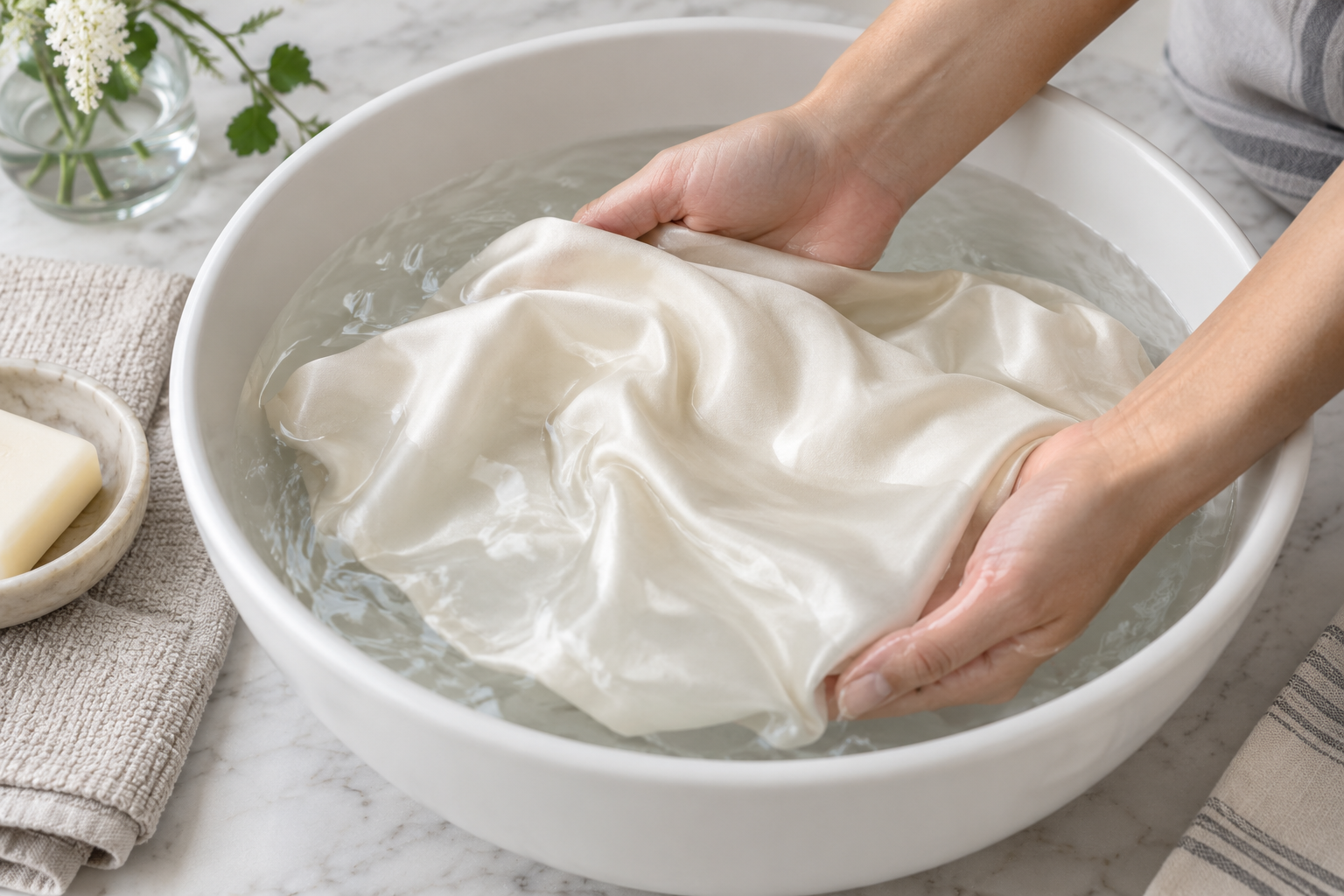
- Prepare the wash water. Follow the item’s specified temperature and the detergent’s mixing and dosing directions. Avoid making the water hotter because a mark looks stubborn.
- Place the case in the water gently. Support it as it becomes wet. Use the gentle movement allowed by the maker rather than rubbing the fabric against itself or scrubbing a seam.
- Follow the stated contact time. Do not invent an overnight soak. If the instructions do not specify soaking, avoid turning a brief wash into an extended treatment.
- Rinse according to the care directions. Replace wash water with clean water as needed. Handle the item gently through the change rather than lifting it by one corner or the zipper.
- Remove excess water without twisting. When permitted by the care instructions, support the case on a clean towel and press gently. Move it to the prepared drying surface.
Pause if you see an unexpected change such as substantial color release, a new tear, or a closure separating from the fabric. Do not respond by adding another chemical. Record what happened and seek product-specific guidance. A care routine should have a stopping point; it should not become an escalating sequence of treatments.
Use a clean, colorfast towel for moisture removal. Lay out the case without pulling it taut, then absorb water with gentle pressure. The purpose is to make handling and drying easier, not to flatten every wrinkle. If the towel becomes wet, move to a dry one rather than pressing harder.
For a first wash, keep a brief note of the approved method and any difficulty you encountered. Note whether the basin was large enough, whether the dose was easy to measure, and whether the drying setup worked. Those observations can improve your next routine without making claims about stain-removal performance or the item’s long-term durability.
How do you prepare an approved machine wash?
Make a small compatibility check before loading: the pillowcase, detergent, program, and other laundry must all suit the intended routine. A mesh bag addresses handling and snagging; it does not correct an incompatible detergent, an excessive temperature, or a care label that prohibits machine washing.
Where the maker directs it, turn the case inside out and secure the closure before placing it in the bag. Check that the zipper is not trapping the silk. Give the item room within the bag rather than compressing several cases into a tight bundle. Inspect the bag’s fastening so it does not open during the cycle.
Avoid using towels, jeans, and garments with exposed hooks as convenient companions for a delicate pillowcase. Choose a compatible load only if all the items share the approved routine. When in doubt, keep the silk separate rather than adjusting its care to suit the larger pile. A few minutes spent sorting can prevent a conflicting decision at the machine.
Select the permitted program and confirm its settings before starting. On a shared machine, inspect the drum and dispenser for visible debris or leftover products. If you cannot establish that the machine is suitable, ask the operator or use another label-approved method. This is a check on the actual equipment, not a claim that a home or commercial machine is inherently better.
Stay available to remove the case when the cycle ends and move it to the planned drying area. Do not transfer the whole load automatically into a dryer. One practical household habit is to attach a visible air-dry reminder to the laundry basket while the case is washing, then remove the reminder after you have separated it.
Can a silk pillowcase go in the dryer?
There is no universal yes. The exact drying instruction decides. Slip says not to tumble dry its pillowcases. Blissy prefers air drying but describes a fallback using a mesh bag on no heat or the lowest heat for no more than 20 minutes. That exception is not a drying recommendation for Slip, an unknown brand, or a case whose label says otherwise.
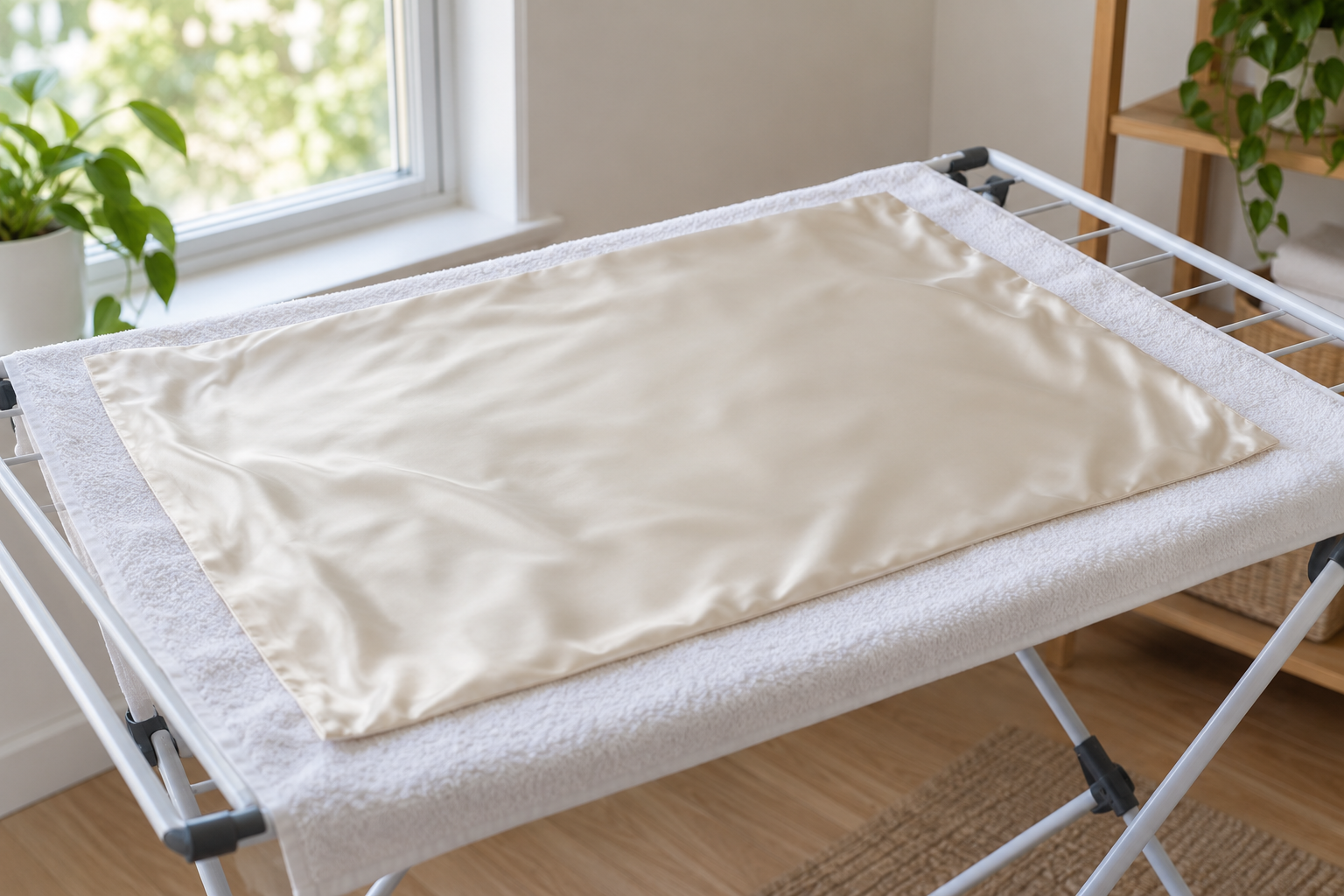
Plan for air drying when the product directs it. Lay the case flat or hang it as the maker allows, keeping it out of direct sunlight and away from a radiator or other strong heat source. Choose a place where the fabric will not be brushed by passing clothing, trapped under another item, or moved by someone clearing a table.
If you use a towel beneath it, check whether the towel remains damp. Replace it when needed and allow access to air. Do not fold the case into a compact square while it is still drying. Open the envelope flap and check the seam and closure areas before deciding that the whole item is ready to put away.
Drying time depends on the item and the conditions, so this guide does not promise a fixed number of minutes or hours. Start early enough that you will not need the case immediately. Keeping a spare in rotation is a scheduling solution; forcing the process with unapproved heat is a different care method.
What should you do about makeup, oils, or an unknown stain?
Identify the substance if possible and read the item’s stain-treatment instructions. Do not assume that an ordinary wash will remove every mark, or that a stain remover safe on cotton is also safe on silk. The decision to pretreat requires approval for both the fabric and the exact product.
For a washable item with an approved treatment, follow the specified amount, contact time, and test procedure. A hidden-area test may reveal a problem, but it cannot guarantee that a visible stain will disappear without a trace. Avoid aggressive rubbing and do not improvise a sequence of different products when the first treatment is inconclusive.
For an unknown spill, a valuable case, or a dry-clean-only item, gather information for the maker or cleaner instead. A useful message includes the fiber label, photographs taken in normal light, the likely substance, how long it has been there, and anything already applied. That is a more useful starting point than describing the case simply as dirty.
After an allowed wash, inspect the item before any approved heat step. If a mark remains, reassess rather than repeating the same process at a higher temperature. Some discoloration may not be removable, and a cleaning plan should not imply that every change in appearance can be reversed. Preserve the fabric rather than pursuing a spotless result at any cost.
For routine prevention, keep the case away from unfinished makeup application and spills while making the bed. This is not a recommendation to change prescribed skincare or a promise of skin benefits. It is simply a way to reduce avoidable contact with products that might create a separate stain-treatment problem.
What if the case feels stiff, looks dull, or changes size?
First compare the result with the instructions and what actually happened. Was the detergent compatible? Was the dose measured for the basin or machine? Was the rinse completed? Did the case go through an unapproved dryer cycle? A factual sequence is more useful than choosing a restoration trick from a search result.
A different feel does not identify its cause. Residue, a changed finish, wear, and damage are not interchangeable diagnoses. If the manufacturer recommends an additional rinse for suspected residue, follow that instruction. Otherwise, ask before adding a new product or another full wash. Do not describe vinegar, conditioner, or any homemade mixture as a guaranteed way to restore silk.
If the case seems smaller, let it finish drying by the approved method and compare its fit without stretching it over an oversized pillow. Check the original size and whether the opening is caught or folded. If there is a real dimensional change, send photographs and the care history to the maker. Pulling hard on wet seams is not a reliable resizing method.
Photograph tears, abrasion, or a distorted zipper before further handling. Keep the purchase information and care record if you plan to ask about repair or warranty support. This guide cannot determine whether a particular change qualifies for coverage, and cleaning the item again may make the original condition harder to explain.
How should you schedule washing and store the case?
Choose a routine that accounts for actual use, visible soiling, and the maker’s guidance. A case used nightly needs a different calendar from a spare in a guest room. Check it regularly rather than assuming its appearance or fragrance proves that it is clean. This article does not set a medical laundering schedule or claim that silk eliminates the need for washing.
A two-case rotation is a practical option: one is available for use while the other is being washed and fully dried. You do not need an expensive collection to make the routine work; the spare simply prevents bedtime from becoming a deadline for wet silk. A different-fiber spare is fine if you follow that spare’s own care instructions.
When the case is dry, fold it loosely and place it in a clean, dry location away from things that can snag it. Check the opening and seams, not just the center panel, before storage. Do not put a damp case into a closed travel pouch or under a pile of freshly folded bedding.
For travel, separate used and clean cases so you do not lose track of which needs washing. If you cannot provide a suitable drying area at your destination, bring a spare and postpone washing until you can finish the complete process. A hotel bathroom with no drying space is a planning constraint, not a reason to use an unapproved dryer.
How can a household avoid accidental mixed-load damage?
The most useful routine is one that another person can follow without guessing. Keep the case in a separate delicates bag or clearly identified part of the hamper. Leave a short care note with the exact method rather than writing only be careful. Include the drying restriction because that is an easy instruction to miss during a transfer.
Agree on where an uncertain item should go. A designated set-aside basket is better than expecting every household member to recognize silk by touch. If someone finds a missing label or a new stain, the next step should be to flag it, not to put it into the nearest load to clear the hamper.
Consider a simple example: one person starts the machine and another finishes laundry later. The second person sees a mesh bag and assumes everything inside can be tumble dried. A note on the basket stating which item must be separated addresses that handoff directly. The solution is clear information, not relying on a bag’s color or hoping the other person remembers.
Keep detergent in its original labeled container so the next person can confirm suitability and dose. If you keep a written checklist, update it when the product or pillowcase changes. A routine built around a previous formula or an old case should not silently become the instruction for everything purchased afterward.
Where does laundromat or drop-off service fit?
Separate the silk-care decision from the rest of your laundry plan. You may be able to wash ordinary compatible clothing together while caring for the pillowcase by its own instructions. Fresh Spin’s self-service information explains that option, but it is not a promise that every delicate item is suitable for every available machine.
Fresh Spin also offers in-store drop-off wash-dry-fold. Before bringing a silk pillowcase for service, ask the team whether that exact item and its labeled care requirements can be accommodated. Bring the label or a clear photograph. Do not assume a standard wash-dry-fold order includes hand washing, specialist silk treatment, or dry cleaning.
Keep an item requiring special instructions separate from ordinary laundry until its handling is agreed. Explain the fabric, allowed method, drying restriction, and any stain treatment already attempted. This avoids an important ambiguity: asking someone to take care with a delicate is not the same as providing a specific instruction that the service can accept.
If the required care is outside the service’s scope, use another suitable option for that item while continuing with the ordinary load. That is a successful planning decision, not a reason to override the label. No price, completion time, or acceptance guarantee for silk is implied by this guide.
What should your next-wash checklist contain?
What information should you save with the item?
A useful care note is short enough to read at the hamper but specific enough to prevent a guess. Include the product name, the date you checked its instructions, the allowed wash method, and the drying restriction. Add a photograph of the original tag rather than rewriting symbols from memory. Keep the manufacturer’s support link with the note so a later question can be checked at its source.
For a shared household, add the location of the compatible detergent and the measuring tool. Do not write a permanent dose without identifying the product and wash setup. If either changes, the old number may no longer apply. You can instead write where to find the appropriate directions on the bottle. This keeps the note useful without pretending that every future formula has the same concentration.
If you seek outside help, send a concrete question: this is the case and its label; this is the stain, if any; this is what has already been applied; can you follow these washing and drying instructions? Ask separately whether the provider accepts the item and whether it can offer the requested method. Acceptance of ordinary bedding does not answer a question about silk.
Finally, keep unresolved questions visible. A note that says care instructions requested is more useful than leaving the item in an ordinary basket while waiting for a reply. Once you receive clarification, replace the temporary note with the confirmed routine. This gives uncertainty an explicit next step instead of letting it turn into an accidental wash.
Keep this checklist with your care note. It is designed to catch decisions that are easy to miss, not to replace the manufacturer’s directions.
- Identity: I know the fiber, model, and which care instructions belong to this case.
- Condition: I checked seams, the opening, closures, and any mark that needs separate advice.
- Method: The label expressly allows the washing method I am about to use.
- Products: My detergent is compatible, and I have a dose for this actual wash setup.
- Handling: The basin or machine and any accompanying items fit the permitted routine.
- Drying: The drying surface is ready, and nobody will automatically transfer this item to a dryer.
- Finish: I will check the fully dried case before use or storage and ask for advice if something unexpected occurred.
Frequently asked questions
Can I use a delicates cycle for a hand-wash-only case?
Not unless the manufacturer approves that substitution. The machine’s program name does not amend the item’s label. Ask about the exact model if you need a machine option; otherwise follow the hand-wash instruction.
Does a mesh bag make a regular load safe?
No. The detergent, temperature, cycle, other items, and drying method still need to be compatible. A bag is one part of an approved routine, not an all-purpose safeguard.
Can I wash the pillow at the same time?
Only if its own instructions allow the proposed method and the combined load is appropriate. This guide addresses the removable case. Foam, down, synthetic fill, and other pillow constructions need their own care assessment.
Should I iron every wrinkle out?
No. Ironing is a separate optional step, and the label decides whether it is allowed. Do not raise the heat to chase a stubborn crease. If a neat fold is all you need for storage, ironing may be unnecessary.
Can I use a silk detergent on everything in the load?
Check each item’s requirements and the detergent’s intended use. A product suitable for the pillowcase does not automatically meet the cleaning needs of heavily soiled workwear or every other fabric. Sort by compatible care rather than bottle availability.
What is the most important thing to remember?
Plan the whole process before you start: identify the item, choose an allowed wash method, prepare drying, and know when to stop for clarification. That approach is more dependable than searching for a universal silk shortcut after the case is already wet.
Leave A Comment