
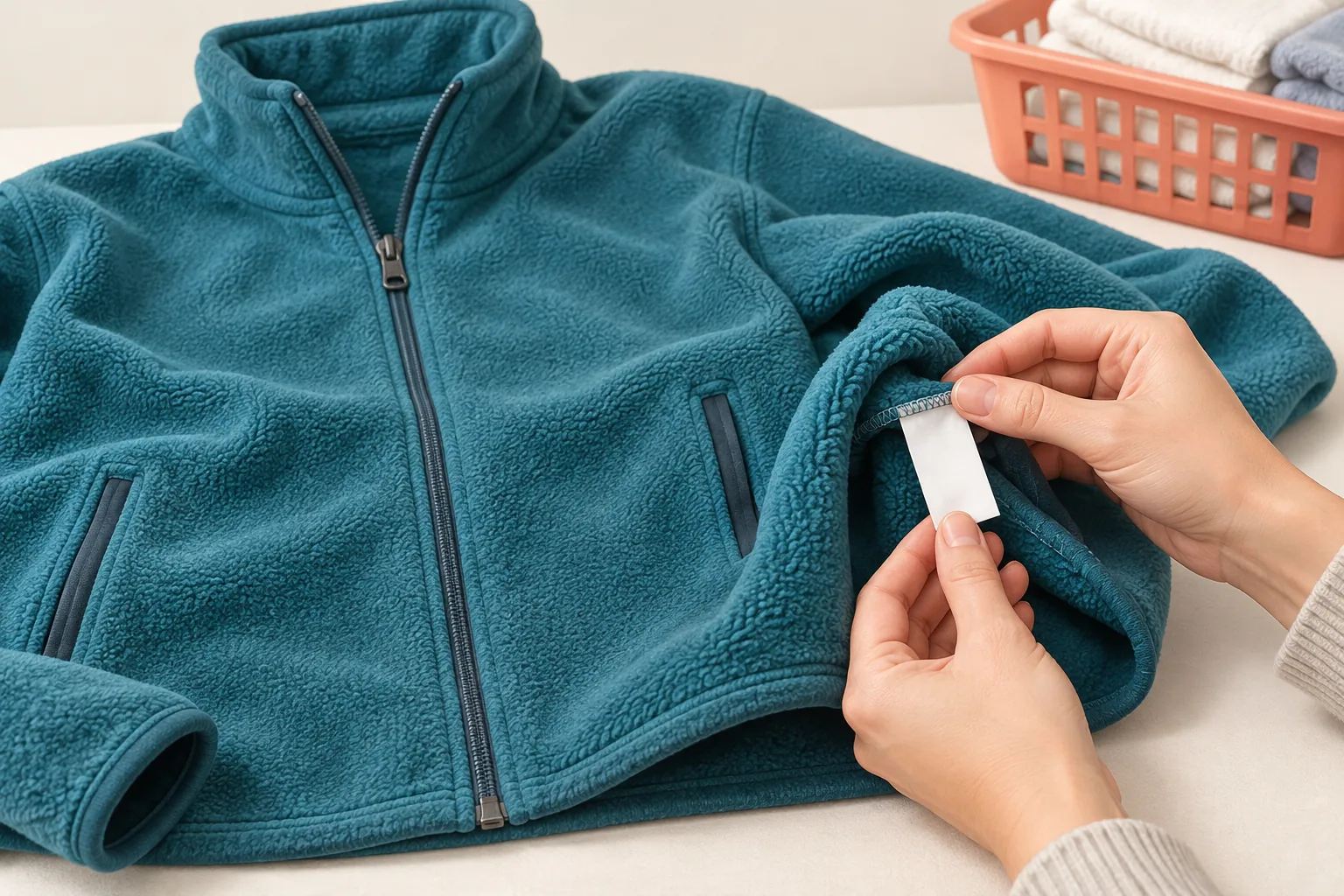
Wash a fleece jacket according to its care label, using compatible detergent and the permitted wash cycle. For many washable synthetic fleeces, a cold, gentle wash and air drying are sensible choices; use a dryer only when the label allows it, at the stated setting. Close fasteners, keep abrasive items out of the load, and avoid treating extra heat or fabric softener as a shortcut to softness.
The important question is not simply whether fleece can go in a washing machine. It is whether this particular jacket, including its lining, panels, trim, and fasteners, can follow the routine you have chosen. A lightweight polyester pullover, a wool-blend fleece, and a fleece-lined weatherproof jacket may look similarly cozy while needing different care.
This guide focuses on fleece jackets and pullovers, especially washable synthetic garments. It is not a universal method for wool, down-filled coats, waterproof shells, or household blankets. The steps below help you make a plan before starting, recognize when to stop, and evaluate the result without assuming every change in texture can be washed away.
What should you check before choosing a wash method?
Find both the fiber-content information and the care instructions. They answer different questions. A fiber label identifies materials; a care label explains how the finished item should be treated. Read the whole instruction, including drying and warnings, rather than stopping after the word polyester. Our laundry care-label guide can help you interpret unfamiliar symbols.
The FTC’s care-label guidance explains that care instructions must account for components such as linings and trim, not just the main fabric. In practice, a chest overlay, bonded panel, decorative patch, or elastic cuff is a reason to check the complete garment’s instructions rather than borrow settings from another fleece.
Make four decisions while the jacket is still dry: whether it may be washed, whether hand or machine washing is specified, which cleaning products are compatible, and how it must dry. If one answer is missing, resolve that gap first. Starting a wash without a drying plan can leave you choosing between a method the garment does not allow and a damp jacket you cannot use.
Inspect its condition too. Photograph any existing thinning, flattened areas, loose stitching, or damaged zipper. These observations give you a useful baseline; they are not a diagnosis. Set aside a garment with an opening seam or unstable trim for advice or repair before putting it through a cycle that might make the problem harder to manage.
Are all fabrics called fleece cared for the same way?
No. Treat fleece as the beginning of an identification task, not a complete material specification. The term appears on smooth-faced midlayers, fuzzy high-pile jackets, sweatshirt fabrics, and blended garments. A product name such as sherpa describes an appearance or construction, but it does not replace the fiber and care information inside your item.
Polartec’s fleece guidance describes cold washing with mild detergent, avoiding softener, and low tumble drying or hanging, while still directing users to the garment’s own care instructions. That is useful context for its fabrics, not permission to apply one Polartec setting to every garment marketed as fleece.
If the jacket contains wool, stop treating it as ordinary polyester fleece. Use its specific instructions; our wool-sweater care guide explains why wool requires a separate decision path. Likewise, a fleece lining attached to a shell stays part of that shell’s care problem. Do not pull apart attached layers or assume the fuzzy side determines the whole jacket’s washing method.
For a detachable liner, check the instructions for both pieces and the directions for separating them. Keep any removable components together in a labeled place. A simple photograph before disassembly can help you reconnect the correct loops and fasteners afterward without forcing a zipper that was never meant to join those two parts.
Does the jacket need a full wash or a smaller intervention?
Look at what actually needs attention. A jacket with one small food mark presents a different problem from a garment with widespread soil, collar buildup, or persistent odor. A full wash may be appropriate, but the presence of one speck of lint does not automatically justify another complete cycle.
Choose a limited intervention only when it fits the care instructions and the problem. Loose surface debris may need careful removal. A washable spot may be suitable for a compatible local treatment. General soiling calls for the approved cleaning routine. If the jacket smells unpleasant after it has dried and aired, do not conceal the problem with fragrance and declare it clean.
Use your actual wear pattern rather than a rigid calendar. Write down what happened: a muddy walk, food spilled on the cuff, a workout, or ordinary indoor wear. This description is more useful when choosing a treatment than an unsupported rule that every fleece must be washed after a fixed number of outings.
There is also a practical scheduling question. If you need the jacket tomorrow morning, first check whether its permitted drying method fits that deadline. Selecting another jacket can be a better decision than rushing this one through excessive heat. Cleaning and being ready to wear are separate milestones; plan for both.
How do you prepare pockets, zippers, and the load?
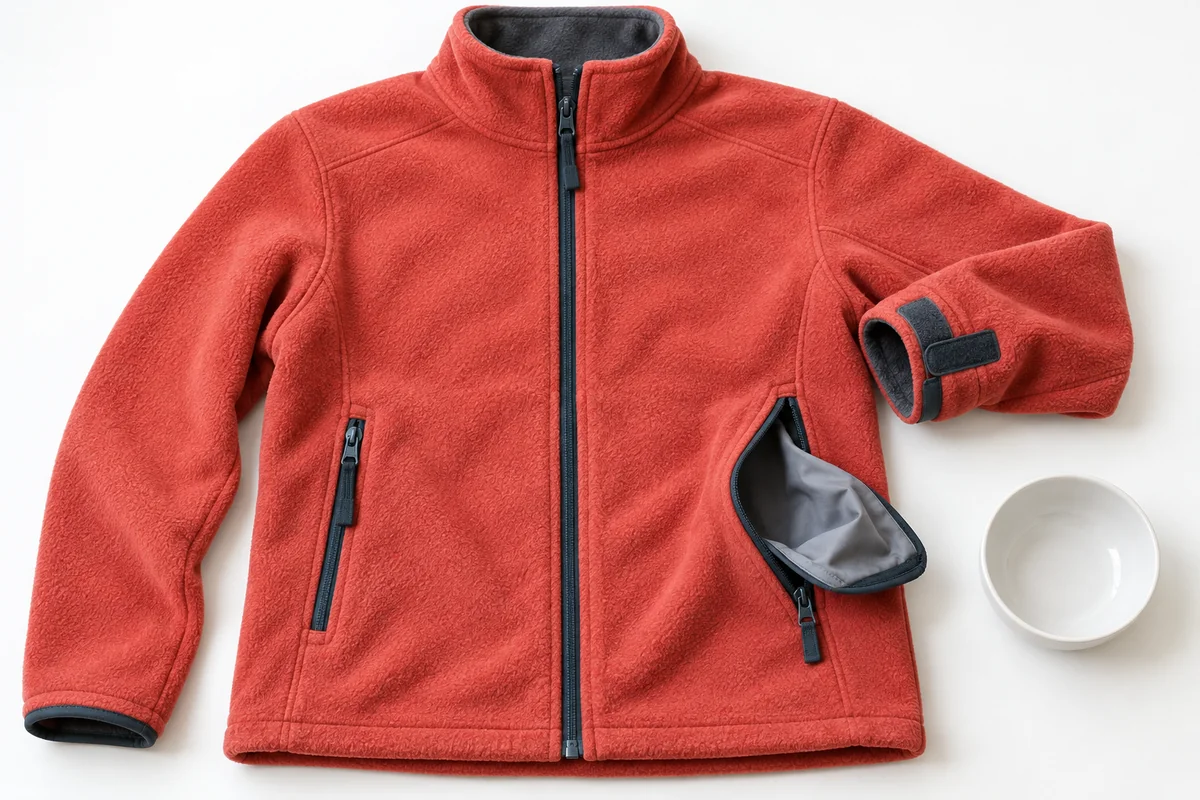
Empty every pocket, including internal and chest pockets. Check for tissues, wrappers, removable electronics, and small items hidden in corners. Inspect the zipper track before closing it. Do not force a broken or misaligned zipper; a washing cycle is not a repair method.
The North Face’s fleece instructions recommend closing zippers and hook-and-loop fasteners, using mild detergent and a cold cycle, and turning the jacket inside out as a way to limit pilling. Follow any more specific instructions supplied with your own garment, including how to handle removable parts.
Set up the rest of the load deliberately. Rather than asking only whether the colors match, ask whether the items have compatible care instructions and whether exposed hardware or rough surfaces could rub against the fleece. A load that works for sturdy work trousers may be a poor match for a soft, high-pile pullover.
Do not force a jacket into an already full drum to avoid a separate wash. Follow the appliance’s loading guidance and leave the load able to move as intended. If you use a laundry bag, it should be suitable for the garment and machine, with enough room for the item rather than compressing it into a tight bundle. A bag does not override a hand-wash-only label.
Which detergent should you use, and how much?
Read the detergent directions alongside the garment and washer instructions. Mild does not mean that every bottle carrying gentle-sounding marketing is suitable for every technical fabric. Check for restrictions on softener, bleach, additives, or a particular cleaner type. Where the garment maker calls for a technical wash, follow that direction rather than adding several household products to imitate it.
Measure for the actual load and the product’s concentration. Whirlpool’s dosing guidance identifies load size, soil, detergent type, and machine requirements as relevant factors, and warns that excess detergent can leave residue. A cap from one product is not a reliable measuring reference for a different concentrated formula.
Before pouring, identify where the appliance expects that product. Some machines have separate compartments or automatic dosing features. Follow the machine directions instead of adding detergent in two places because you are uncertain whether one dispenser is active. At a shared laundry, ask about the controls rather than experimenting on the garment.
Keep the routine simple enough to evaluate. If a wash leaves an unwanted result, it is harder to understand the cause when detergent, booster, softener, fragrance beads, and a home remedy were all used together. Choose the compatible cleaning product and intended dose first; add another treatment only when its purpose and compatibility are clear.
Should you use fabric softener, bleach, or a waterproofing product?
Do not assume a soft-feeling fabric needs a softener. Columbia’s fleece-care instructions advise mild detergent without bleach or fabric softener and describe air drying or low dryer heat. They also distinguish polyester fleece from cotton-majority fleece for ironing. Those differences are another reason to consult the actual label before adding products or heat.
A laundry additive is not a neutral extra. If the label says not to bleach, a product described as color-safe is not automatic permission to use it. If you cannot tell whether a combined detergent contains an excluded additive, use the manufacturer’s ingredient information or ask for clarification before washing.
Cleaning and adding water repellency are different jobs. Nikwax lists Tech Wash as a cleaner compatible with fleece and technical clothing. That does not establish that every fleece needs an additional waterproofing treatment, or that adding one turns a fleece into a waterproof shell. Use finishing treatments only when they are appropriate to the particular garment and their directions agree with its care requirements.
For a mixed-panel jacket, avoid borrowing an outer-shell heat-reactivation procedure simply because one panel looks water resistant. Ask the garment maker which instructions apply to the finished item. There is no need to buy a new product merely because the jacket has a technical-sounding name; establish a genuine requirement first.
How should you handle a stain before washing?
Identify the spill if possible, then check whether the garment permits a stain treatment. Write down what it is and whether anything has already been applied. Knowing that a cuff contains cooking oil, rather than an unidentified mark, gives you a better starting point when consulting product directions or asking a cleaner for advice.
The American Cleaning Institute’s stain guide separates methods by stain type; for example, it advises removing dry mud before laundering. Use it to identify the kind of problem, not to override a fleece label’s product restrictions. A general stain recipe that allows bleach on some fabrics is not suitable for a garment that prohibits it.
Follow the treatment’s stated contact time and testing instructions. Do not substitute an overnight soak for a brief pretreatment, and do not let a product dry on the fabric unless its directions specifically allow that. Work without forceful scrubbing of the pile. If a test produces color transfer, a texture change, or another unexpected result, stop that treatment.
After the wash, inspect the original mark before using dryer heat. If it remains, reassess the stain and the allowed treatment rather than escalating immediately to hotter water. Photograph the dry result if you need professional advice. A persistent mark and damaged fabric are different problems, and repeated washing is not a guaranteed solution to either.
What is a practical machine-washing sequence?
Use this sequence only after the label confirms machine washing is suitable. It is an order of decisions, not a substitute set of temperature, spin, or timing specifications. If your jacket’s directions differ, follow them.
- Confirm the full plan. Read washing and drying instructions together. Set out the compatible detergent and decide where the jacket will dry before starting.
- Prepare the item. Empty pockets, inspect vulnerable areas, secure permitted fasteners, and follow directions about turning the garment inside out or separating a liner.
- Build a compatible load. Keep excluded fabrics and abrasive hardware out. Use the machine’s loading guidance rather than a guessed maximum number of jackets.
- Set the controls deliberately. Select the permitted temperature and cycle. Check that a default high-temperature or extra-heavy setting has not carried over from the previous load.
- Add the measured product. Use the correct dispenser or placement method. Do not double-dose because the jacket looks bulky when dry.
- Review the result before drying. Check for visible residue, remaining stains, twisted components, or a fastener that opened. Follow the appliance instructions if another rinse is needed.
Keep a short note of the settings you actually used. The note is especially useful on a machine with several similarly named cycles. Record the label’s requirements separately from your chosen controls so that next time you can verify the match instead of remembering only that you pressed the blue button.
Do not change multiple variables after one disappointing wash without first identifying the problem. If the stain remains but the rest of the garment is clean, focus on stain treatment. If residue remains, investigate dosing and rinsing. If the pile looks different, examine it dry before assuming the wash needs to be repeated.
When is hand washing appropriate?
Hand washing is an option when the garment’s instructions permit or require it, not a way to make every restricted garment washable. If the label says not to wash, placing the jacket in a sink does not avoid that restriction. A missing label also does not automatically make hand washing a proven safe choice.
Before beginning an approved hand wash, choose a clean container large enough to handle the jacket without cramming it into a small basin. Use the stated water temperature and a compatible product at its hand-washing dose. The concentration intended for a full machine load should not be poured into a much smaller container by guesswork.
Follow the garment directions for soaking and movement. Support the wet item when lifting it, and avoid treating aggressive twisting as a necessary step. Plan how you will rinse and transfer it to its permitted drying surface without dragging it over a dirty floor or carrying a dripping bundle through a cluttered room.
Hand washing trades machine control for your own handling. It can be awkward for a large, lined jacket, and it may take more space than expected. If you cannot carry out the instructions consistently, asking the manufacturer or a suitable cleaner for advice is preferable to improvising a more forceful method halfway through.
How do you decide between air drying and a dryer?
Read the drying instruction as a separate requirement. Permission to machine wash does not necessarily include permission to tumble dry. Columbia’s fleece guide favors air drying and describes low heat or an air setting when a dryer is appropriate. By contrast, Arc’teryx’s fleece-care instructions describe low-temperature tumble drying while emphasizing product-specific labels. Do not turn either example into a universal rule.
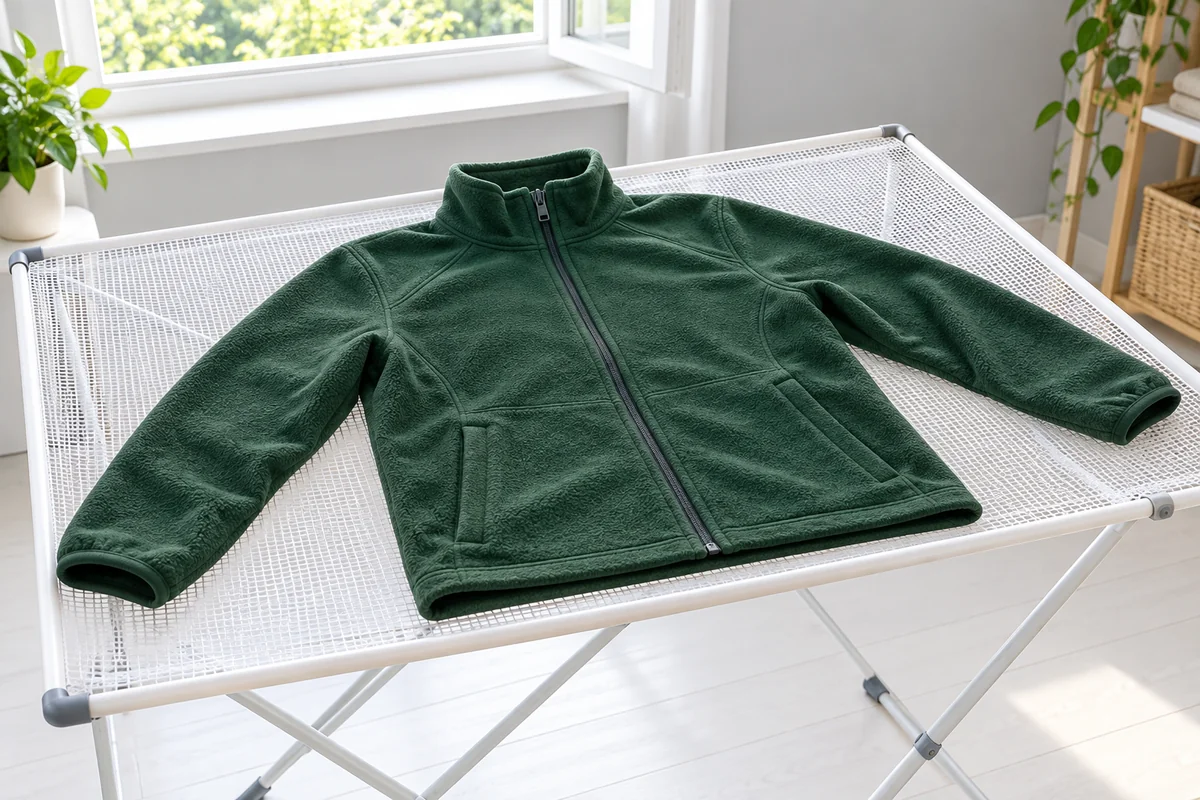
If air drying is allowed, arrange the garment using the method its label specifies, with enough space to inspect it and let moisture escape. Avoid folding damp sleeves into the body and then assuming the whole item has dried because the outside feels dry. Recheck cuffs, pocket bags, seams, and overlapping panels before storage.
If tumble drying is allowed, use the specified setting and the machine’s operating directions. Do not raise the heat because another item in the drum is taking longer. That is a load-planning problem, not evidence that the fleece can tolerate a hotter setting.
Choose the drying method before your schedule becomes urgent. When the label permits either method, consider available space, the machine controls, and when you can check the garment. Do not invent a guaranteed drying time: jacket construction, remaining water, airflow, and conditions all affect when the item is ready to put away.
Why does fleece pill, and what can you realistically fix?
First distinguish attached pills from loose debris. A pill is a small tangle attached to the surface; a strand of another fabric resting on top may simply be lint. A flattened patch under a backpack strap is a different observation again. Calling every texture change pilling can send you toward the wrong remedy.
REI explains that abrasion commonly causes fibers to loosen and tangle into pills, including friction during wear. Reducing rubbing and following care instructions can help, but some fabrics still pill. Washing is not guaranteed to remove attached pills or make a worn garment look new.
Before trying a shaver, comb, stone, or brush, check whether the garment maker recommends that tool for the particular surface. A tool that works on a smooth knit may be inappropriate for long, fluffy pile. Start only with an approved method on an inconspicuous area, and stop if it catches, removes the intended pile, or changes the surface unevenly.
Set a realistic goal. Removing a few pills may improve appearance, but it does not rebuild missing fibers or reverse every source of wear. If the jacket still functions well, accepting a cosmetic change may be preferable to repeatedly cutting or brushing the fabric in pursuit of a finish it no longer has.
What if the jacket feels stiff, matted, or unusually flat?
Evaluate the jacket when it is fully dry, in good light, and compare it with your before-wash observations. Note whether the change affects the whole garment or just a cuff, elbow, collar, or area that was pressed against something. Do not diagnose permanent damage from a photograph alone or assume every stiff area is detergent.
If you can see residue or remember an accidental overdose, review the product and machine instructions for an appropriate corrective rinse or wash. If the texture changed after a hot dryer cycle, stop adding heat and ask the garment maker about the specific material. More softener, hotter water, or forceful brushing should not be the automatic next experiment.
For advice, gather useful details: model or style number, fiber content, label photographs, products used, wash settings, drying method, and where the texture changed. This is more actionable than saying only that the fleece feels wrong. Keep the garment available for inspection rather than applying several remedies before anyone can assess it.
Be cautious about promises to restore all fleece with vinegar, conditioner, steam, or a pet brush. A before-and-after video may involve a different fabric or a different problem. You need a method appropriate to your item, and some changes may be irreversible. Do not claim success until the jacket has dried and the relevant area has been checked again.
How should you handle odor that remains after cleaning?
Separate the observation from the explanation. An odor may be associated with a particular area, a cleaning product, incomplete drying, or another cause; smell alone does not identify it. Note when it appears and whether other items washed in the same machine have the same issue.
Check the straightforward parts of the process first. Was the correct product used at the intended dose? Was the load compatible and able to move? Did the jacket finish rinsing? Was it dried as instructed before being folded or bagged? These questions help identify a missed step without immediately changing to a harsher chemical treatment.
If the garment instructions permit another wash, make the next attempt purposeful. Correct an identified dosing or loading error rather than adding every available laundry booster. If the smell persists, the label is unclear, or a treatment would exceed a stated restriction, contact the manufacturer or an appropriate cleaner before proceeding.
A scented jacket is not necessarily a clean jacket, and ordinary washing is not a medical decontamination claim. Clothing exposed to a workplace contaminant or a situation requiring a specific cleaning procedure needs the relevant specialist instructions, not this general household fleece routine.
What changes at a laundromat or shared laundry?
The care label does not change with the building. Before loading a shared machine, locate its temperature and cycle controls, product compartments, and posted instructions. Do not assume a setting called delicate has the same temperature or action as the setting with that name on your home machine.
Bring the product information you need, plus a clear photograph of the label if it is difficult to read while the jacket is inside out. Keep items that require separate treatment apart from the general laundry. If the machine cannot provide a required setting, choose another appropriate method rather than hoping the closest available option is equivalent.
Plan the trip home as part of drying. A jacket that must finish air drying needs an arrangement that does not turn a damp bundle into forgotten storage. Set up the drying space before leaving and unpack promptly when you return. Do not treat the end of a paid cycle as proof that every pocket and seam is dry.
Fresh Spin offers drop-off wash-dry-fold, but this article does not promise acceptance of a particular fleece or a special treatment. Ask about your garment’s label, stains, and drying restrictions before leaving it. For an in-store order, enter through the Ash entrance and place the order in the mini-mart. Use the contact and directions page to plan the visit.
How should you store the jacket and plan its next wash?
Put the jacket away only after checking that it is clean enough for storage and fully dry. Inspect areas that fold over each other instead of checking only the front panel. Choose a clean, dry storage location and follow any garment-specific hanging or folding instructions.
Keep a small care record if the item is complicated: a label photograph, the manufacturer’s current guidance, the compatible cleaner, and the machine settings that matched those instructions. This is particularly helpful for households with several similar-looking jackets. A note for one garment should not become an assumed recipe for all the others.
At the next wash, review the item rather than repeating the previous routine automatically. A newly damaged zipper, a different stain, or a change of detergent may alter the plan. The useful habit is checking what has changed, not building an elaborate ritual around a jacket that only needs ordinary permitted care.
How do different jackets lead to different cleaning plans?
The following examples are hypothetical planning exercises, not reports of tested garments or customer results. Each starts with information the owner has verified. Their purpose is to show how the same general routine changes when a label, a stain, or a construction detail changes.
A simple pullover with a clear label: Suppose its instructions allow a cold gentle machine wash and require air drying. The owner has compatible detergent and a suitable drying space. The decision is straightforward: prepare the garment, choose a compatible load, measure the product, and use the allowed settings. The dryer is not a backup just because it is available. If the pullover is still damp when it is time to leave, the sensible adjustment is to wear something else, not reinterpret the drying restriction. Keeping a photograph of that label makes the next wash easier without turning the example into instructions for every pullover.
A fleece-lined jacket with an unclear outer panel: Suppose the main fabric looks familiar, but the owner cannot identify the shiny shoulder panels and the care label has faded. The first task is identification, not selecting a cycle. Find the style information and ask the maker for the finished garment’s directions. Meanwhile, avoid experimenting with a waterproofing wash, dryer heat, or a cleaning solvent on the panel. Once the correct instructions are obtained, decide whether the available machine can follow them. The delay is useful because it resolves a missing fact; it is not proof that the jacket is unusually fragile or needs a special paid service.
A washable jacket with one persistent mark: Suppose the label is clear, the approved wash has finished, and the original food stain remains on one cuff. The rest of the jacket does not automatically need stronger treatment. Check the stain-product directions and garment restrictions, then decide whether a targeted second attempt is appropriate. Keep dryer heat out of the decision until the mark has been reassessed. If another allowed attempt fails, gather the product and care information for advice. Do not repeatedly increase temperature, contact time, and scrubbing together; that makes it difficult to tell which change affected the stain or the fabric.
These examples also help when more than one person handles the laundry. Communicate the unresolved decision, not just a vague instruction to be careful. A note that says the drying method still needs confirmation prevents a different mistake from a note that identifies a cuff stain for inspection. Keep the instruction with the item until the question is answered, then update the care record so an old uncertainty does not become a permanent household rule.
What are the most useful answers to common fleece questions?
Can you wash a fleece jacket with towels or jeans?
Do not decide by color alone. Compare care instructions, fabric weight, surface texture, exposed hardware, and the machine’s loading requirements. If the items need different settings or create an unsuitable rubbing environment, separate them. A convenient mixed load is not worth using a cycle that conflicts with one garment’s label.
Can you use hot water to remove a stubborn smell?
Only use temperatures the garment permits. An odor is a reason to investigate cleaning and drying, not automatic permission to increase heat. Check the label, detergent dose, rinse result, and drying completion. If a particular contamination requires special treatment, obtain the relevant instructions instead of relying on a generic hot wash.
Is a no-heat dryer setting always safe?
No. A no-heat setting still involves machine handling, and a garment may prohibit tumble drying altogether. Read the complete drying instruction. If the jacket must dry flat, a cycle advertised as air only does not turn a tumbling drum into a flat drying surface.
What should you do when the care label is missing?
Look for a style number, old order confirmation, or another identifying tag and contact the manufacturer. Send photographs of the whole jacket and its panels or lining. Do not rely on a resale listing for a vaguely similar item. If identification remains uncertain, seek suitable cleaning advice before committing to a full wash.
Can every fleece be made fluffy again?
No reliable universal method can promise that. Loose lint, attached pills, flattened pile, residue, and heat damage call for different assessments. Start by identifying what changed and checking the manufacturer’s guidance. Stop any treatment that catches fibers or worsens the texture, and accept that some wear cannot be reversed.
A successful fleece-care routine is a sequence of compatible decisions: identify the garment, prepare it, clean it within its limits, dry it correctly, and inspect the result. You do not need the strongest cycle or the most products. You need a method that fits the jacket in front of you and a clear stopping point when the instructions or condition are uncertain.


Leave A Comment