
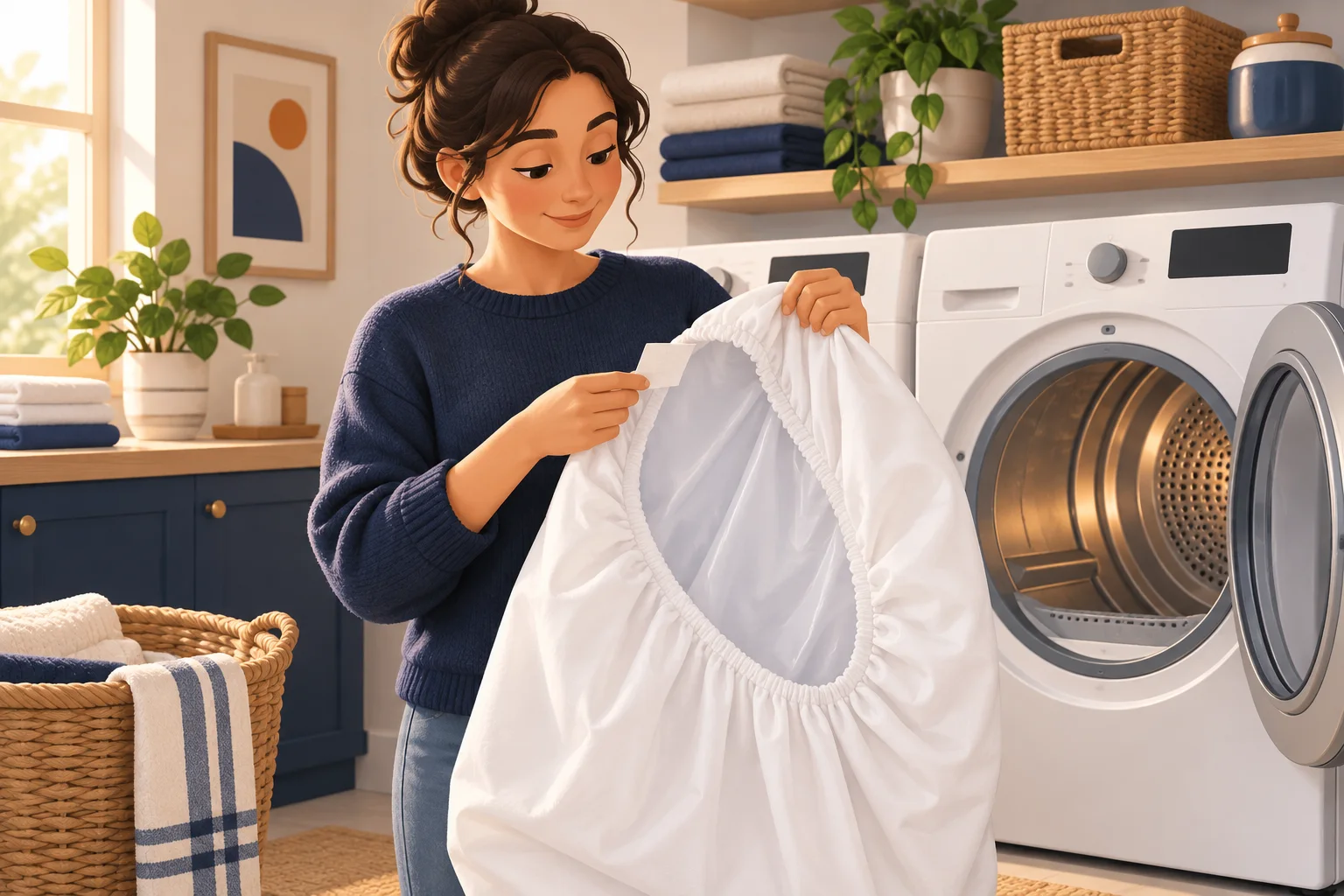
Yes, some waterproof mattress protectors can go in the dryer—but only if the care instructions for that exact protector allow it. Low heat is common, yet it is not a universal rule. Check the permitted drying method, temperature, and any instructions about drying with other linens before starting. If the label prohibits tumble drying, a larger commercial dryer does not change that restriction.
A protector can look like an ordinary fitted sheet while needing a different laundry routine. The fabric surface is only part of the product: a waterproof backing, elastic skirt, laminated layers, or zipper can affect how it should be cleaned. The goal is to finish with a dry, usable protector, not simply get it through a hot cycle as quickly as possible.
This guide explains how to make that decision at home or at a laundromat, what to do when instructions are missing, and which shortcuts are worth skipping. It draws on manufacturer care directions reviewed September 20, 2026. Brand examples illustrate differences in instructions; they are not Fresh Spin product tests or endorsements.
Should Your Mattress Protector Go in the Dryer?
Use the instructions attached to your product as the starting point. “Waterproof,” “cooling,” “premium,” and “cotton” describe features or materials; none independently tells you the correct dryer setting. If your protector came with an instruction sheet, check that too. An online guide for a newer version may not describe the protector already on your bed.
| What the instructions say | What to do | What to avoid assuming |
|---|---|---|
| Tumble dry low | Use the permitted low setting and follow any additional loading instructions. | That extra heat is acceptable because the item is still damp. |
| Air dry or line dry only | Use the specified air-drying method with enough space around the material. | That a commercial dryer makes a prohibited method safe. |
| Dry with towels or other linens | Follow that product-specific instruction using compatible clean items. | That every protector should be dried alone—or with towels. |
| Missing or unreadable directions | Identify the model and ask the manufacturer before washing or applying heat. | That another brand’s directions are a substitute. |
| Peeling lining, damaged seams, or melted areas | Pause and check with the manufacturer about continued use or replacement. | That another wash will repair the waterproof layer. |
The most useful laundry decision happens before the machine starts. Write down the allowed method, choose compatible items, and leave time for the drying process the product actually permits. If that process will not fit today’s schedule, adjust the schedule or use a spare protector. The care instructions do not change because bedtime is approaching.
Are You Washing a Protector, a Mattress Cover, or a Topper?
These names are often used interchangeably in conversation, but they can describe very different products. Before taking anything off the bed, identify the item you intend to wash. A removable accessory that you purchased separately is not automatically equivalent to a zippered cover built into the mattress.
A fitted mattress protector
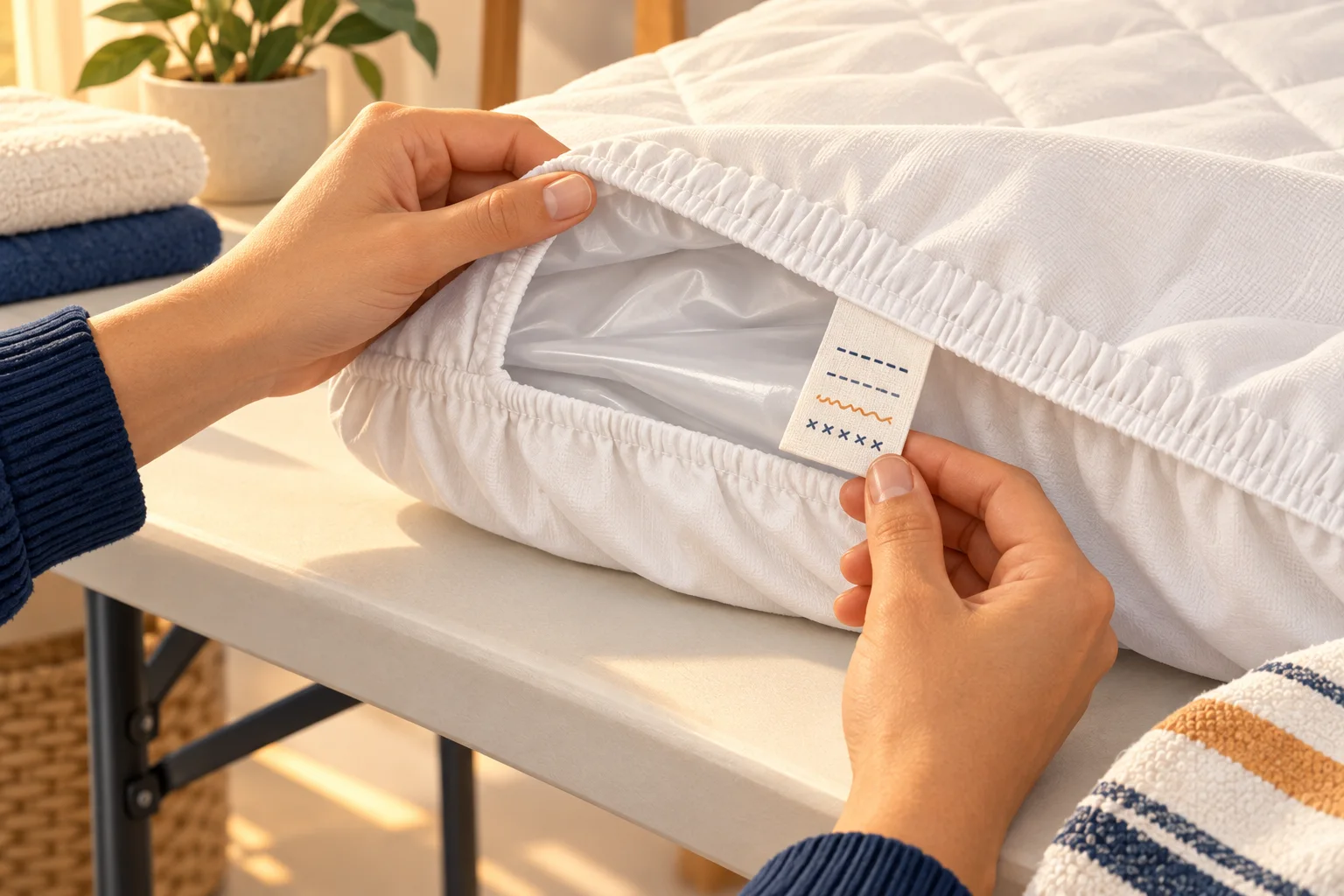
This commonly sits between the mattress and fitted sheet and has an elastic skirt. Some versions include a waterproof barrier; others mainly protect against ordinary surface soil. Find the care tag on the protector itself. Reading the sheet’s label tells you how to wash the sheet, not the layer underneath it.
A full mattress encasement
An encasement surrounds more of the mattress and usually closes with a zipper. Look for instructions about the zipper, washing, drying, and reinstallation. Do not treat a zippered opening as an invitation to remove a product without reading its directions. If the encasement has a specific protective purpose, ask its manufacturer how cleaning fits that use.
The mattress’s own outer cover
The outer covering supplied as part of the mattress is a separate question. For example, Purple’s guidance for its mattress zip cover describes localized cleaning and advises against over-wetting. That is different from its instructions for a separately sold washable mattress protector. Product identity matters more than the presence of a zipper.
A mattress pad or foam topper
A pad may add cushioning; a topper may contain a substantial foam layer. Neither should be sent through a protector’s wash routine by default. Saatva’s bedding-care guide distinguishes washable pads and protectors from foam toppers, which it advises against machine washing. If the item is thick foam rather than a flexible fabric accessory, stop and find its own cleaning directions.
A practical way to avoid confusion is to photograph each item’s tag while it is still on the bed. Save the pictures with a description such as “queen guest-room protector” or “king fitted sheet.” That small record can prevent several nearly identical white bedding items from receiving the same settings by mistake.
What Do Mattress Protector Manufacturers Actually Recommend?
There is a useful reason to compare instructions: it shows why one universal setting is unreliable. The following are examples from manufacturer pages, not directions for every item sold under those brands. Your sewn-in label and guidance for your exact model take priority.
- Casper Waterproof Mattress Protector: its current product page recommends cold machine washing and low tumble drying, with air drying as an option. It advises against solvents, bleach, fabric softener, and dry cleaning, and warns about heat-related damage. Read Casper’s current materials and care instructions.
- Purple Waterproof Mattress Protector: the current product page lists cold machine washing and low tumble drying, and recommends drying with other bedding for best results. This applies to that accessory, not automatically to the mattress’s built-in cover. Read Purple’s current protector instructions.
- Protect-A-Bed examples: its UK FAQ includes instructions that vary by product and specifically discusses drying with towels or linens. Its guidance should not be transferred to a different model or market. Read the Protect-A-Bed UK product-care FAQ.
The practical lesson is not to combine these instructions into one homemade recipe. If one product permits a certain temperature and another calls for a different loading method, following both at once does not necessarily suit either one. Find the instructions that match the item you own.
When the care tag and a website appear to disagree, keep the question specific. Send the manufacturer a photo of the tag, the model name, and the instruction you found online. Ask which direction applies to your item. That is more useful than asking whether “waterproof bedding” can go into a dryer.
How Should You Wash a Waterproof Mattress Protector?
Start by confirming that the item is machine washable. Then build the load around its directions. A good wash plan addresses what is being washed, which products are allowed, how much room the item needs, and how you will dry it afterward. The following sequence is a planning guide; settings come from your product.
1. Inspect the protector before it gets wet
Lay out enough of the item to see the fabric, backing, seams, and elastic. Look for obvious damage or areas where layers appear to be separating. A preexisting defect is useful information for the manufacturer and for anyone helping with the laundry. Do not assume laundering will restore a damaged barrier.
If you notice a problem, photograph it before treatment. Include a wider picture that shows its location and a close picture of the affected area. This gives you a record without having to describe an unfamiliar material from memory. Keep any receipt or model information available if you plan to ask about replacement.
2. Read the detergent restrictions
Check both the protector’s instructions and the laundry product’s label. Some detergent bottles combine cleaning ingredients with other additives. A product described as suitable for ordinary white cotton may still be inappropriate for an item with a waterproof backing. Choose the allowed product rather than relying on its color, fragrance, or marketing language.
Measure the dose appropriate to the product, load, and machine instructions. A king-size protector is large in surface area, but that does not by itself tell you how much detergent to pour. If you are uncertain at a laundromat, ask how to use the dispenser and confirm that the detergent is appropriate for the machine.
3. Check stains without improvising a chemical mix
Point out any stain before starting, especially if you are asking someone else to wash the item. Tell them what caused it, if known, and what has already been applied. A useful note is “coffee spill; no treatment yet” or “unknown mark; already washed once.” It is better to describe uncertainty than name a stain that has not been identified.
Do not assume a general clothing-stain recipe applies to a coated bedding product. Choose a treatment only when it is compatible with the protector’s directions. If a stain remains, deciding whether to repeat an allowed treatment is different from deciding to escalate to an unapproved product. Appearance and waterproof performance are separate concerns.
4. Assemble a compatible load
Check instructions about washing alone or with other items. Similar color is only one consideration: the items also need compatible wash settings and products. A pile of white bedding can contain a protector, a cotton sheet, a foam item, and a blanket with entirely different directions.
Sort before paying for the machine. Put the protector in its own identifiable bag or basket until the load is settled. Keep the care tag or a photo accessible. If the instructions require a particular companion item, make that part of the plan instead of adding an arbitrary towel at the last moment.
5. Choose the machine and cycle deliberately
Read the machine’s operating instructions as well as the item’s label. The fact that a door closes does not establish that a load is appropriate. If you cannot tell whether the available machine or cycle fits the care directions, ask staff before beginning. A different machine may help with capacity, but it cannot remove a product restriction.
For a refresher on reading the label itself, see our laundry care label guide. Use the full set of instructions, including the drying symbols or wording. Washing an item first and only then discovering that it must air dry can turn a straightforward job into an avoidable scheduling problem.
How Do You Dry a Mattress Protector Without Guessing?
Once the wash is complete, check the planned drying method again. Keep the protector separate from items heading into a hotter load. If several family members are helping, tell the person moving the laundry which item has special instructions. A correct wash does not help if the next person treats everything as towels.
If tumble drying is permitted
Select the allowed heat setting and follow the loading directions. Do not choose a setting just because the machine is labeled “commercial” or the protector is labeled “waterproof.” Those labels answer different questions from “Which cycle may this item use?” If controls are unfamiliar, ask about them before starting.
Plan to check the item rather than assuming a fixed drying time. Dryer models, loads, and product construction differ, so this guide does not promise a number of minutes. If the protector is not dry when you expected, first verify that the process matches the care instructions. A higher setting is not an automatic correction.
Before returning the protector to the bed, inspect the areas that folded over during drying, including corners and the elastic skirt. The outside of a folded item can feel different from an enclosed section. Finish the allowed drying process if needed, then check the fit when putting it back on.
If air drying is permitted or required
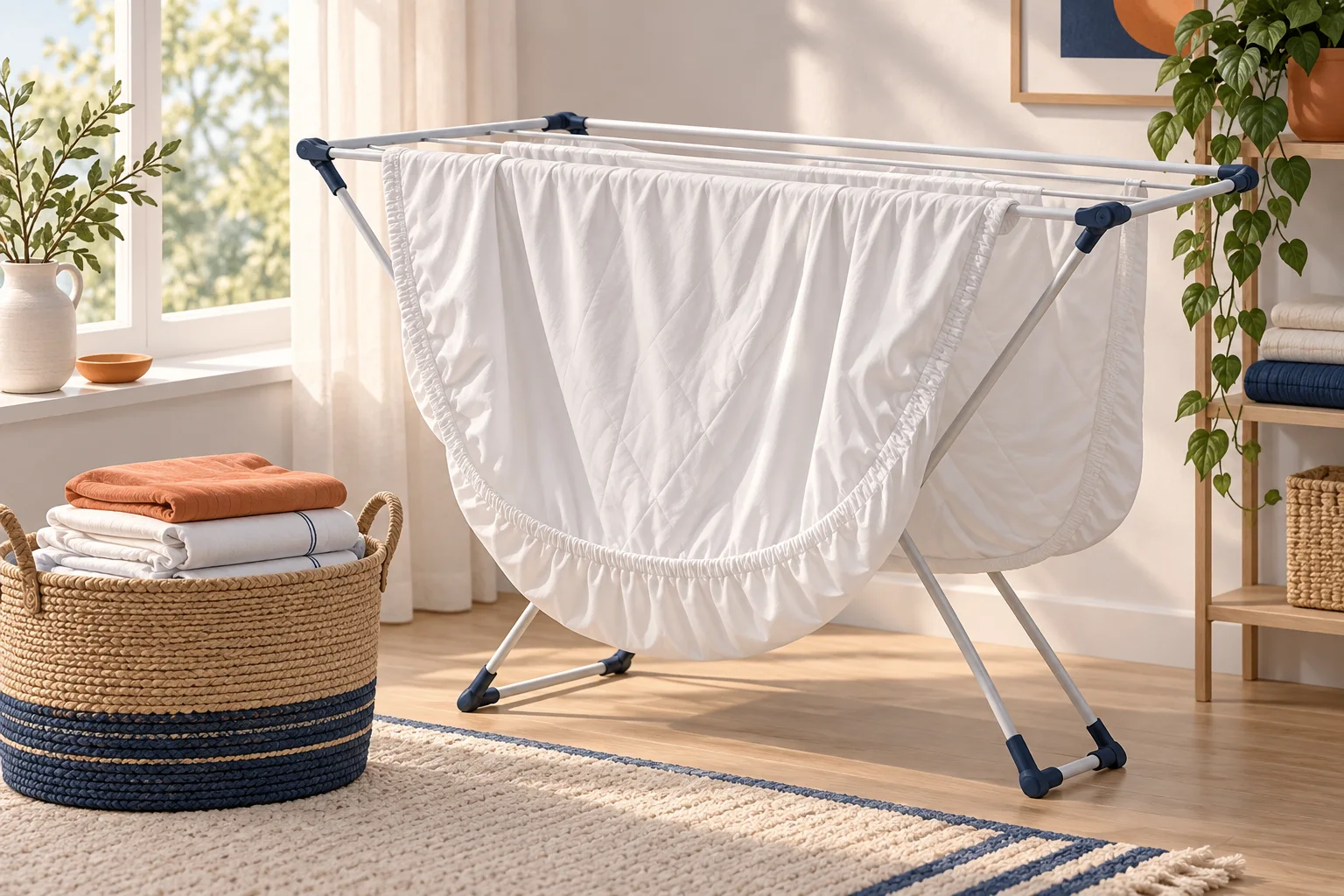
Choose a clean place where you can arrange the protector using its recommended drying method. A rack may help spread a large item without bunching it into a wet bundle. Plan enough space for the full item, and follow any directions about sunlight, hanging, or support.
Keep the practical details in mind before washing. Is there room for the rack? Can it stay undisturbed? Will you need a spare protector tonight? Those questions do not require special laundry equipment, but they determine whether the routine will work for your household. Do not fold the item into storage while it is still damp.
If the instructions cannot be found
Pause before applying heat or beginning a new cleaning method. Check the purchase record, packaging, sewn-in tag, or manufacturer support page. Search for the exact model name, not simply the brand plus “washing.” If you still cannot identify the product, ask its manufacturer or seller for help and explain what information is missing.
When writing to support, include the item’s approximate purchase date, size, model or order number if available, and photographs of both sides. Ask whether it is machine washable, what drying method is allowed, which products to avoid, and whether the dryer load needs anything else. One clear inquiry can resolve the whole routine.
What If the Protector Is Still Damp, Stained, or Damaged?
Treat the observed problem as a question to investigate. “Still damp,” “still stained,” and “lining looks damaged” are different findings and do not call for the same response. Start with what you can actually see or feel, then compare it with the care directions.
It is still damp after the planned dry cycle
Check whether it has folded into itself and whether the selected settings match the instructions. Follow the product and machine directions for continuing the process. If you need help, show staff the label rather than asking for the “fastest” setting. Drying speed is useful only within the limits of the item.
For the next laundry day, leave more flexibility between washing and remaking the bed. A backup protector can make that easier, but buying a second one is optional. You might instead start earlier, divide the bedding job across days, or plan a period when the bed will not be needed immediately.
A stain is visible after washing
A remaining mark does not tell you which stronger product is safe. Review the approved treatment options and the cleaning history. If the manufacturer has specific instructions for that stain, follow those. If it does not, ask before treating a waterproof layer like an ordinary white shirt.
Keep expectations realistic. This article cannot promise that every stain will disappear or that washing restores a damaged protector. When you discuss an item with a laundry attendant, separate your priorities: stain appearance, odor, required care settings, and any concern about the backing. That helps make the next decision explicit.
The backing is peeling, blistered, or distorted
Stop experimenting with additional heat or products. Photograph the condition and ask the manufacturer whether the item should remain in use. Do not assume that a clean-looking surface means the protective layer is intact. Equally, do not diagnose every discoloration as a total failure from appearance alone.
If replacement becomes necessary, note what you would choose differently next time: clearer instructions, an easier drying method, a spare, or a product whose care requirements fit the machines you use. A purchase that fits your laundry routine may be more practical than one selected only for an impressive feature list.
Which Mattress Protector Laundry Shortcuts Should You Skip?
Most avoidable mistakes begin with a reasonable goal: finish faster, remove a mark, or combine several jobs. The problem is substituting that goal for the item’s instructions. Consider these common decisions before the bedding reaches the machine.
- Using high heat to make up for a late start. Change the timing or use a spare when possible; do not change the permitted settings simply to finish sooner.
- Assuming all white bedding can use the same products. Sort by care requirements as well as appearance.
- Borrowing instructions from another brand. A helpful example is still an example, not permission for your item.
- Removing a mattress’s own cover because it has a zipper. Confirm whether removal and washing are allowed first.
- Adding softener automatically. Check product-specific restrictions before any additive, including products built into a detergent.
- Trying to repair a damaged barrier by washing again. Cleaning and material repair are different tasks.
- Putting the protector back while it is damp. Finish the permitted drying process before reinstalling or storing it.
None of these decisions requires buying a complicated collection of laundry supplies. Start with the instructions, an appropriate detergent, a suitable machine or drying space, and a plan. Extra products are useful only when they solve a supported problem and are permitted for that item.
Can You Wash a Mattress Protector at a Laundromat in Independence?
A laundromat can be a practical option when the protector is machine washable and the available equipment can follow its instructions. It can also make sense when you are handling several separate bedding loads and want access to appropriate machines in one visit. It is not automatically necessary for every thin protector.
Fresh Spin Laundry offers self-service washers and dryers in Independence. Bring the product’s care label and ask about a suitable machine before starting an unfamiliar item. Match the item to the available settings; do not assume a larger washer or dryer makes every protector washable.
If you prefer to leave the active washing and folding to the team, review Fresh Spin’s in-store drop-off wash-dry-fold service and ask whether your exact protector can be accepted under its care requirements. Identify it as a waterproof protector rather than simply calling it bedding. Confirm any restrictions, pricing, and completion estimate before leaving the item.
Fresh Spin is at 10215 E Truman Road, Independence, Missouri. Use the contact and directions page to plan the visit or call with an item-specific question. Customers bring drop-off orders to the store and return to collect them. Fresh Spin does not provide home pickup or delivery.
If the same trip includes a comforter, keep its instructions separate. Our comforter-washing guide covers that different bedding job. Combining errands can be convenient; combining incompatible wash instructions usually makes the task harder to manage.
How Can You Make the Next Bedding Laundry Day Easier?
Build a small routine around the items you actually own. The following examples are planning suggestions, not manufacturer instructions or stories about real Fresh Spin customers. Choose the parts that fit your household and keep the care label in charge of machine settings.
If you share laundry responsibilities
Create a short bedding note that identifies the protector separately from the sheets. Include where the instructions are saved, which items can share its load, and the required drying method. Make the note specific enough that someone else can follow it without having to remember a conversation from several weeks earlier.
For example, a household might write: “Guest-room protector: check saved tag photo before washing; keep out of the towel load until settings are checked.” This is an organizational reminder, not a universal care rule. It prevents the common handoff problem in which the person loading the dryer does not know that one item needs different treatment.
If you have several beds
Identify the size and room before stripping everything at once. Similar-looking protectors can be different models, particularly when purchased at different times. Label the storage bag or keep a simple list linking each item to its care photo. You do not need to write on the protector or attach anything that could damage it.
Decide which bed must be ready first and plan the order of washing accordingly. If one protector must air dry while another permits tumble drying, their schedules will differ even when the sheets look identical. The useful efficiency gain comes from organizing the sequence, not applying one aggressive setting to every load.
If you only have one protector
Check the drying plan before removing it. If you need the bed again soon and the required drying method takes more flexibility than today allows, choose another time when practical. After an unexpected spill, tell anyone helping exactly what happened and follow the product’s cleanup directions.
A spare may be convenient for some households, but it is not a requirement created by this guide. Start by seeing whether a different start time or a more predictable laundry routine solves the problem. The goal is a manageable habit, not a shopping list.
If you use a laundry service
Make the instructions easy to find and point out the item at the counter. Explain if the label is missing or if you have already contacted the manufacturer. Ask whether the service can follow the documented requirements before assuming the protector can be included with everyday clothing.
Keep a record of any answer that matters for the next order. If the service cannot accept that particular item, the next step may be following the manufacturer’s home-care method or asking the manufacturer about another suitable cleaning option. An honest acceptance decision is more valuable than a promise made before anyone reads the label.
Common Questions About Washing and Drying Mattress Protectors
Can you tumble dry a waterproof mattress protector on low?
Yes, when its own care directions allow low-heat tumble drying. Confirm any other instructions about the load or companion linens. Low heat is common in the manufacturer examples above, but it is not permission to tumble dry an item labeled for air drying only.
Can a king-size mattress protector go in a home washer?
Possibly. First confirm that it is machine washable, then check the machine’s instructions and whether the load is suitable. Size alone does not settle the question. A thin fitted protector and a thick padded product may need different handling even when both fit a king mattress.
Should you dry a mattress protector by itself?
Follow the instructions for your product. Some directions call for other linens in the dryer; other products have different requirements. Do not make “always alone” or “always with towels” your default rule for every protector you own.
Can you use fabric softener on a waterproof mattress protector?
Only if its care instructions permit it. Some manufacturers explicitly prohibit softener. Check combination detergents and other additives too, and do not assume a product is suitable just because you use it successfully on sheets or clothing.
How long does a mattress protector take to dry?
There is no dependable universal time. The protector, permitted method, machine, and load all matter. Plan to inspect it and finish the allowed process instead of increasing heat to meet an arbitrary deadline. Check folded areas before returning it to the bed.
How often should you wash a mattress protector?
Use the guidance for your model and respond to spills or soil according to its instructions. Household use varies, so a single calendar rule does not fit every protector. Add inspection to your sheet-changing routine so you notice when the protector needs attention.
Does a waterproof protector mean the mattress never needs attention?
No. Follow the mattress’s own care instructions as well. If liquid reaches the mattress or another problem appears, address that separately. A protector’s cleaning directions describe the accessory and should not be treated as instructions for cleaning the whole mattress.
Will a laundromat restore damaged waterproofing?
Do not expect ordinary washing or drying to repair a damaged barrier. Ask the manufacturer about visible defects and continued use. A laundromat helps you carry out a suitable laundry process; it does not change the construction or condition of the item.
Before Your Next Wash, Make These Three Decisions
Identify the exact protector, confirm its permitted drying method, and decide where that process will happen. Those answers determine the rest of the visit: which machine to choose, what else belongs in the load, and whether to do the work yourself or ask about drop-off service.
For Fresh Spin customers, the practical next step is simple: bring the care information with the item. The more clearly you can explain what the protector requires, the easier it is to decide whether self-service or an accepted drop-off order fits the job. A successful laundry day finishes with bedding you can use confidently and a routine you can repeat.