
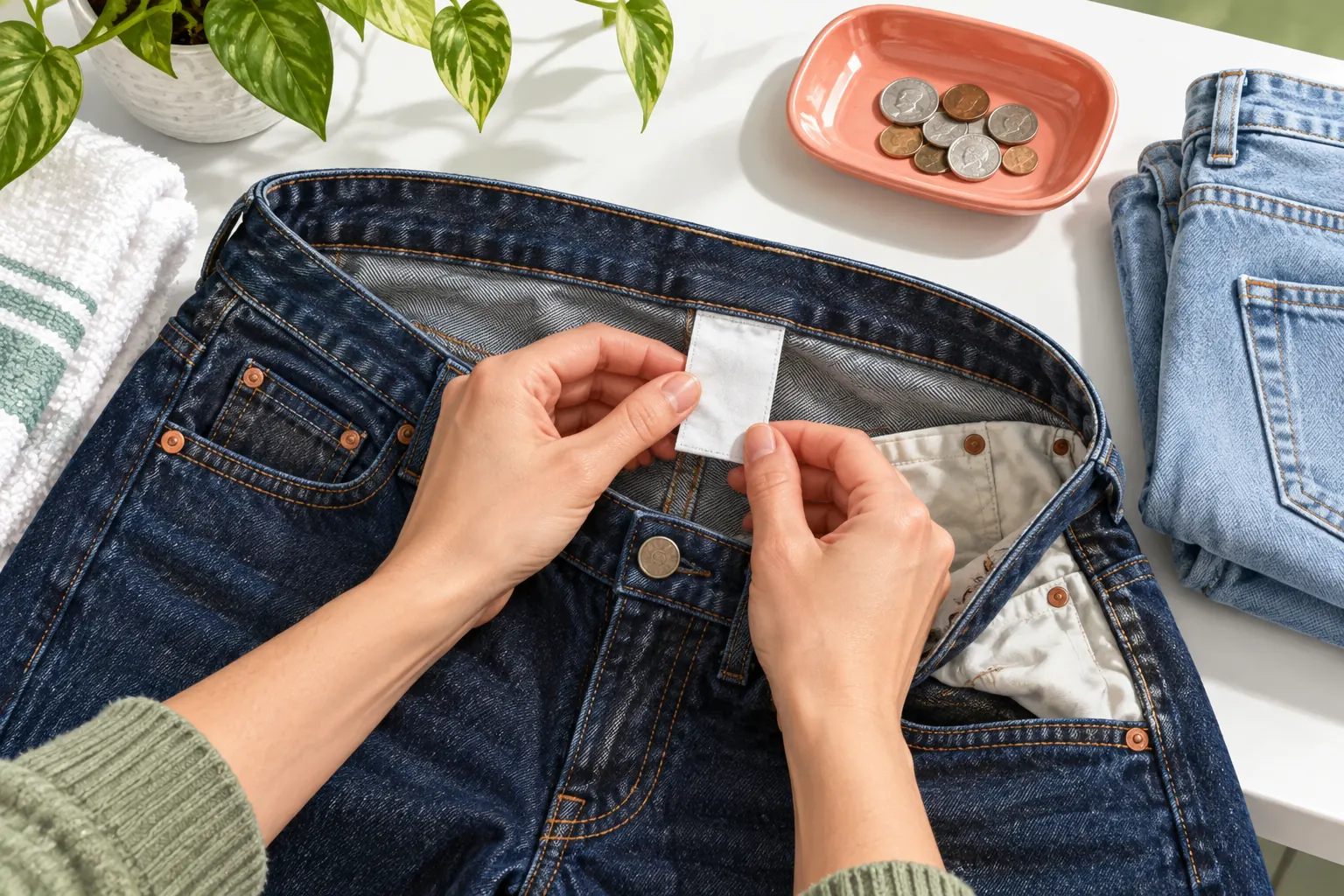
To wash jeans, check the garment label, empty the pockets, turn the pair inside out, and choose a compatible wash and drying routine. For many ordinary washable jeans, cold water and gentle handling are useful starting points, but raw, stretch, coated, and decorated denim need their own instructions. Separate new dark denim from pale clothing, measure detergent, and inspect the result before applying dryer heat.
The most useful question is not simply whether jeans can go in a washer. It is whether this particular pair can share the settings, products, and drying method you have planned. Two pairs that look almost identical may have different fiber blends or finishing instructions. A household routine works better when those exceptions are identified before the laundry leaves the bedroom.
This guide explains how to make that decision, prepare a load, handle ordinary stains, and plan drying without relying on a universal wash schedule. The examples are hypothetical planning situations, not product tests. Manufacturer guidance is cited where it informs a care decision; your own garment’s instructions remain the starting point.
What should you check before washing a pair of jeans?
Read the care instructions, not just the fiber percentage
Find the sewn label inside the waistband, pocket area, or side seam. Read the whole instruction sequence, including washing, bleaching, drying, and ironing restrictions. A cotton percentage tells you what the fabric contains; it does not settle how a coating, decorative trim, or particular finish should be cleaned. The FTC’s care-label guidance explains that care instructions must account for the complete garment and warn against procedures that could cause harm.
For a household checklist, record four answers: can it be washed, what temperature or cycle is specified, what products are restricted, and how must it dry? If a symbol is unfamiliar, use the Fresh Spin laundry care-label guide before selecting a program. Do not substitute a generic denim article for an unreadable or missing instruction when the garment has unusual construction.
Make an exception pile before making a wash pile
Put uncertain garments aside first. Useful reasons include an absent label, fragile embroidery, a peeling surface finish, an open seam, or a special raw-denim care card. This is a decision pile, not a permanent collection of unwashable clothes. Its purpose is to prevent one uncertain item from being swept into a routine load while you are sorting everything else.
Take a readable photograph of the label and the product identifier before contacting the maker. Ask a specific question such as whether the exact style permits machine washing and tumble drying. A photo of a blue trouser leg alone may not identify the treatment. Keep the answer with that garment’s notes so the same uncertainty does not recur next wash day.
How are ordinary, stretch, raw, and selvedge jeans different?
Ordinary washed denim: begin with the established routine
If the pair has already been washed successfully according to its label, use that history as a practical reference. Write down the actual setting rather than remembering that you used the blue button. When changing machines, translate the garment requirements again: the control layout and program names may differ. A previously successful routine is useful evidence, but it does not override new damage or a changed product formula.
Levi’s denim-care instructions recommend inside-out washing with closed zippers, cold water, a gentle cycle, and mild detergent. They favor air drying, including drying inside out in shade. Treat this as the maker’s general guidance, not proof that every denim garment from every brand has the same label.
Stretch denim: include drying in the care decision
Look for elastane or spandex in the fiber list, then read the drying instruction carefully. Wrangler’s denim-care guide distinguishes its stretch and comfort-flex fabrics from traditional cotton denim and cautions against high heat for stretch materials. It favors air drying and low heat when machine drying is appropriate. The important practical point is to decide the finish before starting the wash, not at the moment wet jeans come out.
If one pair must air dry while the rest of the family load can tumble dry, identify it in advance. A written list of the exceptions is more reliable than relying on memory while unloading. Do not attach an improvised pin or object that could damage the garment or machine. Keep the note outside the load and check each item as it moves to the next step.
Raw and Shrink-to-Fit denim: avoid a generic first wash
Levi’s explains that its Shrink-to-Fit jeans are not preshrunk and are designed to change fit. That makes the first wash a fit decision as well as a cleaning decision. Read the exact product instructions before choosing a method. Do not assume a percentage of shrinkage, a number of lost inches, or a universal soaking recipe for an unidentified pair.
Before asking for advice, note the style number, current fit, and whether the pair has ever been soaked or washed. If the waist is already snug or the length barely sufficient, say so. Those observations help frame the question without pretending to predict the result. The aim is to avoid an irreversible experiment on a garment whose expected behavior has not been established.
Selvedge is a construction detail, not a wash setting
Levi’s distinguishes raw denim from selvedge construction. A finished edge visible inside a cuff does not by itself tell you whether the fabric has been washed or preshrunk. The brand’s selvedge-care page recommends infrequent washing, cold water, gentle detergent, and air drying where possible. Still identify the exact garment before choosing its first cleaning routine.
How often do jeans actually need washing?
A wear count is a rough planning aid, not a cleanliness test. Wearing jeans briefly for dinner is different from wearing them through a sweaty outdoor shift. Inspect the waistband, seat, knees, cuffs, and areas that touched food or dirty surfaces. Decide from actual soil, odor, use, and the garment instructions rather than trying to achieve a particular number of wears.
Levi’s suggests approximately ten wears in its general care advice, while also discussing spot cleaning. That is not a requirement to keep wearing visibly dirty jeans. A stain needs attention when it happens; a lightly worn, clean pair may not need an automatic wash simply because it came off at bedtime. Keep the distinction between a scheduling habit and the condition of the clothing clear.
Use three simple destinations after wearing
- Ready to wear again: the pair is dry, has no noticeable soil or odor, and does not need a care intervention. Return it to a designated place rather than the wash hamper.
- Needs attention: there is a mark to identify, a repair to consider, or an unclear instruction. Keep it separate so another household member does not wash it accidentally.
- Ready to wash: the garment needs cleaning and its care requirements are understood. Sort it into a compatible load rather than adding it to whatever is running next.
This arrangement is especially useful in a shared household because it makes the decision visible. It does not require everyone to remember when a pair was last worn. If someone else handles laundry, explain what the destinations mean; an unlabeled pile on a chair is easy to mistake for either clean clothing or forgotten washing.
What should you do with new dark jeans?
New dark denim deserves its own sorting decision. Levi’s dye-transfer guidance explains that excess dye can rub onto other fabrics and surfaces, especially with new dark, black, or raw denim. It recommends washing before first wear, cold inside-out washing, dark-compatible companions, and extra caution around pale clothing, accessories, and upholstery. Wet denim warrants particular care.
Do not treat the absence of visible blue water as a guarantee that a pair will never transfer color. If the garment comes with a dye warning, keep that warning in mind after washing too. When raw-denim first-care instructions and generic before-first-wear advice seem inconsistent, ask the maker about the exact product instead of combining pieces of unrelated advice.
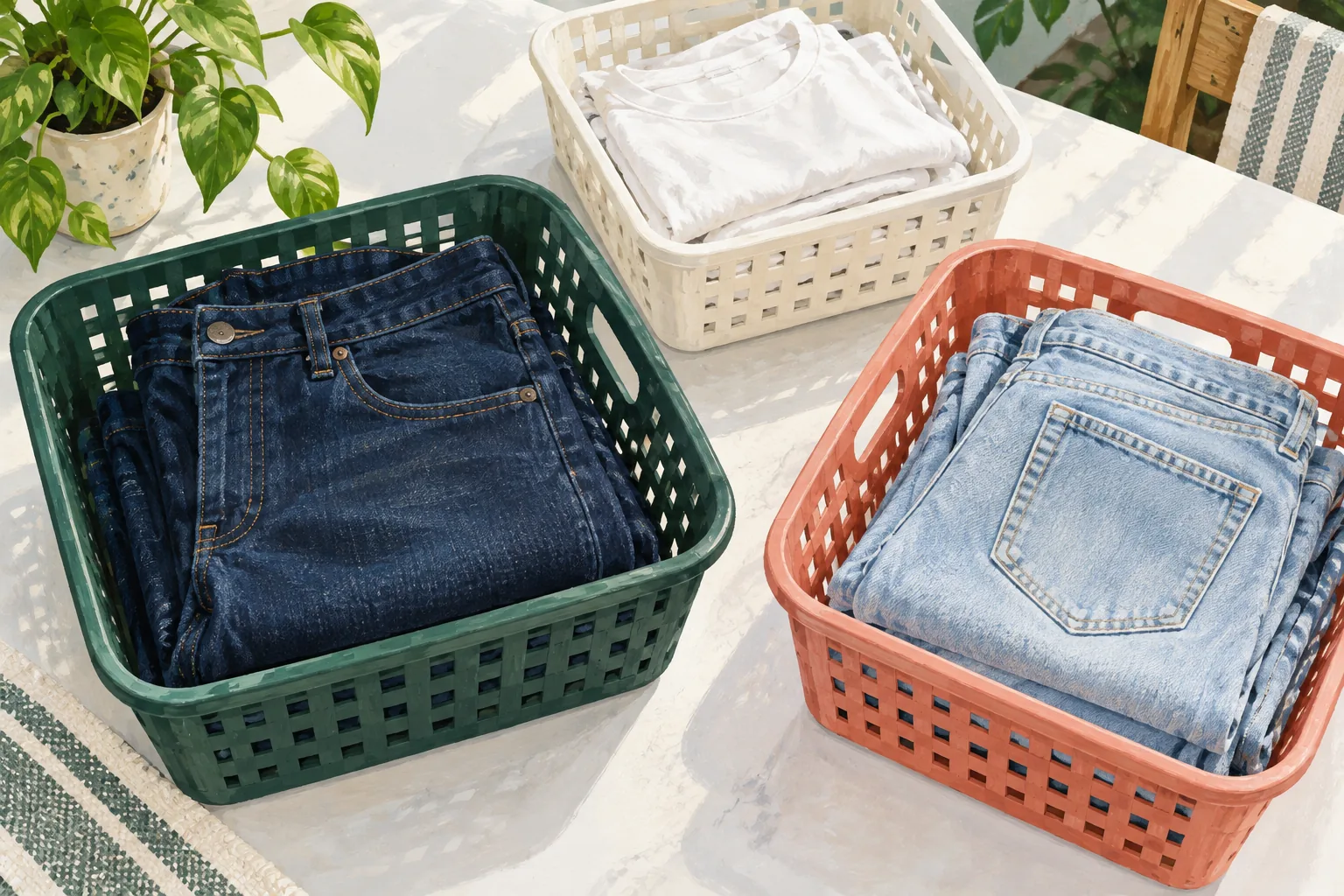
Can jeans share a load with shirts or towels?
Color is only one compatibility check. Tide’s sorting guidance also separates heavier items from lighter fabrics to reduce abrasion and advises separate early washes for strongly colored new garments. For a practical denim load, compare the labels, fabric weight, soil level, and lint risk before combining items. A dark delicate blouse is not automatically a suitable companion for heavy dark jeans.
For example, imagine a basket containing two established blue pairs, a new black pair with a dye warning, and a white shirt. The useful decision is not to fit all four into one machine. Set aside the white shirt, give the new pair its instructed first-wash treatment, and assess whether the established pairs can share a routine. The number of loads follows the compatibility decision, not the other way around.
How do you prepare jeans before they enter the washer?
Work through one complete pair at a time. Empty every pocket, including the small coin pocket, and unfold the cuffs. Look for pens, tissues, receipts, keys, and anything left from work. Check both front and back rather than assuming a pocket is empty because it looks flat. Keep removed objects in a tray away from the machine controls.
Inspect the waistband fastener, zipper, belt loops, inner thighs, hems, and existing holes. If a seam is opening, decide whether repair should come first. Do not expect a gentle program to repair weak stitching. Follow the garment’s preparation instructions; Whirlpool’s laundry preparation tips include fastening buttons and zippers to help prevent wash damage.
Keep repair and stain decisions separate
A hole and a stain are different problems. Mark them in your notes separately so a stain treatment does not distract from an unstable seam. With distressed jeans, distinguish deliberate openings from new damage around their edges. If you are unsure whether washing will worsen a damaged area, consult the garment maker or a repair professional before putting it through a machine.
For a household handoff, a useful note might say: “Dark pair, label photographed, mark on right knee, line dry.” That is more actionable than “special jeans.” Keep instructions attached to the laundry plan, not loose inside a pocket. If the person taking over cannot carry out a restriction, leave the pair out rather than silently substituting another method.
How should you treat ordinary stains on denim?
Start by identifying what happened and checking both garment and treatment labels. The American Cleaning Institute’s laundry basics recommend prompt attention, appropriate pretreatment, and checking wet clothing before drying because heat can set remaining stains. A stain remover, liquid laundry detergent, or another labeled treatment may be appropriate; compatibility matters more than choosing the strongest product available.
Test a proposed treatment on an inconspicuous area when its directions call for it, especially where a change in color would matter. Do not scrub harder simply because denim feels sturdy. Record the product used and its contact time. That makes a second decision more informed if the mark remains and helps a professional understand what has already been tried.
What if you cannot identify the mark?
Look at its location, color, and the activity that preceded it. A hem mark after gardening, a small food spot near a pocket, and a pen line call for different investigation. The ACI mystery-stain guide emphasizes those clues and cautions against drying a garment while a stain remains. Do not turn an uncertain stain into a sequence of unrelated chemical experiments.
Take a photo before treatment if the item is important to you. After washing, compare the same area under similar light. A wet dark fabric can make a spot harder to judge, so avoid declaring success based only on a quick look inside the machine. If the mark persists, reconsider the identification and product directions before repeating anything.
Keep stain products within their intended use
The ACI stain-remover safety guidance warns against combining stain removers with ammonia, chlorine bleach, or other household cleaners. Use the product for its labeled purpose and follow handling instructions. This guide is for ordinary washable clothing, not for garments contaminated with fuel, solvents, pesticides, or other hazardous materials; obtain instructions appropriate to that contamination instead of using a routine laundry recipe.
Which temperature and washer cycle should you choose?
Match the garment instructions to the available machine controls. Cold water may be appropriate for preserving dark denim, but cycle names are not standardized care permissions. A “jeans” button does not cancel a gentle-wash restriction, and a bulky-looking garment does not automatically need the strongest agitation. Read the selected program’s temperature and other available settings before starting it.
Whirlpool’s cycle guide discusses normal or darks programs for jeans and heavier-duty programs for some work clothing. That differs from the gentler general advice offered by denim brands. The difference is a reason to use the exact label and machine instructions together, not evidence that one program is universally correct for every pair.
Check defaults instead of relying on the program name
A concrete example appears in a Whirlpool model-specific cycle guide: its jeans program has warm as the displayed default, with other temperature choices listed. That document describes those particular models, not Fresh Spin’s machines. It demonstrates why selecting a named cycle without checking its defaults can produce a different routine from the one you intended.
Before pressing start, pause for a three-part check: the garments permit the chosen process, the selected temperature matches your plan, and the machine is loaded according to its instructions. If you cannot establish one of those answers, resolve it first. Do not improvise a capacity rule based on a fixed number of pairs; denim weights and machine designs vary.
How much detergent do jeans need?
Use the detergent label and machine directions, accounting for load size, soil, and product concentration. Whirlpool’s dosing guide notes that too much detergent can leave residue and too little can clean poorly. Use an HE-compatible product where required. There is no reliable universal capful measurement across different bottles, concentrations, and loads.
A useful planning habit is to keep the measuring device with its original product. If you change from one concentration to another, reread the dose instead of transferring the old habit. Also check whether the machine already dispenses detergent; follow the machine instructions rather than adding another dose on assumption. The goal is the intended amount, not the most visible suds.
Do dark jeans require a whole shelf of additives?
Begin with the garment-approved detergent and method. The Levi’s denim guide discusses mild detergent for dark colors and cautions that softener may leave residue affecting appearance or texture. That does not establish that every specialty product is necessary. Read what your garment and chosen product require before adding another step.
Keep the routine understandable. If a load develops a problem after several products are changed at once, it is harder to identify which decision needs correction. Record what actually went into the machine. Avoid promising that vinegar, salt, a color-catching product, or any other additive will permanently stop dye transfer; this guide does not establish such a guarantee.
When is hand washing a practical option?
Hand washing may be appropriate when the garment instructions allow or require it and you have enough clean space to handle the pair. Tide’s hand-washing guidance starts with label-compatible water, a small measured amount of detergent, gentle movement, rinsing, and removal of excess water without wringing. Follow the actual product directions rather than treating a general soaking time as mandatory.
Plan the whole process before filling the basin: where the pair will be supported, how you will drain and rinse, and where it will dry. Heavy wet fabric can be awkward to lift. If you cannot manage the garment comfortably without dragging it onto an unsuitable surface, choose another label-approved option or seek appropriate help. Hand washing is not automatically the easiest choice simply because it avoids a machine.
Keep the work area clear of other laundry and household products. Do not leave the pair soaking while you go away and forget it. Set a reminder for the interval specified by the applicable instructions, and finish rinsing before moving to the planned drying area. A controlled short task is more useful than an improvised overnight soak.
How can you dry jeans without guessing about fit?
Read the drying instruction independently of the washing instruction. Permission to machine wash is not permission to use high dryer heat. If the label permits tumble drying, select the specified heat and process. If air drying is required or chosen within the maker’s guidance, prepare suitable support before the wash finishes. Do not use an attempt to force shrinkage as the normal cleaning routine.
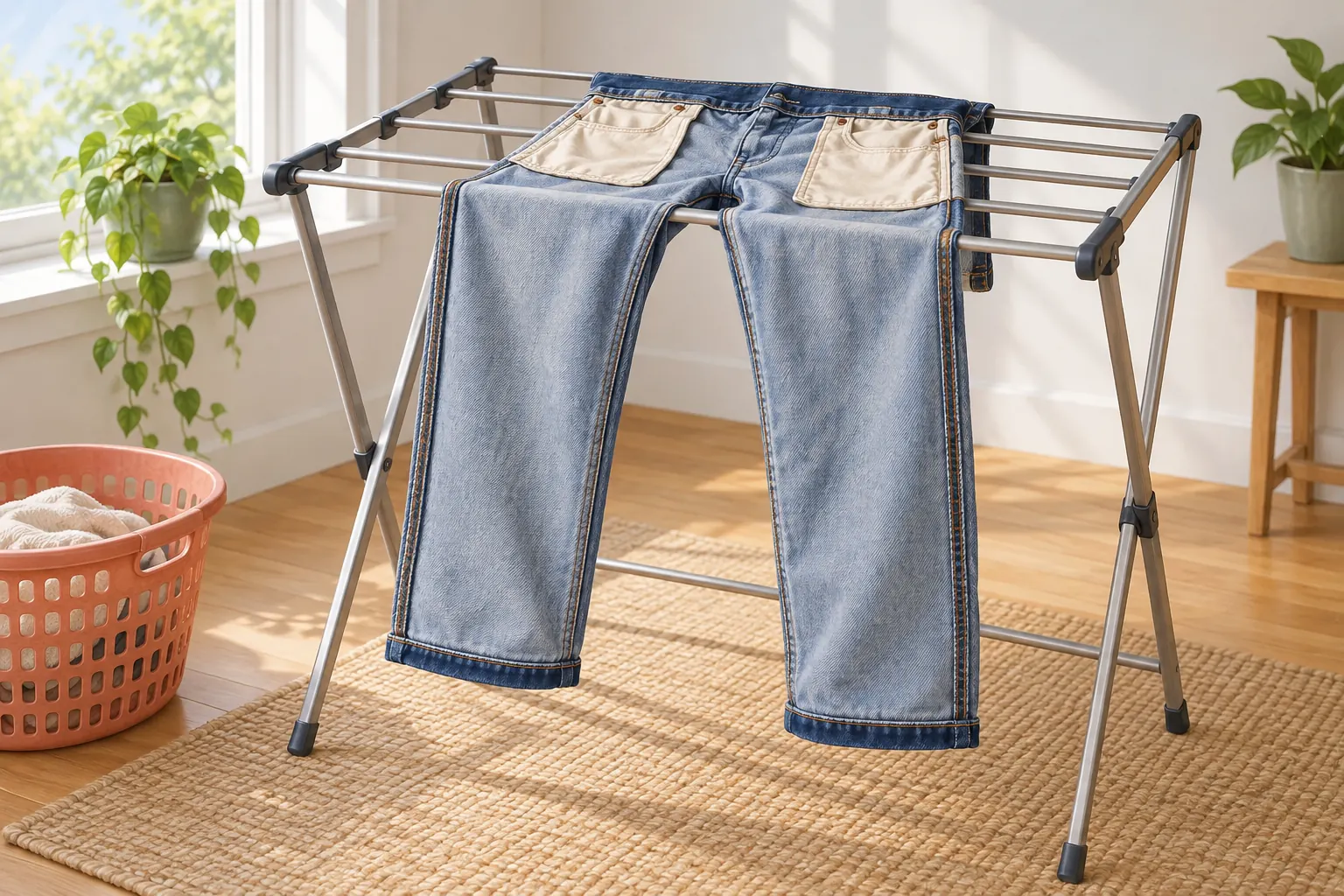
Plan a realistic drying window
There is no single drying time that fits all denim weights, room conditions, and methods. For planning purposes, do not start with the assumption that the pair will be ready immediately after a wash cycle. If you need jeans for a morning departure, keep another outfit available rather than changing the care method at the last minute to meet the clock.
Check the thick areas before folding: waistband, pockets, seams, and hems. Wrangler specifically notes the need to dry heavyweight workwear thoroughly before storage. Choose a place where the garment can remain supported and undisturbed while drying, not a temporary surface that must be cleared for dinner. A realistic location is part of the laundry plan, not an optional finishing detail.
What if jeans feel tight after washing?
First compare the actual routine with the label and the garment’s product instructions. Record whether the pair was already snug, which temperature was selected, and how it dried. Do not assume every change can be reversed by stretching, wet wearing, or another hot cycle. Ask the maker about the exact style before trying a fit-restoration technique on a valued garment.
For future reference, record fit observations consistently rather than relying on a vague memory. Note whether the issue is waist comfort, thigh room, or leg length. Those are different problems. A pair that needs tailoring or a different size is not necessarily a laundry failure, and washing should not be used as an unverified substitute for a fit decision.
What should you do about white marks or lingering residue?
White marks are not automatically evidence that dye has disappeared. Whirlpool’s white-residue guidance identifies excess or undissolved detergent as one possible cause of visible deposits. Check what product and amount were used and whether the load followed the machine instructions. A photo and your wash notes are more informative than immediately adding another cleaner.
If the machine or product guidance calls for a rinse or rewash, keep it within the garment’s permitted care. Do not keep adding detergent to a problem that may involve detergent residue. If the mark appears to be a lasting color change rather than something on the surface, additional cleaning may not restore it. Escalate the question to the garment maker rather than claiming a guaranteed rescue.
How do you diagnose an unexpected result without making it worse?
Separate observation from explanation. “There are pale streaks along the folds” describes what you see. “The detergent ruined the dye” is a conclusion that has not yet been established. Likewise, a stiff feel, a remaining food mark, and a shorter inseam are different observations. Naming the actual problem helps you choose the relevant manufacturer guidance instead of repeating an entire wash routine on guesswork.
Build a short record of the last wash
- Garment identity: record the brand, style or product number, fiber information, and label photograph. Note whether this was its first wash and whether repairs or alterations were present.
- Starting condition: note the original mark, existing fading, fit concern, or odor. Include a photograph if available so an old feature is not mistaken for a new problem.
- Actual process: record the machine program, selected temperature, detergent product and measured dose, other treatments, companion items, and drying method. Write what happened, not what you intended to select.
- Result: describe the location and appearance of the issue, whether other garments were affected, and any next step already taken. Keep original product containers available for their instructions.
Use that record to decide whom to ask. A product-specific fit or finish question belongs with the garment manufacturer. An unfamiliar machine default or dispensing question belongs with the equipment instructions or operator. A question about a treatment’s contact time belongs with that product’s directions. This division avoids asking one source to guarantee something outside its scope.
Change a decision only after identifying its purpose
If the evidence points to a dosing mistake, correct the dose according to the instructions; do not simultaneously change the detergent, temperature, additives, and drying method. If a stain remains, reassess that stain rather than assuming the whole load needs stronger treatment. If an instruction was followed and damage still appears, document it before any further attempt and ask the maker how to proceed.
Also establish a stopping point. A second unexplained result, an uncertain coating, or a valuable garment with a changing fit is a reason to pause, not a challenge to find a more aggressive home remedy. A useful care plan includes a decision not to proceed when the relevant facts are missing. That protects the garment and leaves a clearer account for anyone helping you later.
How do you organize a jeans load at a laundromat?
Sort at home where labels, spare bags, and good lighting are readily available. Bring only the garments whose routine you have decided. Keep exceptions separate, carry the relevant instructions, and know which items must leave the washer for air drying rather than move to a dryer. This reduces decisions made while someone else is waiting for a machine.
At the machine, read its posted instructions and verify the selected settings. If the controls cannot provide the process your garment requires, choose a different suitable option rather than relaxing the restriction. Fresh Spin’s self-serve laundry page is the place to begin planning a self-service visit; this guide does not establish a particular machine’s capacity or a special denim program.
What should you ask before using drop-off wash and fold?
Fresh Spin offers in-store drop-off wash and fold. Before including a pair with unusual instructions, ask whether that garment and its requirements fit the service. Show the label and identify stains, raw-denim status, trim, or a drying restriction. The existence of a laundry service is not a promise that every specialized garment or custom process is accepted.
Use the contact page for questions before visiting. Ask about the specific requirement you need answered rather than requesting a broad assurance that jeans are safe. For instance, explain that a label prohibits tumble drying. If the necessary handling is not available or has not been confirmed, keep that pair out of the order.
What does a useful household jeans-care plan look like?
Example: a mixed family laundry basket
Imagine a household has three established washable pairs, one new dark pair, and a decorated pair with unclear instructions. Start by moving the decorated pair to the decision pile and reading the new pair’s first-care warning. Then compare the established pairs’ labels. The result may be more than one routine, even though every item is casually described as jeans.
Write a short loading list and a separate drying list. Assign the uncertain pair a concrete next step, such as finding its product page, so it does not disappear into an indefinite backlog. The outcome is not a predetermined number of loads. It is a set of garments whose requirements can be followed without guessing or surprising the person who unloads them.
Example: a valued pair needed for travel
Suppose a favorite pair needs cleaning before a trip and must air dry. Work backward from packing time and reserve a suitable drying place. If the schedule is already too tight, choose another outfit. Do not use extra heat simply to preserve the original packing plan. The practical tradeoff is between convenience today and respecting the garment’s care limits.
Keep the travel decision separate from stain treatment too. A persistent mark may need another assessment; it should not be hidden by packing the garment damp. A spare outfit gives you room to make that decision calmly. This is planning advice, not a claim about how many hours a particular pair will need or whether a particular mark can be removed.
Frequently asked questions about washing jeans
Can all jeans be washed in cold water on gentle?
No universal setting replaces the garment label. That combination appears in several denim makers’ general advice, but a specific coating, trim, construction, or care restriction can change the decision. Identify the exact pair first, especially before its first wash.
Should I wait a fixed number of wears?
No. Use wear counts only as rough planning guidance. Visible soil, odor, spills, and the way the jeans were used matter more than reaching a target. A brief clean wear and a sweaty workday should not automatically lead to the same decision.
Can I wash a new black pair with white shirts?
Keep them separate. New dark denim may release dye, and the garment’s warning may require separate early washes. Do not use an additive as permission to disregard sorting instructions. Also consider where wet dark denim is placed after the wash.
Does selvedge mean the jeans will shrink?
The edge construction alone does not answer that question. Find out whether the exact fabric is raw, preshrunk, washed, or sold with specific fit-changing instructions. Do not calculate expected shrinkage from the appearance of a cuff.
Can I put jeans in the dryer?
Only when the garment’s care instructions permit that process, using the specified setting. Plan drying before washing and identify any exceptions in a mixed load. If an instruction is unclear, resolve it instead of assuming the lowest available heat makes every garment suitable.
Will a careful wash prevent every change in color or fit?
No care routine guarantees an unchanged garment. Following instructions helps you avoid preventable mistakes, but it is not a promise of permanent color, a particular fit, or successful stain removal. Keep the routine documented and seek product-specific advice when the result is unexpected.


Leave A Comment