
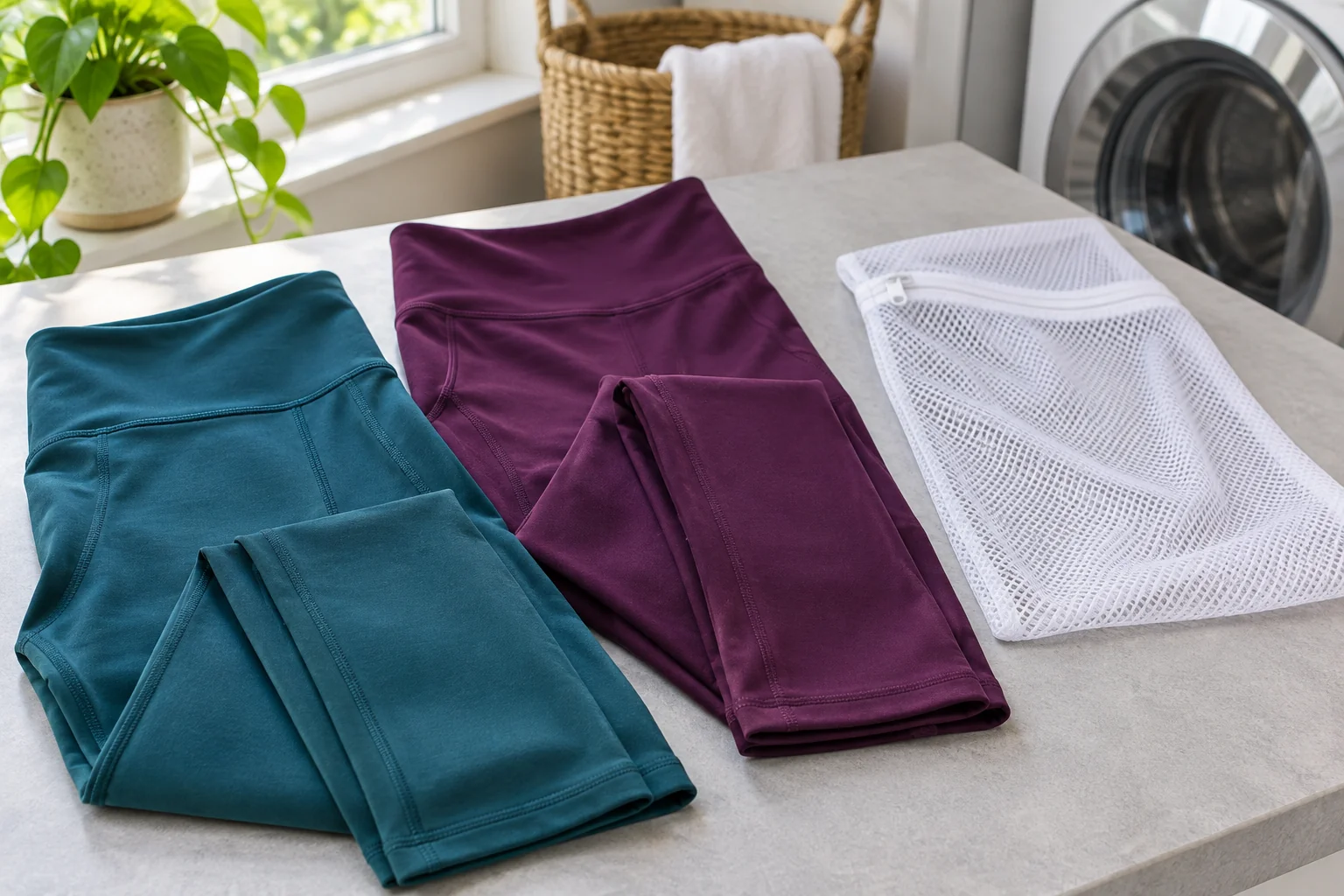
To wash leggings, read the care label, empty every pocket, separate them from rough or lint-shedding items, and use the permitted wash and drying settings. Many technical pairs call for cold washing without fabric softener, but cotton, wool, coated and specialty leggings may need different care. Measure detergent for the actual load, protect vulnerable details, and check the waistband and pockets for dampness before putting the pair away.
The important distinction is not simply expensive versus inexpensive leggings, or workout clothes versus everyday clothes. Two pairs that look alike may have different fabric blends, surface finishes, bonded details and drying limits. Treat the instructions attached to each pair as its own care plan. This guide explains how to turn those instructions into a workable routine, including what to do when a pair has mesh panels, zippered pockets, persistent odor or an unfamiliar label.
This is a clothing-care guide, not advice about medical compression garments or a promise to restore damaged elastic. For prescribed garments, use the supplier’s instructions. For ordinary leggings, the goal is straightforward: clean the clothing without taking unnecessary chances with its fit, finish or construction.
What should you check on the label before washing leggings?
Read the washing and drying directions together, before opening the detergent. Note whether the pair allows machine washing, hand washing or another treatment; then check the temperature, cycle, bleaching restrictions and drying method. A washable item is not automatically tumble-dryer safe. If you cannot complete its permitted drying method, choose another day or another pair to wear rather than improvising after the wash.
GINETEX’s care-symbol explanations distinguish the washing process from drying and other treatments. A crossed-out treatment is not permission to try a gentler version of that treatment. Use our laundry care-label guide when you need help organizing the symbols into a practical checklist.
Photograph the tag while it is readable, including the product name or style number if present. Save it with a plain description such as “black running pair with rear zip” instead of a filename you will not recognize. If several family members own similar leggings, that small identification step prevents one person’s dryer-safe pair from becoming the assumed rule for everyone else’s clothing.
Why do leggings that look similar need different routines?
A useful first sort is by construction, not appearance. Look for a smooth technical knit, a brushed surface, a cotton-rich everyday fabric, a wool base layer, a coated finish or decorative panels. Read the fiber label, but do not try to calculate a washing temperature from the percentages. The finished garment includes seams, waistbands, trims and possibly adhesives that the fiber list alone does not explain.
For an ordinary synthetic workout pair, check the activewear instructions. For cotton-rich leggings, use that pair’s directions instead of assuming it belongs with towels. For wool leggings, consult the specific wool garment guidance rather than a general gym-clothing routine. Leather-look or coated leggings deserve their own review; their surface appearance does not tell you whether water, rubbing, heat or professional cleaning is permitted.
Create only as many groups as you need. Three nearly identical pairs with matching instructions can share a plan. One unusual pair can stay separate until its requirements are clear. A special-care pile should be a deliberate temporary decision, not an indefinite hiding place: write down the question that must be answered, such as “Does this model permit tumble drying?”
What do clothing manufacturers actually recommend?
Manufacturer advice helps show why a single internet rule is insufficient. lululemon’s general care page recommends cold washing with similar fabrics and colors, avoiding cotton fabrics and towels, avoiding fabric softener, and hanging items to dry. It directs shoppers to the individual product information for more specific material and care details. Those are brand guidelines, not proof that every pair of leggings from every manufacturer has the same needs.
Nike’s leggings-care guide advises cold washing inside out and avoiding wringing. It also recommends washing or airing leggings after a workout rather than leaving them bundled in the hamper. Keep those points tied to Nike’s guidance and check the actual garment before applying them.
The Under Armour care FAQ similarly describes a cold, gentle wash with like colors and no bleach or fabric softener. Agreement among these examples makes them useful starting questions, but it does not replace your label. When a general brand page and a specific tag differ, ask the manufacturer about the exact style rather than blending both instructions into a new method.
What should happen between a workout and laundry day?
Start by unpacking the gym bag. Remove the leggings from beneath a damp towel or other used clothing, check the pockets and decide whether you will wash them now or later. Keep worn clothing separate from the clean outfit packed for the next session. This is mainly an organization problem: the washing routine cannot begin if the pair remains forgotten in a zipped compartment.
If you are not washing immediately, open the garment out in a suitable place rather than leaving it rolled into a tight bundle. Keep it away from clean laundry and surfaces that could transfer dirt or dye. Airing is a holding step, not the equivalent of laundering a sweaty pair. Do not put it into the clean drawer merely because it no longer feels wet.
For a shared household, choose a clear location for items awaiting care. A separate basket or designated hanging space is easier to understand than clothing scattered across several rooms. Place anything needing stain inspection where the person doing the wash will see it. A short note about a spill is more useful than assuming another person will notice a faint mark on dark fabric.
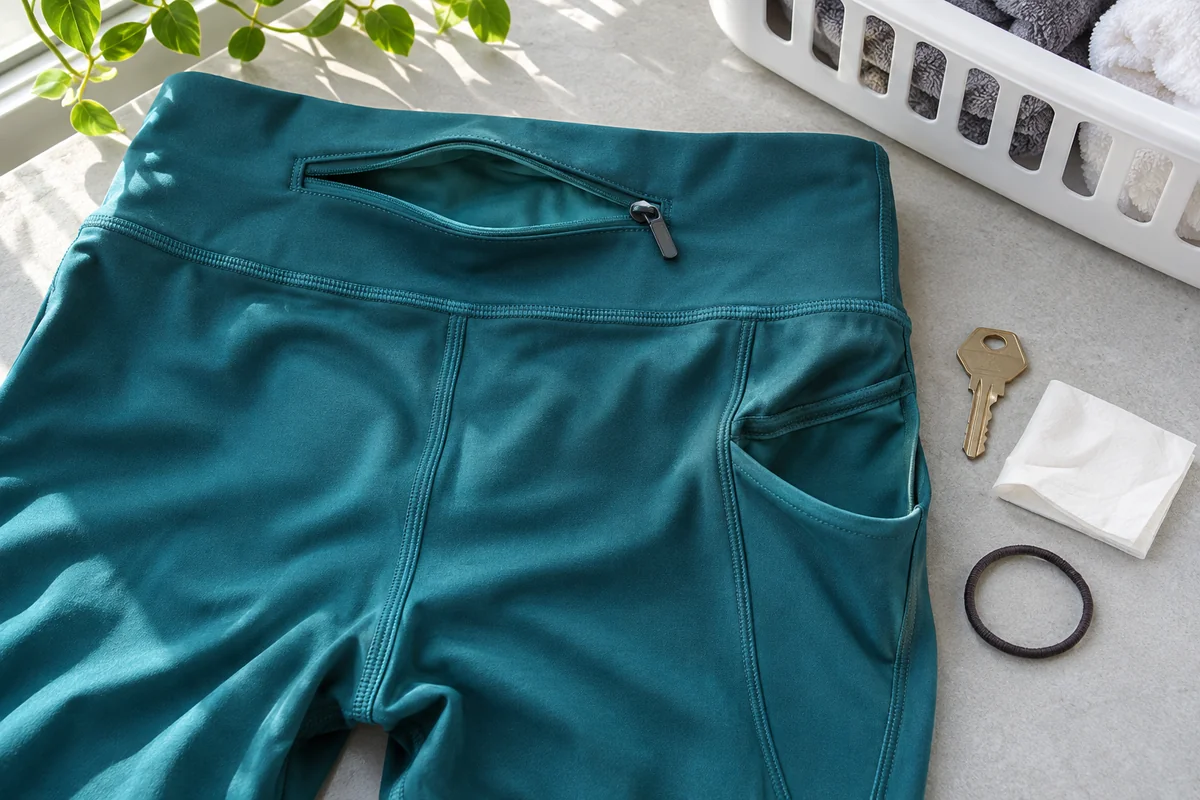
How do you empty pockets and inspect the waistband?
Check more than the obvious side pockets. Running leggings may have a narrow waistband opening, a hidden rear pocket, an inner key sleeve or a small zip compartment. Remove keys, cards, tissues, coins, hair ties and any packet or wrapper. Feel along the pocket lining gently; do not stretch the opening aggressively to prove it is empty.
Look at the waist seam, crotch seam, knees and hems before turning the pair inside out. Note loose stitching, an opening in a pocket lining, a snag or a lifting print. Taking a quick picture of an existing defect makes later troubleshooting less confusing. You will know whether a mark was present before washing rather than attributing every change to the most recent cycle.
Handle drawcords and closures according to the garment instructions. Do not pull an internal cord completely through its channel or make a tight knot that you cannot undo. Close a zipper when the maker directs it and ensure the slider is not catching fabric. If a seam is opening, set the pair aside for an appropriate repair before subjecting it to another wash.
How should you sort leggings with the rest of the load?
Build a load from compatible care requirements, fabric surfaces and colors. Matching color alone is not enough: black jeans, a dark bath towel and black technical leggings are still different laundry items. Ask whether each companion item has exposed hardware, rough areas, loose hook-and-loop fasteners or a surface likely to shed lint.
Consider the whole outfit separately. A sports bra may require a bag, removable-pad handling or a different drying approach; our bra-washing guide covers those decisions. Socks, hoodies and outer layers do not inherit the leggings’ instructions just because they were worn during the same workout. Sort each piece by what it needs next.
If only one pair is ready, do not add unsuitable items simply to make the load feel worthwhile. You can wait for other compatible clothing if the pair is being held appropriately, or use another permitted cleaning method. Equally, do not run many unnecessary tiny loads because colors differ slightly; check color-care directions and group sensible compatible items. The objective is a defensible load, not a perfect-looking sorting system.
When is a mesh laundry bag useful?
A washable mesh bag can help keep a small or vulnerable garment identifiable and separated within a compatible machine load, when the clothing instructions allow that approach. Choose a bag large enough that the leggings are not compressed into a dense ball. Check that the bag itself is clean, intact and appropriate for the intended cycle.
Use a bag as an additional handling choice, not as a permission slip. It does not make hand-wash-only leggings machine washable, change the permitted temperature, or allow rough items into an otherwise unsuitable load. A pair with damaged mesh or a lifting bonded detail may need manufacturer advice rather than merely a smaller bag.
One practical advantage is tracking: a recognizable bag can mark an item that must not enter the dryer with the rest of the load. Tell anyone sharing the task what the bag means. Do not rely only on its color or on your own memory. After washing, open the bag and inspect the clothing instead of placing the closed bundle straight into storage.
How do you handle mesh, reflective details and brushed fabric?
Inspect these areas as separate parts of the garment. A mesh calf panel can catch on an object even when the surrounding fabric looks sturdy. A reflective strip, transfer print or bonded pocket edge may have specific restrictions that are not obvious from the main fabric. Check the product guidance before treating those areas with a brush, iron or stain remover.
When turning leggings inside out, work gradually from the waistband and guide each leg through. Avoid pulling hard on a decorative panel or on the hem alone. Lay the pair out long enough to see whether the legs are fully opened rather than twisted together. This also gives you a better view of the inner waistband and seams where a mark could be missed from the outside.
Do not use a razor, stiff brush or aggressive lint tool on an unfamiliar surface just because it works on another garment. If loose fibers, snagging or a lifting finish concern you, ask the maker about that specific material. Washing is not a general repair technique, and repeating it will not necessarily improve an already damaged surface.
How much detergent should you use for leggings?
Measure for the actual product, washer and load rather than pouring a familiar-looking amount. Concentration varies, and a cap may carry several fill lines. The American Cleaning Institute’s detergent guidance says to follow the product label: both too much and too little detergent can leave clothing less clean than the appropriate amount.
This matters when general activewear advice says to “use less.” Less than what? A previous habit of overfilling the cap is not a useful baseline. Read the dosing instructions for load size, soil and water conditions, while honoring the garment and appliance requirements. If the directions appear incompatible, ask the product or garment manufacturer instead of inventing a fixed number of teaspoons for all leggings.
Keep the container or a clear picture of its directions available when someone else washes the load. Do not transfer detergent into an unmarked bottle or use a scoop from an unrelated product. Our detergent comparison guide can help separate product choice from dose, cost and fabric compatibility. A specialty label is not a substitute for clear usage directions.
Should fabric softener, scent products or bleach be added?
Check each additive separately. Detergent, fabric softener, fragrance boosters and bleach perform different roles; they are not interchangeable ways to make a wash “stronger.” The manufacturer examples above specifically restrict softener for their technical clothing. Do not add it simply because the leggings feel less smooth than they did when new.
Likewise, a pleasant scent does not establish that a garment has been cleaned adequately. Before adding fragrance to address an odor, review the washing process and the source of the problem. An extra product also introduces another instruction to reconcile with the fabric label. Keeping a routine simple makes it easier to identify what happened if the result is unsatisfactory.
Do not decide bleach compatibility from color alone. White leggings can still contain materials or finishes with bleaching restrictions. Follow the garment and product instructions, and do not mix laundry chemicals in an attempt to create a stronger treatment. When the tag forbids an additive, a smaller quantity is not a workaround. Keep an unfamiliar pair out of an additive-treated load until its requirements are known.
How do you pretreat a spot without treating the whole pair?
Identify the problem as clearly as you can: a food spill, outdoor dirt, a cosmetics mark, a transfer from another surface or an unknown discoloration. Note where it is and whether the area includes a print, mesh or coated panel. That information is more useful than choosing the strongest stain product available.
Select only a treatment compatible with the garment and follow its directions for testing, application and contact time. Check whether the product can be used on colored fabric and on the specific fiber or finish. If the instructions call for a hidden-area test, use a genuinely inconspicuous area and inspect it before proceeding. Do not turn a small uncertain mark into a full-garment experiment.
Tell the person completing the wash that the item has been treated and which product was used. Keep treated leggings separate from untreated clothing until the planned wash, and do not allow a product to remain longer than directed. After laundering, inspect the original area before any permitted heat drying. If the mark persists, reassess it rather than automatically repeating the same treatment at a stronger concentration.
How do you choose and run the machine cycle?
Choose the program that matches the garment instructions and the machine manual. “Sports,” “delicates” and “normal” are machine labels, not universal definitions of temperature or mechanical action. Check adjustable settings before starting, especially on a washer shared with people who may have selected a different temperature or extra treatment for the previous load.
Load compatible clothing loosely as directed by the appliance. Do not pack a small mesh bag tightly or fill the drum by pressing everything down. Place detergent in the location specified for that product and machine. A convenient compartment is not necessarily the correct one, and a laundry packet should not be opened or divided to improvise a smaller dose.
Arrange the finish of the wash as deliberately as its start. Set a reminder so the leggings can move to their drying step when the cycle finishes. If the washer displays a fault, follow its instructions and wait for it to stop and unlock before handling the load. Do not reach into moving equipment or override a door lock to retrieve a garment.
When does hand washing make sense?
Hand washing is an option only when the garment permits it and you can follow its complete care instructions. It is not automatically gentler in practice: vigorous rubbing, twisting, prolonged soaking or poorly controlled water temperature can be unsuitable. Begin with a clean basin and enough workspace to handle the garment without dropping it onto a dirty surface.
Use the allowed detergent and dilution, then follow the garment’s directions for movement, soaking and rinsing. Do not copy a long soak from a different fabric or treat “hand wash” as permission for scrubbing. Keep unfamiliar colors separate. If the label gives specific limitations, write them down before your hands and the tag become wet.
Plan water removal and drying before starting. Support the fabric while moving it, and avoid wringing when the instructions forbid it. A towel used to assist drying should itself be clean and color-compatible. If you cannot rinse or dry the item adequately with the available setup, postponing the task is preferable to leaving a wet pair in a basin with no workable next step.
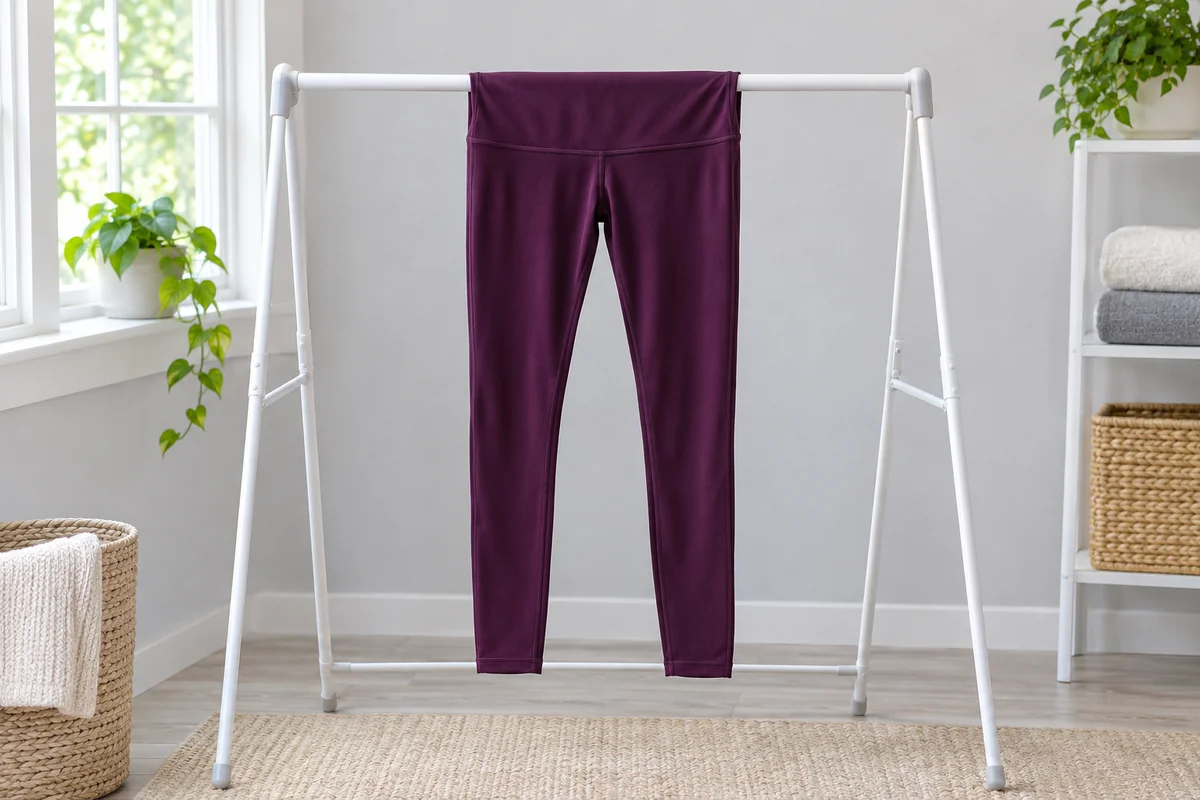
How should you dry leggings without guessing?
Read the drying instruction literally. Hang drying, flat drying and tumble drying are different processes, and “low heat” is not the same as “do not tumble dry.” Use the permitted method for the specific pair. Do not move every item from a mixed washer load into one dryer merely because they were washed together.
For a pair that permits hanging, open the legs and pockets so the garment is not drying as a folded bundle. Use a clean support that will not snag the fabric. For flat drying, provide the support and space the instructions require rather than draping most of the garment off a narrow edge. Keep separate items from overlapping so you can inspect each one.
If tumble drying is allowed, select the permitted setting and check the actual garment rather than assuming the machine’s ending signal guarantees every layer is dry. Remove items that are ready instead of keeping them in with a slower-drying load. Do not improvise with a radiator, hair dryer or iron to hurry a pair needed for an upcoming workout.
Where can dampness hide after the legs feel dry?
Check the waistband, pocket linings, folded hems and any doubled panels. A thin lower leg and a multilayer waistband are different parts of the same garment. Turn pockets out as their construction allows, separate folded edges and inspect both sides. Let the item cool if it has been tumble dried within its instructions before deciding it is ready to store.
Make this check before folding the pair tightly. A compact roll can conceal the very area that needed more time. If part remains damp, continue with the permitted drying method and keep it out of the drawer or packed gym bag. There is no useful universal drying time: the garment, the equipment and the room conditions all vary.
Once dry, fold the leggings without pulling the waistband into a stretched shape. Store them where you can identify the pair without repeatedly digging through a tight pile. A separate space for special-care clothing can prevent it from being grabbed and washed with the wrong group next time. Keep the saved care information available even after the original tag becomes difficult to read.
What if leggings still smell after washing?
Describe when the odor appears. Is it noticeable as the washer opens, after the garment dries, or only after the pair is worn again? Check whether other items from the same load have the problem. This does not diagnose a cause, but it helps separate a single-garment issue from a load-wide or storage issue before you choose a next step.
Review the actual routine: detergent and dose, load size, selected program, time left wet, drying method and storage condition. Check the garment maker’s troubleshooting advice and the appliance maintenance instructions. If the washer itself needs attention, follow its manual rather than running a clothing experiment inside it. For shared equipment, report the concern instead of attempting internal repairs.
Do not jump from “odor remains” to a hot wash, a stronger chemical mixture or repeated soaking. Those changes may conflict with the label and still fail to address the cause. Ask the clothing manufacturer about a compatible next treatment, especially for a costly or unusual pair. No smell-based check can establish disinfection, and this everyday-care routine should not be treated as an infection-control procedure.
What if you see pale marks, lint or an uneven surface?
Look closely before choosing a remedy. A removable piece of lint, a dried surface mark, a change in color and a damaged knit are different observations. Inspect the garment in ordinary light and compare both sides. Think about which other items were in the load and whether a pocket contained tissue or another object.
If you suspect a laundering problem, consult the product guidance before rewashing. Record the detergent amount and how full the machine was so you have something concrete to review. Do not call every pale patch detergent residue; some marks may be wear, discoloration or a previous treatment’s effect. Aggressively brushing an uncertain mark can make later evaluation harder.
For lint, choose a method the fabric maker allows and test gently before working across the whole pair. For pilling or snagging, ask whether the material can tolerate a fabric-care tool. Stop if fibers pull, the surface changes or a seam opens. A cosmetic issue does not justify risking the garment’s structure, and no cleaning method can promise to return every worn surface to its original appearance.
Can washing restore stretched or sagging leggings?
Do not use a hotter wash or dryer as a fit-restoration experiment. First distinguish a pair that feels different while wet from a persistent change after it is fully dry. Compare the waistband, knees and seams with their previous condition. If you have a product photograph or purchase record, it can help identify the exact style when asking the manufacturer for advice.
Consider fit and condition separately from cleanliness. A clean pair may no longer provide the coverage, comfort or support you want. A loose seam may be repairable, while an overall change in the fabric may not be. Avoid assuming that every problem came from the last wash; the way the garment has been worn and handled also matters.
Set aside a pair with a developing hole or unreliable seam before using it for an activity where failure would be inconvenient. Ask about repair options where appropriate, or repurpose an otherwise suitable pair for a less demanding use. Do not present a weakened garment as restored simply because it looks smaller immediately after heating. Care can manage clothing; it cannot guarantee reversal of wear.
How do you make the routine work in a shared household?
Choose a simple handoff system. Keep a short list of pairs that need special treatment, using recognizable descriptions. The most important message is often the drying instruction: “gray pair, hang dry” is easier to act on than “please be careful with my gym things.” Put the information where the person moving the load will actually see it.
Divide the task into decisions rather than assuming one person must do everything. One person can empty pockets and check labels; another can run the agreed cycle; whoever unloads can separate drying methods. Agree on what should happen when a label is unreadable or a new stain is found. The default should be to set that item aside for review, not guess on someone else’s behalf.
Keep a usable spare outfit if your schedule allows. This reduces the temptation to bypass the drying instructions because the preferred pair is still damp. The same principle applies when packing for travel: consider how and where the clothing can be cared for, not just how little space it occupies in a bag.
What should you bring or ask before a laundromat visit?
Bring the sorted clothing, its care information, the intended detergent and any suitable bags or hangers. Keep special-care pairs identifiable. Before starting, check the instructions on the machine you intend to use; do not assume its controls match a home washer. Confirm how you will finish items that must air dry rather than placing them in a dryer out of habit.
If you are asking someone else to handle the clothing, explain the requirements before handing it over. Ask whether they can follow the actual washing and drying directions, and identify any stains or damage. A general laundry-service description is not confirmation that a particular coated, wool or specialty garment is accepted.
Use Fresh Spin’s contact page for visit questions. Have the garment label available when asking about a specific pair. This guide does not promise a particular machine’s suitability, special garment acceptance, a completion time or a stain-removal result. Clear instructions before the wash are more useful than trying to reconstruct them after the clothing has been processed.
What are the most common leggings-washing questions?
Should I wash leggings inside out?
Check the pair’s directions; Nike’s linked guidance recommends it. Empty and inspect the pockets first, then turn the legs carefully without pulling on mesh or decorative areas. Turning a pair inside out is preparation, not a replacement for sorting, the correct cycle or a permitted drying method.
Can leggings and towels share a wash?
Do not assume they are compatible. Compare their fabric surfaces and care requirements; lululemon’s linked general guidance specifically excludes cotton fabrics and towels from its recommended technical-clothing load. Use the instructions for your own pair, and do not add a towel simply to fill space.
Does every pair need a delicate cycle?
No single program name applies to every pair. The label defines the required treatment, while the appliance manual explains its programs. Check both temperature and cycle settings. A delicate program is not permission to machine wash a hand-wash-only garment or one with unresolved special-care instructions.
Can I use the dryer for just a few minutes?
Only if the garment permits tumble drying at the selected setting. A short exposure is still tumble drying. If the label requires another method, plan enough time for it and use another outfit while the pair finishes drying. Convenience does not change the care restriction.
Are yoga pants cared for differently from running tights?
Those names describe intended use or style, not a complete care specification. Compare the actual fabrics, details and instructions. Flared hems, zippered pockets, brushed surfaces and mesh panels may affect handling, but the product name alone cannot determine a temperature, detergent or drying method.
What if the care label is missing?
Look for a product number, purchase record or manufacturer page that identifies the exact pair. Send clear photographs when asking the brand for help. Do not borrow instructions from a visually similar item. Until you have a supported method, keep the pair separate from routine laundry rather than choosing a speculative wash.


