

To wash oven mitts and potholders, follow the instructions for the complete item, not just the fabric on its outside. Machine wash only when the maker permits it, use the specified temperature and products, and follow the separate drying instructions. Some silicone mitts allow only exterior cleaning. Keep a washed mitt out of cooking service until it is completely dry, and do not assume laundering repairs torn seams, damaged insulation, or a failing grip.
The useful question is not simply whether cotton or silicone can get wet. It is whether this particular combination of shell, lining, padding, stitching, trim, and grip can tolerate the proposed treatment. This guide helps you identify that combination, choose an allowed cleaning route, organize drying, and decide when to stop and ask the manufacturer. It covers ordinary household kitchen mitts and potholders, not industrial protective gloves or a commercial kitchen’s sanitation program.
What should you check before putting a mitt in the wash?
Let the item cool, then read the sewn label and any retained packaging. Look for a brand, product name, model number, and instructions that distinguish cleaning the outside from washing the whole item. Photograph readable directions before laundering so you can refer to them while the mitt is drying. Check each piece separately, including pieces bought as a coordinated kitchen set.
Make three decisions before reaching for detergent: is the item still in usable condition, what cleaning method is permitted, and how will it be dried? A missing answer should remain a missing answer. A cotton content label does not supply a washer cycle, and a washing instruction does not automatically authorize a dryer. Our laundry care-label guide can help you interpret the symbols without substituting a general rule for the actual label.
Inspect both sides, the thumb area, the inside of the cuff, and any pocket you can see without pulling apart the construction. Separate food marks from actual holes, split seams, exposed padding, or a detached lining. Put questionable items aside rather than letting them travel through the same clean-laundry pile as ready-to-use mitts. That small sorting step prevents a household member from mistaking an unresolved condition problem for a completed cleaning job.
Why do cotton and silicone mitts need different decisions?
A quilted cloth mitt may have a different lining or filling from its exterior fabric. A silicone-covered mitt may contain a cloth sleeve that cannot be removed. A small pinch mitt may be a single molded piece, while a visually similar item may include attached fabric. Those descriptions help identify the product; they do not, by themselves, tell you whether immersion, a washer, or a dishwasher is allowed.
For example, Gorilla Grip’s silicone oven-mitt instructions specify washing the exterior with soap and water and prohibit machine washing. The page also describes a cotton lining. That combination makes an important distinction: permission to clean the silicone outside is not permission to soak the fabric inside. Follow the exact item’s current instructions rather than importing a washing routine from another silicone product.
Keep identification practical. Set a fabric mitt, a silicone-covered mitt, and a flat potholder on the counter and find the directions for each. Do not group them just because they share a color or came from the same drawer. If the labels differ, create separate cleaning routes. One may go into an allowed laundry load, another may receive an exterior wipe, and a third may need manufacturer clarification before either process.
Which manufacturer examples show why one recipe is not enough?
The Williams Sonoma Solid Oven Mitt gives a fairly complete example: cold machine washing with similar colors, non-chlorine bleach only when needed, and low tumble drying. Those are instructions for that product. They are not a general prescription for every quilted mitt, and the bleach permission should not be carried over to a different item.
Collisionware’s cotton-product care page allows cold machine washing and either low tumble drying or air drying. It also notes that some shrinkage and reshaping can occur. By contrast, the RITZ Royale pocket-mitt description confirms machine washability without supplying every temperature and drying detail on that page. A partial online description is a reason to consult the item’s label, not fill in omitted settings from a competitor.
Another example is the named Le Creuset cotton oven mitt, whose product page marks it washing-machine safe. Again, confirm the full directions supplied with your particular item. These examples illustrate different levels of instruction, not a ranking of products. A name, material description, and care symbol together are more useful than a generic search result saying that oven mitts are washable.
What if the label is missing or the mitt is handmade?
Start with identification rather than a trial wash. Search your receipt or order history for the exact product and compare its shape, cuff, grip pattern, and materials with the maker’s information. A similar-looking replacement model is not necessarily the same construction. Ask the manufacturer whether the directions apply to the item you own, especially if the current product page differs from older packaging.
For a handmade potholder, ask the maker what fabrics, filling, and thread were used and whether they have care instructions for the finished item. Knowing that the outer fabric was prewashed is not the same as knowing that every layer was. Do not unpick a seam to investigate the filling, or infer heat protection from appearance. If the construction and intended use cannot be established, use a known, appropriately labeled item for handling hot cookware.
Keep a short list of questions when contacting the maker: can the whole item be immersed, is machine washing allowed, which temperature and cycle are permitted, can it tumble dry, and what condition changes require retirement? Send photographs of the label area and the problem, without performing a heat test. An unanswered cleaning question is inconvenient, but it is better than treating an unknown method as an established safe one.
How should you decide between washing and exterior cleaning?
Use the narrowest permission actually given. If the instructions allow only exterior cleaning, keep the work on the outside and avoid deliberately wetting the lining. If they say hand wash, do not convert that into machine washing merely because the washer has a delicate setting. If they allow a machine, choose the stated settings rather than assuming the most intensive kitchen-laundry cycle is necessary.
- Whole-item machine wash allowed: confirm temperature, products, load compatibility, and drying directions before loading.
- Whole-item hand wash allowed: use the maker’s method, including any limits on soaking or manipulation.
- Exterior cleaning only: clean only the permitted surface; ask about an interior spill instead of soaking it.
- Directions missing or contradictory: hold the item out of use while you resolve the instructions.
- Damage or uncertain protection: treat this as a condition question, not merely a stain-removal project.
This decision tree is also useful when another person does the laundry. Leave the directions with the items or make separate, clearly identified piles. A verbal request to wash the kitchen things may unintentionally include a surface-clean-only mitt. Naming the items and their permitted treatment is more reliable than expecting someone else to recognize every construction detail from the laundry basket.
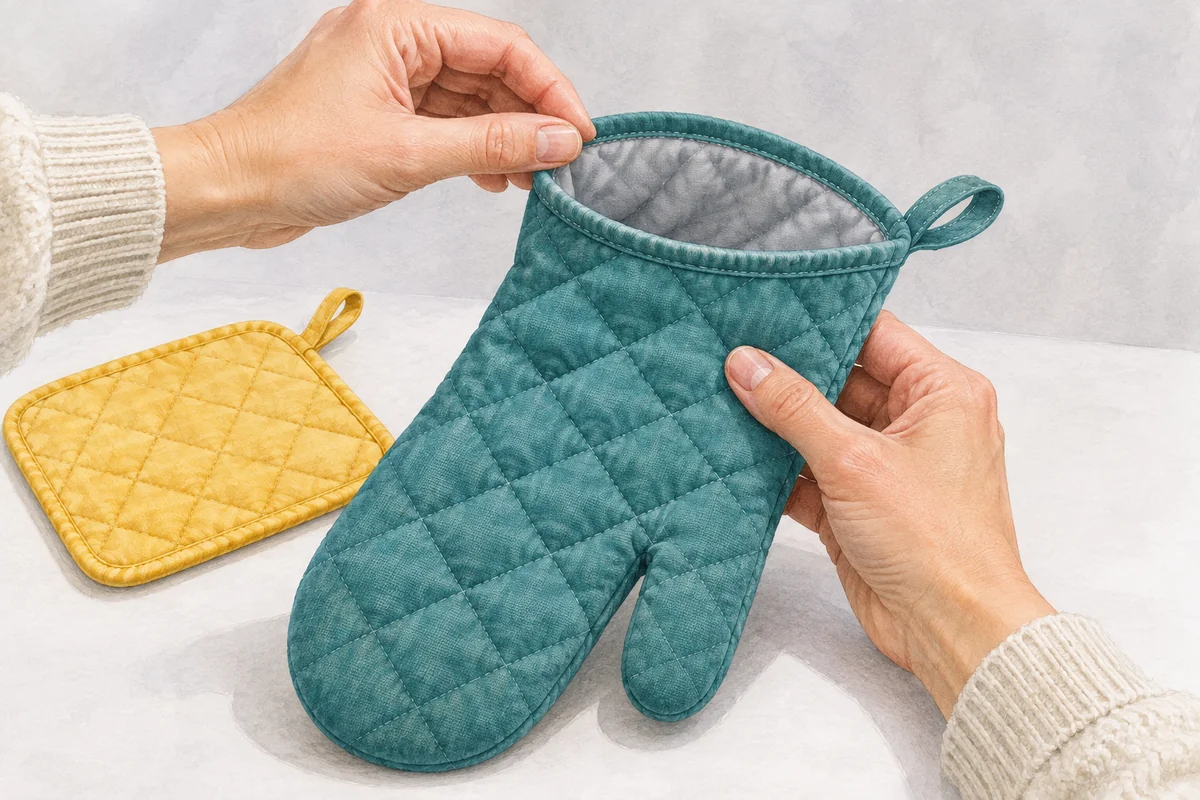
How do you prepare an approved machine-washable mitt?
Begin by checking for loose food and obvious residue after the mitt has cooled. Remove loose crumbs without cutting, scraping, or pulling at the fabric. If a mark needs pretreatment, check both the mitt’s directions and the cleaner’s fabric restrictions. Use only a permitted product and follow its application and contact-time instructions. There is no single soaking duration that this guide can safely assign to all mitts and stain removers.
Inspect the hanging loop, binding, and seams before loading. A loose loop is worth noticing because it may catch on other laundry, but do not treat a quick repair to a structural area as proof that the mitt’s original protective performance remains intact. If padding is exposed or a seam has opened in an area used to grip cookware, stop and seek the maker’s advice or replace the item for its intended use.
Choose compatible laundry only after you know the settings. Similar color alone is insufficient if the other items require a different treatment. A white kitchen towel that allows a hotter cycle or chlorine bleach should not dictate the process for a colored mitt with different restrictions. For related kitchen clothing, our apron-care guide explains its own strap and finish considerations; apron instructions do not transfer automatically to insulated hand protection.
What is a sensible machine-washing sequence when allowed?
Translate the label into a complete sequence before starting. Select the allowed temperature and cycle, use laundry detergent compatible with the item and appliance, and measure according to the detergent instructions for the actual load. Do not add a full large-load dose merely because a mitt has a dark stain. If you cannot reconcile the item, detergent, and machine instructions, pause instead of choosing whichever setting sounds strongest.
- Confirm that every item in the proposed load allows the selected treatment.
- Apply only a permitted pretreatment, following its own directions rather than an invented waiting time.
- Load without packing items tightly, and follow the appliance’s loading guidance.
- Run the label-compatible program and remove the mitt when the cycle finishes.
- Check for remaining residue, damage, and displaced lining before beginning the permitted drying method.
Keep accessories conditional too. A mesh bag is not a way to turn a prohibited wash into an allowed wash, and it does not establish compatibility with an otherwise unsuitable cycle. Use one only where it fits the product and appliance instructions. After washing, do not declare the process successful solely because the outside looks brighter. The next decisions concern drying and condition, which are separate from whether a visible mark improved.
How do you clean a surface-only silicone mitt?
For a model whose directions permit soap-and-water exterior cleaning, work on the permitted exterior with the specified supplies. Keep the opening away from the cleaning water so you are not intentionally filling the lining. Pay attention to the textured gripping surface and the boundary where silicone meets fabric. Follow any rinsing or wiping directions, then set the item aside to dry before returning it to its storage place.
Do not translate the material’s advertised heat resistance into dishwasher permission. A rating associated with handling cookware does not provide a cleaning program for the finished item. Dishwasher detergent, an appliance cycle, and the attached lining raise different questions from the outside surface’s ability to contact heat. Use a dishwasher only if the exact item is explicitly approved for it; otherwise stick with its stated cleaning method.
If food or liquid gets inside a surface-clean-only mitt, the permitted exterior method may not address the problem. Ask the maker how to clean that interior and whether continued use is appropriate. Do not pull out a permanently attached liner, immerse the whole mitt to save time, or assume an interior stain is harmless because the silicone shell looks intact. Keep a known clean, dry alternative available while the question is unresolved.
What about grease, sticky food, and stubborn discoloration?
Describe the problem before choosing a treatment. Loose flour, a small sauce mark, a sticky coating, and a mitt saturated with cooking oil are different situations. A normal laundering routine may address some permitted washable items, but it should not be presented as a universal method for making heavily contaminated material safe. Tell the manufacturer what was spilled and whether it reached the lining or padding.
For ordinary marks, use a stain treatment only if both the item and product directions support it. Avoid escalating through several unrelated cleaners because the first attempt left a shadow. Record what you already used, rinse or launder as directed, and assess the result before another treatment. A remaining color mark is not automatically a reason to use chlorine bleach, a stronger solvent, a hotter dryer, or prolonged soaking.
Do not put oil-exposed or flammable-solvent-contaminated items into a dryer on the assumption that one wash removed the hazard. This Whirlpool dryer manual’s safety section prohibits items exposed to cooking oils and articles affected by flammable substances. Follow your own appliance’s restrictions and obtain product-specific guidance. This article does not provide a decontamination procedure. If an item cannot be cleaned within its permitted method, replacing it can be the more practical decision. The aim is a usable kitchen item, not removal of every visible mark at any cost.
Can bleach, disinfectant, or fabric softener be added?
Check each product separately. Bleach permission is not interchangeable between items, and non-chlorine permission does not authorize chlorine bleach. In the GINETEX symbol system, an empty triangle allows chlorine or oxygen bleach, two diagonal lines restrict the item to oxygen bleach, and a crossed triangle prohibits bleaching. Follow written restrictions on the item too, and do not interpret a plain white fabric as permission to bleach it.
A disinfectant also needs its own compatible-use directions. Do not claim that an ordinary home wash has sanitized or sterilized an insulated mitt merely because the water was hot or the item smells fresh. If a particular contamination event requires a validated sanitation process, ask the manufacturer whether the item can undergo that process. Workplace procedures may impose requirements beyond this household care guide.
There is no need to invent a multi-product finishing routine. Use fabric softener, scent additives, or other extras only where the manufacturer’s instructions permit them and they serve a clear purpose. An unsolved odor should prompt a review of the cleaning method and drying status, not just masking it with fragrance. When multiple instructions conflict, obtain clarification rather than assuming that adding more products makes the result more thorough.
How do you choose between a dryer and air drying?
Read the drying instruction independently of the wash instruction. If low tumble drying is allowed, use the appropriate low setting and the appliance’s directions. If the maker specifies air drying, plan for that from the start. A web listing that says only machine washable has not supplied a drying method. Do not infer one from a neighboring product or from the way you dry ordinary kitchen towels.
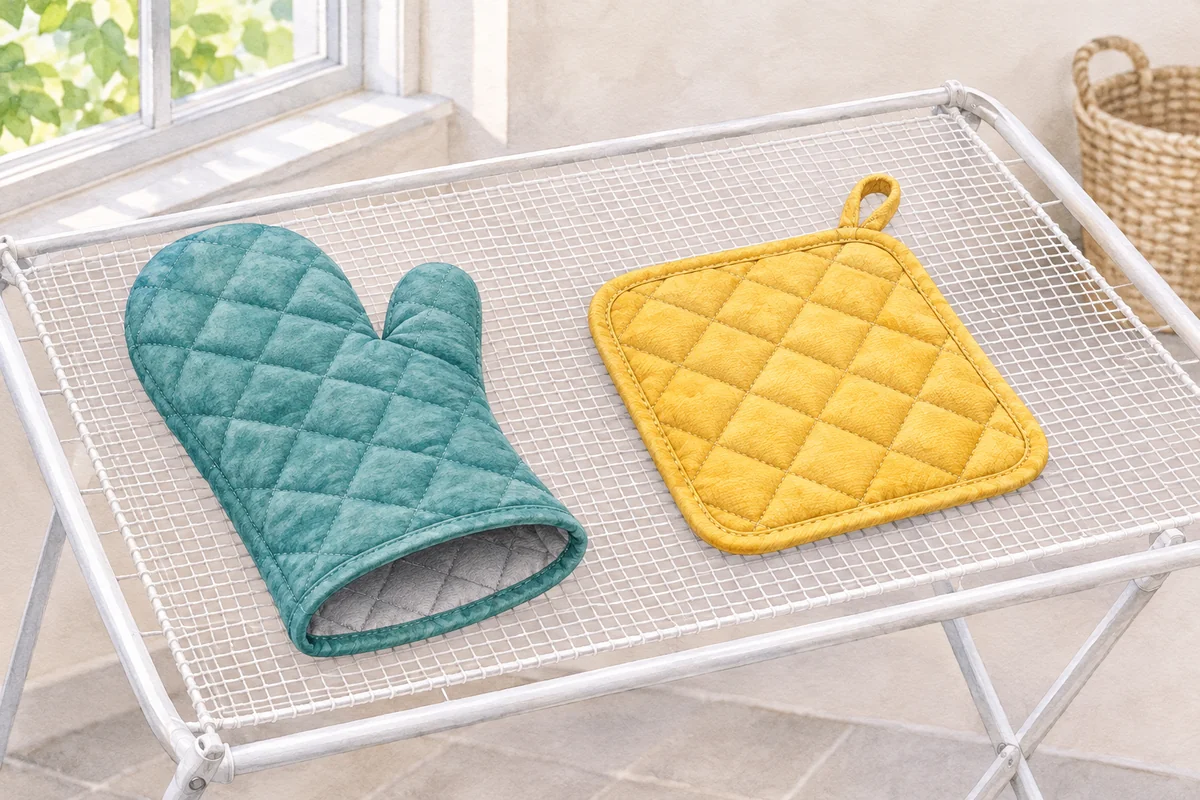
Air drying can be a convenient way to keep an item available for inspection, but it is not an excuse to put it away before the inside is dry. Arrange it as the maker directs, leaving the opening accessible rather than burying the mitt under other laundry. Do not turn a fixed lining inside out unless the construction and instructions permit it. For a flat potholder, make sure you can check both surfaces and any pocket.
Never use an oven, stovetop, open flame, or another improvised cooking heat source to speed drying. Collisionware specifically warns against leaving its cotton products in an oven or on a hot stove; its heat-resistant description does not mean fireproof. Plan enough time for the allowed method instead of improvising when dinner is ready. A spare, suitable pair is a more workable backup than trying to finish drying the only pair during cooking.
How do you decide whether the inside is dry?
Do not rely only on the outer surface or the end of a timed cycle. Check the lining, the thumb area, the cuff, and any accessible pocket after the item has cooled. Follow the maker’s drying directions fully. If any accessible part still feels damp, continue the allowed drying process and keep the mitt out of service. If you cannot establish that a thick or enclosed interior is dry, do not use it for hot cookware.
University of Illinois Extension’s kitchen guidance warns against wet or damp potholders and oven mitts because wet material transfers heat more quickly and can cause burns. That is why drying is a use-readiness decision, not just a storage preference. A clean damp mitt should not be treated as the available backup while the dry ones are in the wash.
A household check cannot certify protective performance or measure hidden moisture precisely. The practical response to uncertainty is more permitted drying time or a different ready-to-use item, not testing the mitt against a hot pan. Likewise, do not grab something hot to see whether a suspect mitt still works. Keep inspection away from heat, and resolve any uncertainty before the item returns to cooking service.
When should a mitt be retired instead of washed again?
Cleaning and condition assessment solve different problems. Washing may change soil or odor; it does not establish that a torn, scorched, split, or altered item still provides its intended protection. Stop using a mitt with exposed padding, separated layers, a damaged gripping surface, or other changes that make its suitability uncertain. Ask the manufacturer about the specific defect, or replace it with an appropriate item rather than relying on another wash.
Inspect the fit as well as the fabric. Does your hand enter and leave normally? Is the lining bunched in a way that interferes with your grip? Has a seam opened around the thumb or palm? These are practical observations, not a home certification test. A product that no longer fits or functions as intended should not be accepted simply because it is clean and matches the rest of the kitchen set.
Do not invent a universal replacement interval. Frequency of use, construction, care history, and actual condition vary. Follow any retirement guidance supplied by the maker and inspect before use. If you repurpose a retired item, mark or store it so nobody retrieves it as heat protection. Keeping an uncertain mitt in the same drawer as ready ones defeats the purpose of identifying the problem in the first place.
How can you organize cleaning without losing your only usable pair?
Make the schedule depend on cooking and drying, not just the laundry basket. Before washing, identify which suitable, dry items will remain available. If you have only one pair and no appropriate replacement, choose a time when the full permitted cleaning and drying process can finish before the next task that needs them. There is no universal number of hours to promise for every lining, room, or drying method.
A simple three-place system can help: ready to use, waiting for cleaning, and drying or awaiting a decision. These need not be special containers; the point is to prevent a damp or questionable mitt from being mistaken for a clean dry one. Keep the locations clear to everyone who cooks. Include surface-clean-only pieces in the system rather than leaving them out because they do not enter the washing machine.
For a busy cooking day, check the dry pair before starting food preparation. If a spill happens, move the affected piece out of the ready group and use another suitable item. This is an organizational example, not a tested cleaning schedule. It avoids the common planning mistake of sending all protective kitchen items through a wash together and then discovering that nothing appropriate is ready when hot cookware needs moving.
Can potholders share a load with towels or table linens?
Sometimes the care instructions overlap, but the decision should be based on the actual items. Compare temperature, cycle, permitted additives, color compatibility, and the nature of the soil. A decorated potholder and a plain towel may need different treatment even though both are kitchen textiles. Separate anything whose instructions or condition do not fit the proposed load rather than weakening one item’s requirements to make everything fit.
Keep the drying decisions separate after washing too. An allowed shared wash does not mean every piece should remain in the same dryer for the same period. Check each item using its own directions, especially where a mitt has a lining or a potholder has several layers. Our tablecloth and cloth-napkin guide addresses those textiles’ separate decisions; it does not certify compatibility with insulated mitts.
If you are considering professional laundering, describe the item and its restrictions before including it with ordinary laundry. Ask whether that particular construction and condition are accepted and how special instructions are handled. Use Fresh Spin’s contact page for service questions. This guide does not promise that every oven mitt, contaminated item, or special-care textile can be accepted for a service order.
What should you do when the result is not what you expected?
Before changing the process, gather the information that will make troubleshooting useful. Write down the model if known, the visible problem, whether it existed before cleaning, the detergent or treatment used, and the settings selected. Include whether the item was immersed, machine washed, or cleaned only on the exterior. A photo of the label alongside a photo of the affected area gives the manufacturer a clearer starting point than a general question about washing oven mitts.
Keep the next action narrow. For a question about a liner, ask whether it is removable and how the inside should be dried. For a question about a stain product, identify that product rather than asking whether any stain remover is acceptable. For a question about fit, describe what changed and where. These details do not guarantee a repair, but they reduce the chance of receiving advice meant for a different construction or a different kind of problem.
Household handoffs need similar clarity. Leave a short note saying what has already been done and what remains unresolved. For example, an item waiting for interior-drying instructions should not be labeled simply clean. Keep the note separate from the mitt while cooking and remove the item from the ready group until the question is settled.
If the outside is clean but the inside is still damp, return to the permitted drying process rather than increasing heat beyond the label. If the lining has shifted, do not force it back with sharp objects or unpick seams. Review the maker’s reshaping instructions if any, and ask about persistent distortion. If detergent residue remains, check what was used and follow compatible rinsing or rewashing guidance instead of covering the residue with another product.
If the mitt shrinks, compare the result with the manufacturer’s stated expectations and the item’s actual fit. A maker may describe some normal shrinkage for its own product, but that does not make all shrinkage acceptable for every mitt. Do not promise to reverse it by stretching, steaming, or reheating. Keep the item out of hot-cookware use if its fit or condition has become uncertain.
If a stain remains but the allowed cleaning process is complete, distinguish appearance from unresolved contamination or damage. A photograph sent to the maker may be more useful than a succession of stronger treatments. Record the product and settings you used so the question is specific. Knowing what happened allows a targeted answer; saying only that the mitt was washed leaves important parts of the care history unknown.
What are the answers to common oven-mitt washing questions?
Can all cotton oven mitts go in the washing machine?
No universal rule follows from the word cotton. Check the complete item’s directions, including filling, trim, and construction. Some named cotton products permit machine washing, while an unidentified or handmade item may not provide enough information to choose a process. Do not treat the cotton exterior of a silicone-lined or multilayer item as a whole-item wash instruction.
Can silicone oven mitts go in a dishwasher?
Only when the exact product’s instructions explicitly permit it. A silicone material description, a heat-resistance claim, and permission to clean the exterior are not dishwasher directions. Check whether the item has a fabric cuff or lining and ask the maker if the care information is incomplete. Use the stated method rather than borrowing directions for a silicone utensil.
Should a mitt be turned inside out?
Do so only if the maker instructs or permits it and the construction supports it. A removable liner and a permanently attached liner are different. Do not pull, detach, or cut material to expose hidden padding for cleaning. If the interior cannot be reached through an allowed method, ask how the manufacturer wants it cleaned and dried.
Is a damp mitt acceptable for a quick job?
Do not use a damp mitt or potholder for handling hot cookware. Waiting until the item is dry is not an optional finishing step, and a shorter task does not turn uncertainty into permission. Use another suitable dry item. Never perform a hot-pan trial to check whether the damp or recently damaged one still protects your hand.
How often should oven mitts be washed?
Follow the maker’s directions and respond to actual soiling, spills, and use. This guide does not prescribe an evidence-free weekly interval for every household. Inspect before use and plan cleaning early enough to complete the allowed drying process. Keep an item with an unresolved spill or condition problem separate from those ready for cooking.
Does washing restore a mitt’s heat rating?
No home wash or visual inspection should be represented as recertifying a heat rating. Care instructions explain permitted maintenance, not a method for proving damaged insulation performs like new. If the item has been scorched, torn, altered, or otherwise changed, seek product-specific guidance or replace it rather than treating clean fabric as proof of protection.
What should your final ready-to-use check include?
Confirm that the permitted cleaning process is complete, the item is dry throughout as far as you can establish, and no unresolved change in fit, seams, lining, padding, or grip remains. Return it to the ready storage area only after those questions are settled. Keep its care information available for the next wash instead of relying on memory of a setting used for a different kitchen textile.
The most useful routine is specific and repeatable: identify the item, follow its complete instructions, allow drying time, and separate cleaning success from suitability for hot cookware. When instructions are absent or condition is doubtful, stop and use a known appropriate alternative. That approach makes the next decision clear without inventing a universal washer setting, a guaranteed stain cure, or a home test of heat protection.


