

Wash a shower curtain or liner only by the method allowed for that particular product. A washable fabric curtain may go in a washing machine, but a plastic liner may require wiping by hand. Check the outer curtain and liner separately, remove detachable hooks, follow the permitted wash settings, and plan the drying method before starting. Plastic and vinyl should be air dried, not put in a heated dryer.
The practical challenge is that two similar-looking bathroom curtains can have different instructions. The word “waterproof” describes use around shower water; it does not automatically authorize agitation, spin, bleach, or dryer heat. This guide helps you identify what you have, choose a permitted cleaning path, deal with remaining residue, and decide when an item is no longer worth trying to clean.
This is a guide to ordinary household shower curtains and liners, not a mold-remediation protocol or a guarantee that a stained item can be restored. For curtains hanging at windows, use the separate window-curtain washing guide, which covers linings and other construction details that differ from bathroom liners.
What should you identify before taking the curtain down?
First, determine whether your shower has one curtain or two separate layers. An outer decorative curtain may hang outside the tub while an inner liner faces the water. A combined design may have a detachable liner, a mesh window, built-in rings, or components that look like one item until you inspect their attachments. Do not assume the care label on one layer covers the entire arrangement.
Look along the side seams, top edge, and lower hem for a label. If it is missing, search your order history or the manufacturer’s product listing using the exact model, material, size, and product number. A photograph of a similar white curtain is not enough to establish care instructions. Retail listings can change, so keep the instructions supplied with your actual item when you have them.
Write down four things before choosing a method: the permitted cleaning process, water-temperature limit, restrictions on cleaning products, and drying instructions. A machine-wash symbol answers only part of the question. You still need to know whether the curtain can be tumble dried, whether bleach is prohibited, and how attached components should be handled. Our care-label guide can help you interpret the instructions rather than guessing from the fabric’s appearance.
Finally, inspect the condition. Check for torn ring holes, cracked film, peeling layers, damaged snaps, and loose weighted pockets. Cleaning can remove soil; it cannot repair a failed attachment or restore a sheet that has split. If the item already struggles to stay on the rod, assess replacement before spending time on a full cleaning cycle.
Why do fabric, vinyl, and PEVA need different decisions?
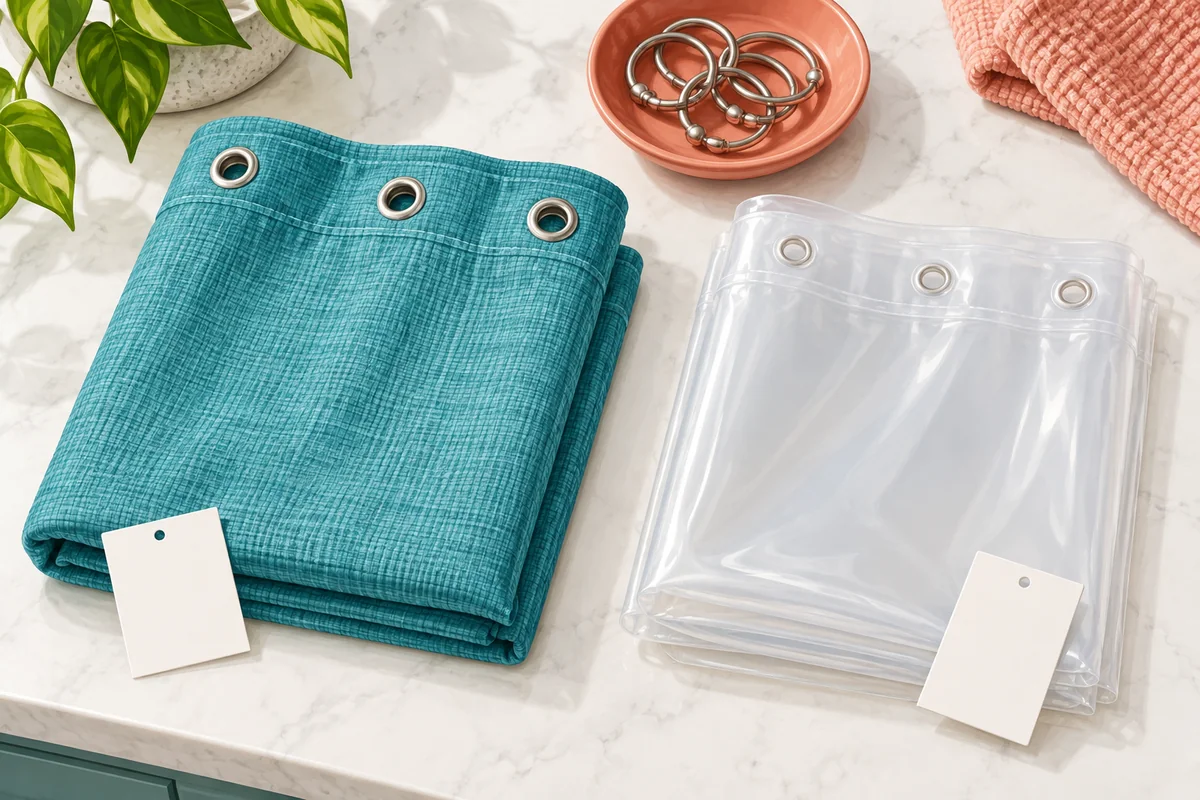
A woven fabric, a coated fabric, and a flexible plastic sheet are different constructions even when all three are sold as shower curtains. Material names narrow the possibilities, but the finished product’s instructions decide the method. A decorative trim, print, coating, or attached component may impose a restriction that a generic material guide does not mention.
For example, IKEA’s BORSTALOE polyester curtain instructions permit a warm machine wash on a durable-press cycle, prohibit bleach and tumble drying, and specify line drying. That is a useful example of a washable fabric curtain that still cannot simply follow the towels into the dryer. It is not a setting recommendation for every polyester curtain.
By contrast, Sainsbury’s describes its own-brand PEVA shower curtain as wipe-clean only, using a soft cloth. The label on another PEVA product may have different details. The important comparison is between each product’s permitted methods, not a contest over which material sounds more durable.
Use this decision order: identify the exact item, read its instructions, and then select a process your equipment supports. If a broad article suggests machine washing but the product says wipe clean, use the product’s restriction. If the washer manual excludes that type of waterproof item, do not use the machine even when the textile label allows laundering. Both sides of the compatibility check matter.
Pay attention to the language used to describe a method. “Wipe clean” points to surface cleaning; it is not the same instruction as “hand wash.” “Line dry” describes a drying arrangement, while “do not tumble dry” rules out a machine process rather than merely advising a cooler setting. “Do not bleach” should not be treated as a suggestion that can be ignored because a curtain is white. Translating each instruction into an action prevents a seemingly small assumption from changing the entire care plan.
If the packaging and a current online listing appear to disagree, check that both refer to the same product version. Product names can remain similar while materials, attached liners, or construction change. Photograph the label, note the product number, and ask the manufacturer which instructions apply to your item. Until that conflict is resolved, do not choose the more aggressive option simply because it promises an easier cleanup.
How do you choose between washing, wiping, and replacement?
Choose machine washing when the specific curtain or liner is labeled for it, the appliance permits the load, the item is intact, and you can follow the drying instructions afterward. This is a planned process, not a test of whether an unknown liner survives. If any of those conditions is missing, resolve it before putting the item in the drum.
Choose hand cleaning when the instructions call for wiping or a gentle hand wash. Those are not interchangeable terms: a wipe-clean label does not necessarily permit prolonged soaking, vigorous scrubbing, or wringing. Keep the product’s intended method intact rather than turning every non-machine item into a bathtub soaking project.
Consider replacement when the item is torn, brittle, delaminating, or no longer performs its basic job. Replacement may also be reasonable when you cannot establish a permitted cleaning method, or when repeated label-compliant cleaning leaves an item you are not comfortable returning to use. There is no universal number of washes after which every liner must be replaced.
A useful stopping rule is to decide in advance what success looks like. You might require an intact liner that hangs correctly, rinses without visible residue, and dries without an objectionable smell. If it still fails those checks after a permitted cleaning, do not keep escalating the heat or chemical strength to rescue a low-cost item. The next step is more information or replacement, not an improvised harsher treatment.
Consider two example decisions. In the first, the outer curtain has a readable machine-wash label, but the inner liner says wipe clean. You would remove and assess the components separately, schedule a permitted fabric wash, and clean the liner by its own instructions. There is no need to make the two products share a process merely because they share a rod.
In the second, a liner has no readable label and one ring hole has begun to split. Before researching stronger cleaners for a mark near the bottom, identify whether a replacement part is available and whether the item can still hang securely. If you cannot establish a suitable cleaning method and the attachment is failing anyway, replacing it may be the more practical decision. These examples organize the choice; they do not predict a particular cleaning result.
What should you prepare before cleaning?
Plan where the wet curtain will go before removing it. A liner that must air dry needs a suitable place where drips will not create a slipping hazard or damage a surface. A household with one shower may also need to schedule the task so the curtain is not immediately put back into use while still awaiting inspection or drying.
Take a quick photograph of how the layers attach. This is especially useful for detachable liners with several snaps, unequal panels, or a particular inside-facing surface. Put detachable hooks and rings in a container rather than leaving them along the tub edge. Do not force off built-in rings or sewn-in components; consult that design’s instructions instead.
Set out only the materials the chosen method needs: the approved detergent or cleaner, a soft cloth if wiping, a place to rinse, and any protection required by the cleaning product. Keep unrelated bathroom chemicals out of the work area. Having several bottles within reach makes it easier to add something impulsively when a stain does not disappear.
For removal, work from a stable position on a dry surface. Do not balance on a wet tub edge or pull on a tension rod to support yourself. If reaching the attachment points is difficult, ask someone to help rather than turning a cleaning task into a precarious overhead job. Support the curtain as you release it so its weight does not pull through the remaining holes.
Keep the removed curtain out of the ordinary clothing hamper while you decide how to handle it. That avoids mixing an uncertain cleaning product, damp liner, or loose hardware with your next clothing load. A separate temporary holding place also makes it harder to forget that the liner and decorative layer have different care requirements.
How should a machine-washable shower curtain be cleaned?
Read the complete care instructions and your washer’s loading guidance. Then remove only the hardware designed to detach, unfold the item, and check that it can move in the drum without being packed tightly. Do not add household laundry simply to fill the remaining space. The useful question is whether every item in the proposed load can follow the same permitted process.
Whirlpool’s shower-curtain guide describes a gentle wash for suitable curtains and explains that a couple of bath towels can help with wiping residue and balancing the load. Treat that as a conditional option after confirming compatibility, not an instruction to put towels into every liner wash. A wipe-clean-only product remains outside this method.
Use the detergent type and amount appropriate to the machine, product instructions, and actual load. Do not substitute dishwashing liquid in an automatic clothes washer. Set the permitted cycle and temperature rather than choosing hot water because the curtain came from a bathroom. If the label and controls use different wording, consult the washer manual instead of guessing what a named cycle does.
Once the cycle finishes, remove the item promptly and open it out for inspection. Check whether the rinse has left visible suds or residue, whether the top edge remains intact, and whether any coating or print has changed. If something looks damaged, stop before transferring it into another machine. Dry only by the method permitted for that item.
Do not interpret a quiet cycle as proof that every future wash is safe. Keep the original instructions and note the process you used. That record is particularly useful when an appliance offers multiple gentle, bulky, bedding, or specialty cycles whose names can be confusing a few months later.
How do you clean a wipe-only liner without overworking it?
Begin with the liner’s own cleaning directions. Support it so you can reach the area being cleaned without stretching the top holes or dragging the lower edge across a dirty floor. Depending on the product and your space, that may mean leaving it hanging or laying part of it in a suitable clean basin. The support arrangement should make gentle wiping easier, not turn the liner into a tensioned sheet.
Use the specified cloth, water temperature, and cleaning product. Work on one manageable area at a time, with particular attention to folds and the lower edge where you can see residue. Do not interpret a stubborn mark as permission to use a scouring pad, stiff brush, or abrasive powder. A smooth film can look strong while still being vulnerable to scratches or small tears.
If the instructions permit a cleaner, follow its application and removal directions rather than adding extra strength or contact time. Keep the identification and dilution instructions visible while you work. Rinse or wipe away the product as directed, then inspect under ordinary room lighting. A wet surface can make a mark seem to disappear temporarily, so judge the final result after drying too.
Do not fold a wet, freshly cleaned liner into a pile while you work on the rest of the bathroom. Arrange it for the permitted air-drying method. If the liner is too awkward to clean without rubbing it against other surfaces, pause and change the setup instead of holding the whole weight in one hand while scrubbing with the other.
A hand-washable fabric curtain may have a different process from a wipe-only plastic liner. Maytag’s curtain-care guidance distinguishes washing, rinsing, and drying methods and emphasizes the care tag. Use the method that matches the actual item; do not extend a fabric soaking routine to a liner whose maker permits only wiping.
Can the outer curtain and liner be cleaned together?
Only combine them when their instructions and the appliance guidance are compatible. Read both labels side by side. Compare the allowed method, water temperature, cycle, detergent restrictions, color concerns, and drying requirements. The fact that the two pieces were sold together does not prove that they should be laundered as one assembly.
For example, a machine-washable outer fabric curtain and a wipe-clean inner liner need two different cleaning paths. Washing them together would violate one set of instructions even if the fabric tolerates the cycle. Two machine-washable components might share a washing method but still require different drying methods, so plan that separation before starting.
Detach a snap-in liner only as its design allows, and keep track of which surface faces the shower. Do not pull on the fabric between snaps to separate a tight fitting. Work at the attachment itself. If a snap, ring, or reinforced hole is already damaged, include that in the repair-or-replace decision rather than hiding it by reinstalling the curtain in a different position.
Separate cleaning has an organizational benefit even when a combined load is permitted: you can inspect the wetter inner layer without treating an otherwise clean decorative curtain more aggressively than necessary. Conversely, do not neglect a visibly dirty outer curtain simply because it usually stays outside the water. The decision should follow the condition and instructions of each piece.
Which cleaning-product combinations should you avoid?
Do not make a stronger bathroom-cleaning mixture by combining products. The CDC’s bleach-safety guidance warns against mixing bleach or disinfectants with other cleaners or disinfectants, and calls for following product directions and ventilation precautions. This includes avoiding improvised combinations of bleach with vinegar, toilet cleaner, or another bathroom spray.
A curtain label that permits bleach is not a recipe, and a bleach product’s directions do not override a curtain label that prohibits it. Both must allow the intended use. This article does not supply a universal bleach dose or soaking time because products, concentrations, surfaces, and appliance instructions differ. Never apply an undiluted product merely because a stain looks persistent.
Similarly, do not assume fabric softener improves a water-repellent curtain. IKEA’s shower-curtain care guide advises against softener for most shower curtains while referring readers to product-specific instructions. Avoid adding scented boosters or finishing products just to cover a remaining smell; reassess cleaning and drying instead.
Before introducing a different product, establish what has already been applied. A curtain sitting in a bathtub may have contacted cleaner used on the tub itself. If you cannot identify the previous product or its removal instructions, do not proceed with another chemical. Keep the products separate and resolve the uncertainty first.
What if marks, odor, or residue remain after cleaning?
Separate three questions: is there loose residue left, is the material damaged, or is there a remaining stain? These are different problems. A visible mark does not tell you exactly what caused it, and color alone is not a reliable way to identify a microorganism. Avoid promising that a particular household recipe will remove every type of spot.
If the item still has visible soap or cleaner residue, review the permitted rinsing process and the amount of product used. Repeating a compatible rinse may be more appropriate than adding another cleaner. If the surface is cracked, sticky, peeling, or shedding material, further washing may not solve the underlying problem; inspect the condition and contact the maker or replace the item.
For a persistent stain on an otherwise intact curtain, consult the maker’s stain-treatment guidance. Check whether a treatment is allowed on the fabric, coating, print, and attached parts, not just the base material. A small hidden-area test can reveal an immediate color reaction, but it does not prove that a long soak or stronger application will be safe everywhere.
If an odor remains, make sure the curtain is actually dry before judging it. Then consider the surrounding bathroom rather than repeatedly treating the curtain alone. A damp bath mat, standing water, or an unresolved moisture problem may require separate attention. Do not diagnose the source from smell alone or treat fragrance as proof that the underlying issue has been resolved.
When is this more than a routine laundry problem?
A curtain-cleaning guide is not the right tool for a larger moisture or mold problem. The EPA’s household mold guidance emphasizes correcting moisture problems and explains that some moldy porous materials may be difficult or impossible to clean fully. Follow that guidance or seek qualified help when contamination extends beyond an ordinary removable curtain, keeps returning, or involves water damage.
Do not use a completed wash cycle as a claim that an item has been disinfected, sterilized, or made safe for every person. Cleaning and disinfection are different processes. A laundry routine chosen to preserve a curtain may not meet the directions for a disinfecting product, and stronger treatment may be incompatible with the curtain.
If someone in the household has a health concern related to exposure, seek appropriate professional advice rather than experimenting with cleaning chemicals. Likewise, a shared laundry service needs accurate information about an unusual item before accepting it. Do not conceal contamination or assume ordinary wash-and-fold is a remediation service.
How should you dry and rehang the curtain?
Read the drying instructions independently of the washing instructions. Machine washable does not mean tumble dryable. Whirlpool specifically directs plastic and vinyl curtains to air drying, while some fabric curtains may permit low-temperature tumble drying. The product label remains the deciding instruction. Do not put an uncertain plastic item in a dryer for even a short trial.
For air drying, arrange the curtain so water can drain where appropriate and the material is not compressed into a thick wet bundle. Spread it across its intended hanging span without putting unnecessary strain on damaged holes or snaps. Check that the rod and attachments are secure and that dripping water stays within a suitable area.
Inspect the bottom edge and folds as well as the broad middle. A curtain can look dry from a distance while water remains gathered in a fold. Do not pack it for storage until it is dry throughout. If you are reinstalling a two-layer arrangement, keep the layers positioned as intended rather than trapping a wet liner inside folded decorative fabric.
Wrinkles are a separate issue. Do not iron or steam a liner because a fabric curtain allows ironing. Some manufacturers specify an ironing step for a particular water-repellent fabric, while other products prohibit heat. Follow the exact product’s finishing directions and skip heat treatment when you cannot establish that it is permitted.

How often should you inspect and clean it?
Build inspection into your normal bathroom routine instead of relying on one universal interval. Look at the liner’s lower edge, the folds, and the attachment points. Note visible residue, persistent dampness, damage, or an objectionable smell. A bathroom used by several people and a rarely used guest shower need not follow identical cleaning schedules.
Manufacturer schedules can provide a starting point, but the condition of the item still matters. Record when you cleaned it and what you observed, then adjust your next inspection accordingly. The aim is to respond before an ordinary cleanup becomes a repeated struggle, not to wash a barely used curtain merely to satisfy an arbitrary calendar rule.
Between cleanings, avoid leaving the liner tightly bunched after a shower. Let the bathroom’s appropriate ventilation do its job and arrange the curtain so it can dry. If moisture stays high or surfaces remain wet, address the room conditions rather than assuming a different detergent will fix them.
For a household sharing the task, keep the care information easy to find. A phone photo of each label and a short note identifying which piece is wipe-only can prevent the next person from putting both layers into a hot load. Record permanent instructions, but recheck temporary details such as the availability of a replacement liner before buying.
A useful cleaning record can be short: identify the curtain and liner, record the method used, and note any unresolved problem after drying. “Wiped liner as labeled; lower attachment pocket still split” is more actionable than “bathroom done.” It separates a completed cleaning task from an outstanding replacement task. When another person takes over, they can see why running an additional wash is unlikely to address a structural defect.
Also decide where detached parts belong while the curtain is being cleaned. Keeping rings, a removable liner, and the care instructions together avoids reinstalling the wrong component or losing a part that is difficult to replace. Before the next shower, check the assembled arrangement rather than assuming that a clean curtain has automatically been hung correctly.
What should you check before replacing a liner?
Measure the existing arrangement and check the attachment type. A snap-in replacement needs the correct dimensions and snap layout, not merely the same color. A conventional liner needs enough width and length for the intended installation without being selected solely by how it looks in a product photograph. Keep the manufacturer and model information when compatibility matters.
Compare future care requirements before choosing a replacement. If you prefer machine washing, look for an item whose own instructions permit it and that your appliance can handle. If wiping is easier in your space, a wipe-clean product may fit that routine. Neither method is automatically the best choice for every household.
Evaluate the whole item’s condition before replacing only one piece. An intact outer curtain with a worn detachable liner may not need to be discarded as a set. On the other hand, a damaged top edge or failing attachments may make replacing the inner sheet alone insufficient. Avoid purchasing parts on the assumption that every brand’s snaps or rings are interchangeable.
Save the new care instructions before discarding the packaging. Photograph the label while it is easy to read, note the product number, and keep the two layers’ instructions distinct. That small administrative step turns the next cleaning decision into a lookup instead of another round of material guessing.
Can a laundromat or wash-and-fold service help?
A larger washing machine is not a way around a wipe-clean restriction. Before taking any shower curtain to shared equipment, check its label, the equipment instructions, and the operator’s acceptance policy. Explain coatings, attached hardware, unusual soil, and any products already used. Do not assume that a machine’s capacity establishes that the item belongs in it.
Fresh Spin offers in-store drop-off wash-dry-fold, but this article does not promise acceptance of shower curtains or liners. Ask about the specific item first through the Contact page. If an order is accepted, enter through the Ash entrance and place the order in the mini-mart. Confirm care requests and collection time before leaving it.
Use the main Wash & Fold page for current service information, pricing, minimums, and options rather than estimating a curtain’s charge from a general article. If the product is wipe-only, plan to follow that method at home or seek the maker’s advice; do not bring it as an ordinary machine-washable load.
What do common shower-curtain questions really depend on?
Can a plastic liner go in the washing machine?
Sometimes, but not as a universal rule. The exact liner and washer must both permit it. Some product-specific instructions say wipe-clean only. If yours does, do not replace that instruction with a generic recommendation for a gentle cycle. Find the model information before treating an unmarked plastic liner as washable.
Can I wash a curtain that has magnets?
Check the instructions for that product and its attachments. Magnets alone do not settle the decision. Inspect their pockets or retaining areas for damage, and do not remove sewn-in parts just to make the curtain resemble a different model. If a weighted component is loose or exposed, resolve the damage before laundering.
Should I always put towels in the load?
No. Some appliance guidance suggests towels for a suitable curtain load, but that does not override care restrictions, capacity limits, or the towels’ own instructions. Do not mix in valued household towels simply because the drum looks empty. Confirm the combination first and keep wipe-only liners out of the washer.
Can a stained liner still be used?
A visible mark alone does not establish what caused it or whether cleaning succeeded. Assess the item after a permitted cleaning and complete drying, including its condition and any remaining residue or odor. Seek product guidance for persistent problems. Replace damaged or unmanageable items rather than escalating to unsupported treatments.
Can I dry a fabric curtain on low heat?
Only if its own instructions allow tumble drying. Some polyester shower curtains explicitly prohibit it, despite being machine washable. Arrange a line-drying location before starting a wash if that is the required method. Low heat is still dryer heat and is not a substitute for a no-tumble-dry instruction.
What is the simplest routine to remember?
Identify each layer, read both sets of instructions, inspect for damage, choose a compatible cleaning method, and plan drying first. After cleaning, inspect again before reinstalling or storing. Keep the labels for next time. That sequence is more dependable than memorizing one temperature, one additive, or one cycle for every shower curtain.


Leave A Comment